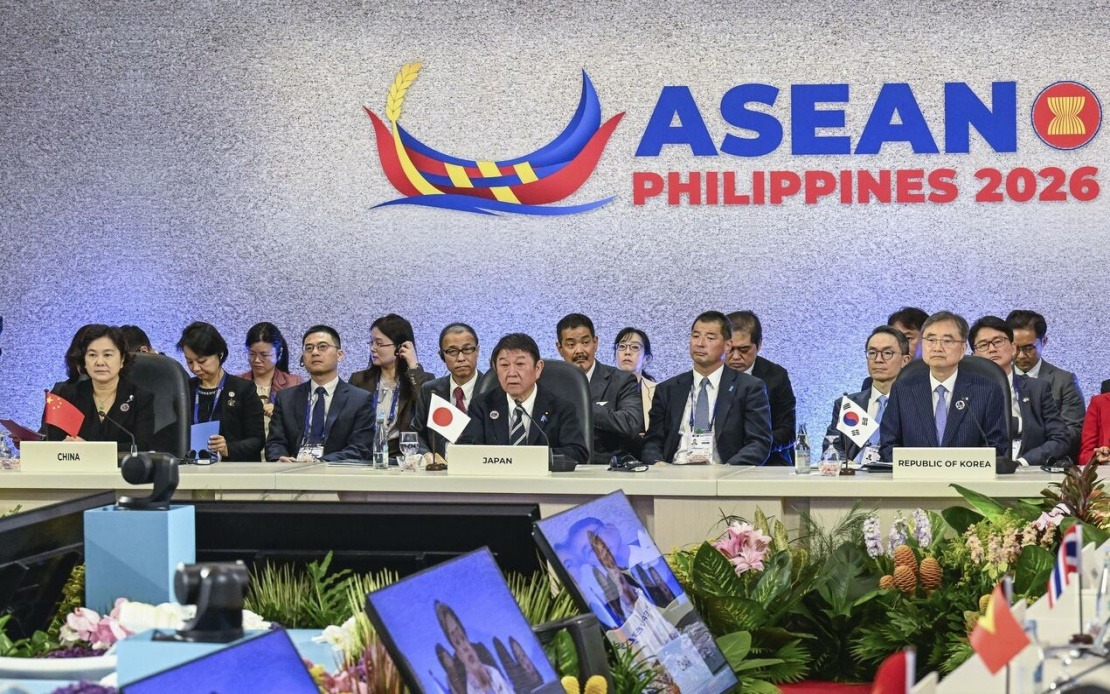
Japan has committed to strengthening regional partnerships on energy infrastructure and cybersecurity challenges during high-level discussions with ASEAN member states, China, and South Korea in Manila. The pledge emerged from a meeting of foreign ministers representing what has become one of the world's most economically significant blocs, with Japanese Foreign Minister Toshimitsu Motegi leading Tokyo's diplomatic outreach to address pressing regional concerns.
Motegi underscored the geopolitical importance of the ASEAN-plus-three framework, emphasising that the combined economies of participating nations now exceed one quarter of global GDP. This substantial economic footprint positions the grouping as a critical player in shaping both regional stability and international economic governance. The Japanese minister's framing reflects Tokyo's strategic assessment that deepened cooperation within this informal multilateral mechanism can amplify influence over regional development priorities.
Central to Japan's agenda was securing commitment from neighbouring economies to enhance energy supply resilience. The initiative responds to volatile conditions in West Asia, which have created uncertainty in global petroleum markets and highlighted vulnerabilities in Asia's energy infrastructure. Japan, heavily dependent on imported energy resources, views regional energy cooperation as essential to long-term economic stability and has positioned itself as a convenor for addressing this shared vulnerability across Southeast Asia.
The cybercrime dimension of Tokyo's proposal targets the proliferation of online scams that have inflicted substantial financial losses across the region. Southeast Asian nations have become increasingly vulnerable to sophisticated digital fraud schemes, with criminal networks exploiting cross-border jurisdictional challenges. Japan's emphasis on this issue reflects both its own experiences managing cybersecurity threats and recognition that Southeast Asia requires enhanced technical capacity and intelligence-sharing mechanisms to combat transnational digital crime effectively.
Motegi explicitly affirmed Japan's endorsement of ASEAN Centrality—the principle that ASEAN should lead regional diplomatic processes and institutional development. This rhetorical commitment carries strategic weight, as it reassures smaller Southeast Asian nations that Japan respects their collective agency despite power imbalances. Simultaneously, Motegi reiterated Tokyo's support for the ASEAN Outlook on the Indo-Pacific, framing Japan's Free and Open Indo-Pacific vision as complementary to ASEAN's initiative rather than competitive.
The alignment between these two concepts matters significantly for Malaysian and regional policymakers. The AOIP represents ASEAN's effort to maintain strategic autonomy amid great power competition, while Japan's Indo-Pacific framework has sometimes been interpreted as reflecting alignment with American strategic priorities. By presenting convergence between the two approaches, Japan attempted to signal that supporting Tokyo's regional vision does not require abandoning ASEAN's commitment to non-alignment and pragmatic engagement with all major powers.
China's representation through Vice Foreign Minister Hua Chunying rather than Foreign Minister Wang Yi may carry diplomatic significance, potentially signalling different priority levels or scheduling constraints. Nevertheless, Beijing's participation in the energy security and cybercrime discussions underscores acknowledgement that these transnational challenges demand coordinated responses regardless of strategic competition. The inclusion of South Korea reflects Seoul's interest in deepening Southeast Asian engagement as part of its broader diversification away from excessive dependence on US alliance relationships.
The ASEAN-plus-three framework itself emerged from Asia's response to the 1997 financial crisis, when regional economies recognised that informal mechanisms for consultation and cooperation could mitigate shared economic vulnerabilities. Over subsequent decades, the grouping has evolved into an established venue for discussing regional challenges spanning trade, finance, disaster management, and increasingly, security issues. Its persistence reflects deep recognition among East and Southeast Asian leaders that intra-regional cooperation remains essential despite strategic competition at the bilateral level.
Motegi's subsequent meeting with British Foreign Secretary Ed Miliband revealed Japan's parallel commitment to strengthening partnership with traditional Western allies. The Japanese minister expressed optimism about UK-Japan cooperation under the new British government led by Prime Minister Andy Burnham. This diplomatic manoeuvre illustrates Japan's broader strategy of maintaining robust relationships across the Indo-Pacific region while simultaneously anchoring itself within Western alliance structures—a delicate balancing act that reflects Tokyo's assessment of how to navigate contemporary geopolitical competition.
For Malaysian policymakers and regional observers, these developments carry several implications. The emphasis on energy security cooperation could create opportunities for Southeast Asian nations to participate in infrastructure projects and technology-sharing arrangements that strengthen their energy independence. The cybercrime initiative may lead to enhanced technical assistance and capacity-building support from Japan, benefiting Malaysia's law enforcement and cybersecurity communities. Simultaneously, the affirmation of ASEAN centrality and the AOIP reflects reassurance that regional autonomy remains valued even as major powers compete for influence.
The convergence of Japanese, Chinese, and South Korean diplomatic initiatives toward ASEAN suggests these three East Asian powers recognise Southeast Asia as a critical zone where regional stability, economic prosperity, and strategic balance must be sustained collaboratively. While bilateral tensions persist between these countries—particularly regarding territorial disputes and historical grievances—their willingness to engage ASEAN collectively on functional issues indicates pragmatic acceptance that certain challenges transcend strategic competition. This functional cooperation offers Southeast Asian nations leverage in negotiations with larger powers while building consensus on issues affecting collective prosperity.
Looking ahead, the success of these pledges will depend on implementation mechanisms and resource allocation. Energy security cooperation requires sustained investment in infrastructure and technology transfer, while cybercrime prevention demands institutional coordination and intelligence sharing that goes beyond rhetorical commitment. Malaysian stakeholders should monitor progress carefully, engaging actively in these discussions to ensure that regional interests receive adequate attention alongside the strategic calculations of larger powers.

