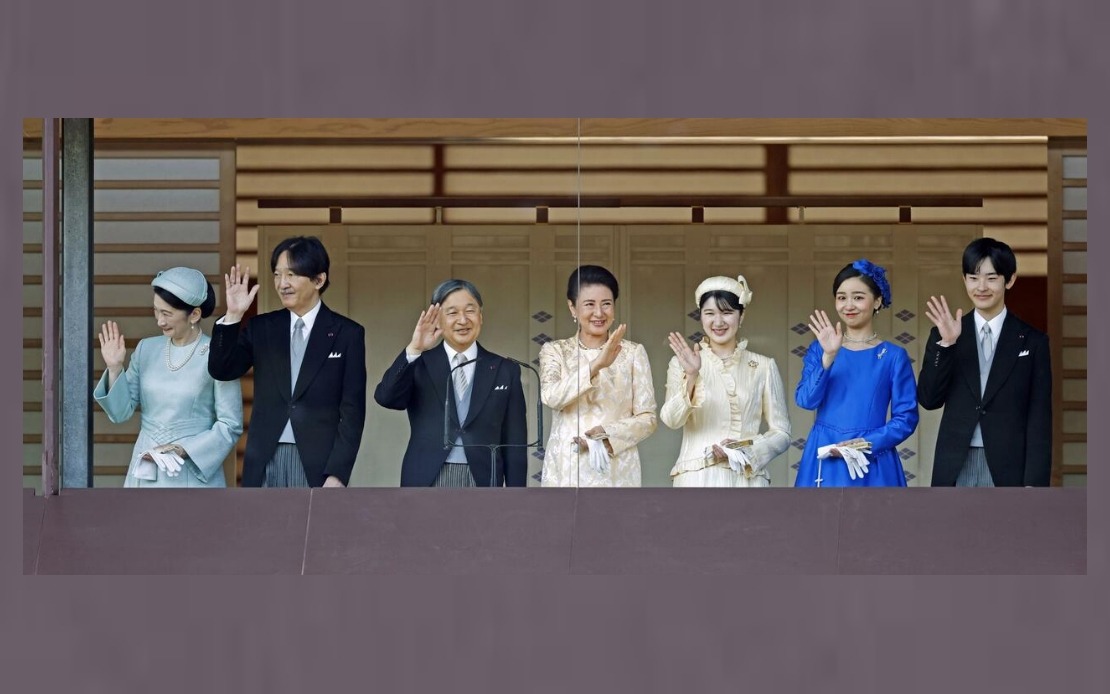
Japan's parliament has approved sweeping changes to its Imperial House Law in a bid to stabilise a monarchy facing an acute succession crisis, yet the legislation conspicuously avoids opening the throne to female heirs despite overwhelming public appetite for such reform. The revised law, the first substantial overhaul since 1947, received parliamentary approval on Friday and introduces two significant modifications designed to expand the shrinking pool of imperial family members eligible to inherit power. The changes reflect the mounting pressures facing the world's oldest continuous hereditary monarchy as it grapples with fewer eligible male successors than at any point in modern history.
Under the reformed legislation, unmarried male descendants from 11 former imperial branch families can now be adopted into the active imperial household, provided they have reached the age of 15. This reverses decades of practice that had rendered such adoptions effectively impossible, opening a theoretical pathway to incorporate male relatives of Emperor Naruhito back into the fold. Alongside this adoption measure, the law now permits female members of the imperial family to maintain their imperial status and privileges even after marrying individuals outside the royal lineage—a modification that represents a notable concession to contemporary family dynamics and marriage patterns. These provisions target the immediate shortage of potential successors; Japan currently has only three male heirs capable of inheriting the Chrysanthemum Throne, a precarious situation that has animated palace succession debates for years.
Prime Minister Sanae Takaichi, herself a historic figure as Japan's first female premier, shepherded the legislation through parliament despite fierce criticism from opposition members who contend the deliberations were insufficiently thorough and rushed. Critics from across the political spectrum have lambasted the ruling Liberal Democratic Party and its junior coalition partner, the Japan Innovation Party, for what they characterise as a conservative preservation of patrilineal traditions at the expense of genuine modernisation. The months-long cross-party negotiations that preceded the final vote produced a legislative consensus incorporating input from 13 parliamentary parties and groups, yet this ostensible broad agreement deliberately sidestepped the succession question entirely. Takaichi's administration has maintained that the revised law, by permitting the adoption of male descendants of former imperial families, adequately addresses succession concerns without requiring the contentious step of opening the throne to female or maternal-line emperors.
The continuity of male-only succession represents a remarkable inflexibility given Japan's democratic maturity and economic development. The operative language of the 1947 Imperial House Law—which mandates that the throne "shall be succeeded to by a male offspring in the male line belonging to the Imperial Lineage"—remains entirely unmodified despite more than three decades of social change. This provision originated during Japan's post-World War II occupation, when the American-led administration and Japanese policymakers jointly restructured the imperial institution. At that juncture, 51 members from 11 collateral branches were removed from imperial status, a decision that created the modern succession bottleneck now driving legislative scrambling. The current reform effectively begins the process of reversing that mid-century pruning, but only for male descendants, thereby maintaining what critics characterise as an outdated gender restriction incompatible with contemporary Japanese values.
Public opinion presents a striking disconnect from the government's conservative legislative approach. A Kyodo News poll conducted in May found that 83 per cent of Japanese respondents favour permitting female emperors, while only 13.1 per cent oppose the notion. This lopsided majority suggests a society substantially more progressive on succession questions than its elected representatives, reflecting a broader pattern in Japanese politics where generational and gender-based value shifts often outpace institutional reform. The legislative choice to ignore this evident popular mandate speaks to the institutional weight of tradition within Japan's political culture and the particular grip that conservatives within the ruling coalition maintain over succession policy. For regional observers, particularly those in Southeast Asia monitoring democratic governance patterns, Japan's approach illustrates how even affluent, stable democracies can struggle to align institutional frameworks with evolving societal preferences on matters touching fundamental traditions.
The implications of Japan's measured approach extend beyond domestic succession politics. The reform's deliberate incompleteness leaves open questions about the long-term viability of the imperial institution if male heirs remain scarce despite the adoption provisions. The 11 former branch families contain multiple eligible males, yet adoption remains a mechanism dependent on willing participants and successful integration into the imperial household—outcomes neither certain nor guaranteed. Should future succession crises emerge despite these reforms, Japan may find itself revisiting the female emperor question with far less time for deliberative consensus-building. The legislative precedent set here, emphasising gradual incremental change over fundamental restructuring, may prove inadequate to anticipated demographic realities.
For Malaysia and other Southeast Asian nations, Japan's imperial succession debates offer instructive parallels to monarchical questions within the region. Like Japan, Malaysia maintains a constitutional monarchy with established succession protocols, yet societies across Southeast Asia increasingly grapple with how hereditary institutions adapt to contemporary expectations around gender equality and merit-based advancement. Japan's cautious approach—preserving patrilineal orthodoxy while permitting supporting modifications—reflects the political difficulty of modernising systems with deep historical roots. The resilience of male-line succession despite overwhelming public support for change demonstrates how institutional inertia and conservative political forces can constrain democratic responsiveness even in technologically advanced, educated societies.
The broader context of Sanae Takaichi's premiership adds another analytical dimension to the imperial law revision. Her elevation as Japan's first female prime minister coexists incongruously with legislation that refuses to contemplate female imperial succession, a contradiction that opposition lawmakers have not hesitated to highlight. This juxtaposition underscores how symbolic advancement—a woman leading the nation—can proceed alongside substantive institutional resistance to gender-inclusive change. Takaichi's government has framed the imperial succession question primarily through demographic and institutional lenses rather than gender equality frameworks, positioning the adoption provisions as pragmatic responses to shrinking pools of eligible heirs rather than as expressions of any commitment to gender parity. This framing strategy has allowed the government to present the reforms as modernising while actually reinforcing traditional patrilineal structures.
The 1947 origins of the current imperial succession law deserve emphasis for regional and international audiences seeking to understand Japan's contemporary choices. The law itself emerged from post-war occupation dynamics, yet it has survived Japan's complete restoration of sovereignty and emergence as an economic superpower fundamentally unchanged in its core provisions. This remarkable stability—or, from reform perspectives, stagnation—across 77 years reflects the extraordinary symbolic weight attached to imperial succession in Japanese political culture. Attempts to modify these provisions encounter fierce resistance from conservative constituencies and institutions that view alterations to imperial succession protocols as threatening to national identity and historical continuity. Understanding Japan's current legislative choice requires appreciating this deep institutional conservatism.
Looking forward, the revised Imperial House Law represents a holding action rather than a definitive solution to succession questions. The adoption of male descendants from former branch families may provide sufficient eligible heirs across multiple generations, thereby preventing acute succession crises in the medium term. However, if demographic patterns continue suggesting declining numbers of male descendants overall, or if major branch family members prove unwilling to accept imperial status, the government may face renewed pressure to reconsider female succession. The legislative record created by this reform—a parliament explicitly considering and rejecting female emperors despite public support—will weigh heavily on future deliberations. For now, Japan's conservative ruling coalition has successfully preserved the patrilineal succession system while making sufficient institutional adjustments to deflect the most urgent demographic pressures.

