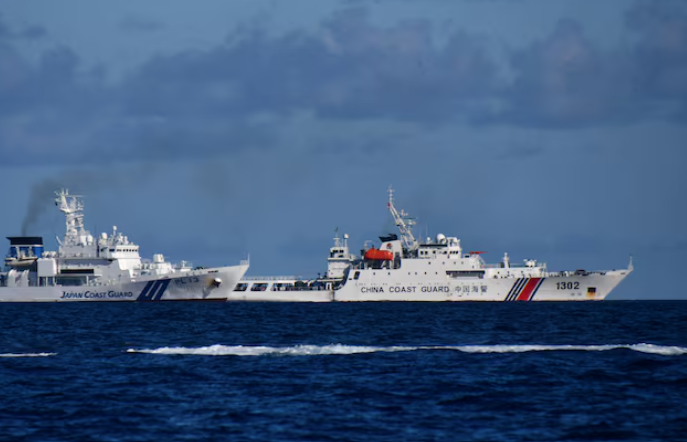
Japan's coast guard successfully forced two Chinese coast guard vessels to withdraw from waters it considers its own near the Senkaku Islands on Tuesday, according to official statements released by Tokyo. The operation, which concluded around 9:20 in the morning local time, came after the Chinese ships were detected approaching a Japanese fishing vessel operating in the contested area. The Japanese authorities moved quickly to protect the fishing boat and compel the foreign vessels to depart, deploying additional coast guard resources to establish a security perimeter around the Japanese commercial vessel. This latest maritime confrontation illustrates the persistent friction that characterises relations between the two major East Asian powers over territory and maritime jurisdiction.
The Senkaku Islands, called the Diaoyu by China, occupy a strategically significant position in waters between Taiwan and Okinawa. Control over these rocky outcrops has become symbolic of broader sovereignty questions in East Asia, with both nations maintaining conflicting territorial claims that have festered for decades. Beyond the symbolic importance, the waters surrounding these islands are believed to contain valuable energy reserves, adding economic incentive to the geopolitical dispute. The strategic location also sits along crucial shipping lanes that connect major regional economies, making maritime access a matter of vital national interest for multiple stakeholders in the region.
While Chinese coast guard vessels regularly patrol waters near the islands, deliberate approaches to Japanese fishing boats represent a notably more aggressive tactic that remains uncommon. The previous recorded instance of Chinese ships entering waters claimed by Japan occurred on June 10, roughly a month before this week's incident. The escalation in behaviour suggests a hardening of China's posture, moving beyond routine presence to direct interference with Japanese economic activities. Such proximity to working fishing vessels carries inherent risks of dangerous encounters that could rapidly escalate beyond the control of either side's coast guard personnel.
Tensions between Tokyo and Beijing have intensified dramatically since November of the previous year, when Japanese Prime Minister Sanae Takaichi made public statements regarding potential military intervention to defend Taiwan should China attack the self-governed island. Beijing interpreted these remarks as unacceptable interference in what it considers an internal matter, viewing Taiwan as a renegade province that must eventually reunify with mainland China. The comments provoked formal condemnation from Chinese authorities and triggered retaliatory economic measures. China subsequently discouraged its citizens from travelling to Japan and imposed trade restrictions on selected Japanese companies, creating friction across multiple dimensions of bilateral relations.
In response to the Taiwan remarks, China has adopted a more muscular approach across multiple disputed maritime territories in the East China Sea. Beyond the Senkaku Islands, Chinese vessels have been deployed to other contested waters where territorial claims overlap with those of Japan and other regional nations. These activities occur despite persistent diplomatic protests from Tokyo demanding cessation of what it characterises as provocative behaviour. The pattern suggests Beijing is employing maritime assertiveness as a tool to express displeasure with Tokyo's political statements and to demonstrate resolve regarding its territorial claims.
Japan's coast guard characterised the presence of the Chinese vessels as a violation of international law, grounding its response in both domestic statutes and internationally recognised maritime protocols. Tokyo maintains that its position reflects adherence to established rules governing territorial waters and maritime conduct. The successful expulsion operation demonstrates Japan's operational capability and willingness to physically defend what it considers its sovereign waters, though the action stops short of military engagement or escalation beyond coast guard protocols. This measured response reflects Tokyo's preference for managing the dispute through law enforcement rather than military confrontation.
The broader strategic context places this incident within a larger pattern of Chinese assertiveness throughout the region. Vietnam, the Philippines, and other Southeast Asian nations with claims in the South China Sea have experienced similar intrusions by Chinese coast guard and military vessels. These parallel disputes create regional concerns about freedom of navigation and the sanctity of maritime boundaries. Malaysia, as a key Southeast Asian maritime power with its own stake in these regional tensions, observes these developments carefully, recognising implications for navigational rights and the broader balance of power in shared waters.
Japan's coast guard has signalled commitment to continued vigilance in protecting its claimed territorial waters, pledging to respond with both firmness and restraint in future encounters. The institutional approach emphasises de-escalation while maintaining resolve, relying on established procedures and international legal frameworks rather than provocative countermeasures. This stance reflects Japan's broader strategy of managing tensions with China through predictable, rule-based responses that avoid unnecessary escalation while making clear the limits of acceptable behaviour.
The incident reflects deeper structural tensions in East Asian geopolitics that extend beyond bilateral Japan-China relations. The unresolved territorial disputes, competing strategic interests, and different interpretations of international law create persistent friction points that periodically manifest in concrete confrontations at sea. For regional observers including Malaysian policymakers and business leaders, these tensions carry implications for maritime security, freedom of navigation, energy security, and the stability of the regional order that underpins economic prosperity and security cooperation across Southeast Asia.

