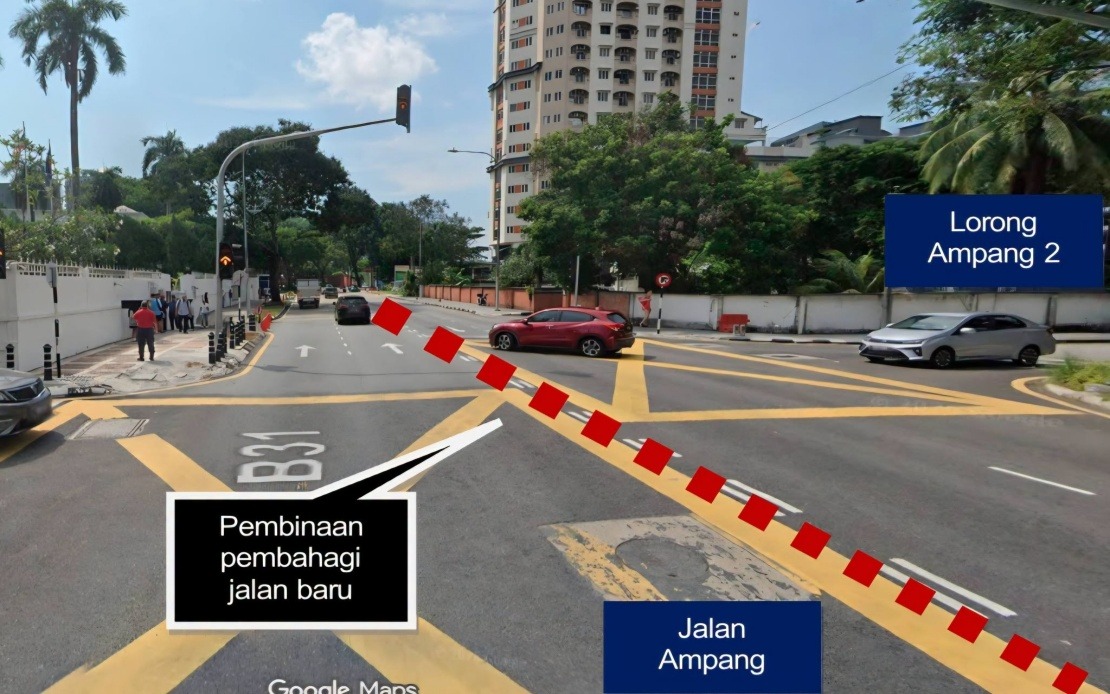
The Kuala Lumpur City Hall (DBKL) has begun permanent closure of two critical traffic light intersections along Jalan Ampang starting today, marking the commencement of a significant infrastructure overhaul in one of the city's major arterial routes. The affected intersections—one in front of the Royal Thai Embassy and another at Lorong Ampang 2—will no longer operate as signalised junctions as part of a comprehensive upgrade initiative spanning 3.2 kilometres of the corridor.
The ambitious Jalan Ampang upgrade project extends from the Jalan Tun Razak intersection through to the Middle Ring Road 2 (MRR2), representing an investment in modernising a heavily trafficked corridor that connects central Kuala Lumpur to the eastern suburbs. This closure marks the beginning of transformative changes designed to fundamentally reshape how traffic flows through this strategic part of the city, with authorities prioritising efficiency gains alongside safety improvements for both vehicular and pedestrian users.
Authorities have framed the project as essential infrastructure modernisation aimed at eliminating inefficiencies within the existing road network. The initiative incorporates systematic improvements including construction of dedicated road dividers to segregate opposing traffic flows, expansion to two-way four-lane roads that maximise capacity, and comprehensive upgrades to pedestrian facilities including safer walkways and enhanced street lighting. These enhancements reflect a deliberate shift towards integrated urban planning that balances vehicle movement with public safety considerations.
The decision to close intersections rather than merely modify traffic signals demonstrates DBKL's confidence that removing conflicting turning movements will yield tangible benefits for overall corridor performance. By eliminating the opportunity for vehicles to cross opposing traffic streams at these specific locations, the authorities anticipate significant reductions in traffic weaving—the chaotic lateral movement that characterises congested intersections. This approach should theoretically diminish intersection delays and create smoother progression along the entire Jalan Ampang corridor, though actual outcomes will depend heavily on implementation quality and how displaced traffic distributes across alternative routes.
For commuters accustomed to navigating these intersections, alternative routing arrangements have been established to minimise disruption. Drivers heading towards Ampang who previously accessed side streets at the Royal Thai Embassy intersection can now execute U-turns at the Jalan Tun Razak junction further west. Similarly, those travelling cityward can perform U-turns at Jalan Ampang Hilir, which lies to the east of the closed intersections. These workarounds require motorists to travel slightly longer distances, adding minutes to certain journey patterns, though DBKL appears to be banking on the premise that improved flow elsewhere will offset these localised inconveniences.
The permanent nature of these closures distinguishes this project from temporary construction disruptions commonly seen in Malaysian cities. This reflects a fundamental redesign of the street network rather than tactical modifications, suggesting that DBKL has invested considerable planning into determining that these intersections genuinely conflict with the upgraded corridor's operational logic. The closure removes future flexibility, committing the city to this particular traffic management philosophy long-term, which carries both benefits and risks depending on how accurately planners have forecast future demand patterns.
For the broader Klang Valley region, the Jalan Ampang upgrade holds significance as part of the incremental enhancement of the metropolitan transport network. As Kuala Lumpur continues urban densification and suburban communities expand eastward, maintaining efficient connections between the city core and peripheral areas becomes increasingly critical. Projects like this attempt to address congestion without constructing entirely new corridors, which are often politically and financially infeasible in established urban areas.
The timing and execution of this closure will be closely watched by traffic management professionals and commuters alike. DBKL has specifically appealed to road users to respect newly installed traffic signage and follow guidance carefully, suggesting that the transition period may present navigation challenges even with advance planning. The authority's confidence in the alternative routes will be tested during peak morning and evening commuting periods, when traffic volumes typically peak and driver patience runs thin.
From a broader urban governance perspective, this project demonstrates DBKL's willingness to undertake controversial infrastructure decisions aimed at long-term network improvement rather than short-term congestion relief. Such decisions often generate initial public resistance but can prove beneficial if execution matches planning assumptions. However, the success of this initiative ultimately depends on comprehensive traffic management coordination across the wider city network, ensuring that displacement of traffic from Jalan Ampang does not simply transfer congestion to parallel routes like Jalan Raja Chulan or Jalan Ampang Hilir.
Commuters and businesses operating along the affected corridor should prepare for an adjustment period. Delivery services, daily commuters, and residents will need to become familiar with alternative routing, and some may experience temporarily increased travel times during the transition. The success of this project will serve as a case study for future DBKL infrastructure decisions and may influence how the city approaches similar bottlenecks elsewhere in the metropolitan area, making the execution quality particularly important for setting precedent.

