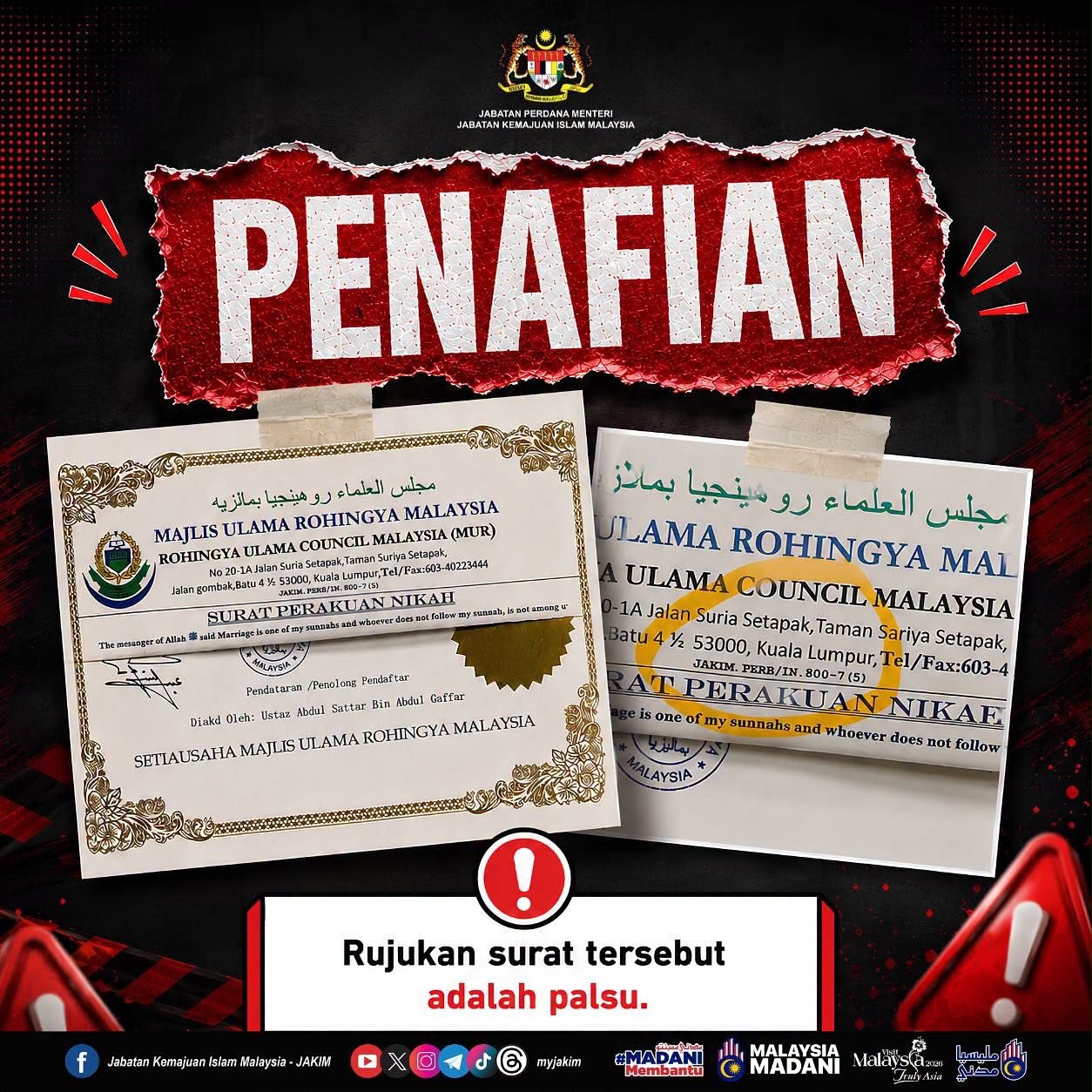
The Department of Islamic Development Malaysia (JAKIM) has issued a stark warning after discovering that a marriage-related letter gaining traction across social media platforms is entirely counterfeit. Through verification checks conducted by the authority, JAKIM confirmed that the document bears no legitimate connection to any Islamic religious institution in Malaysia and that the reference number displayed on it is fabricated. The discovery underscores growing concerns about the circulation of forged religious documents that exploit Malaysia's Islamic governance framework to lend false credibility to questionable claims.
The fraudulent letter, which surfaced recently on social media, allegedly originated from the Malaysia Rohingya Ulama Council and carried the reference number "JAKIM.PERH/LN.800-7(5)". This specific formatting was designed to appear official, mimicking the structural conventions of genuine JAKIM documentation. The letter's apparent authority derived from what appeared to be proper institutional backing, making it potentially persuasive to ordinary citizens unfamiliar with the authentic protocols governing Islamic religious matters in Malaysia. The viral nature of the document's circulation highlights how digital platforms can rapidly amplify false information, particularly when it involves government-sounding credentials.
JAKIM's statement, released through its official Facebook page, categorically rejected any association with the organization mentioned in the viral letter. The department emphasized that neither JAKIM nor any of Malaysia's state Islamic religious councils and departments has ever designated the Malaysia Rohingya Ulama Council or any other entity to manage, oversee, or certify matters related to marriage and matrimonial affairs. This clarification is significant because marriage registration and recognition remain highly regulated matters within Malaysia's Islamic legal framework, handled exclusively through official channels and recognized religious authorities.
The implications of such fraudulent documents extend beyond simple misinformation. In Malaysia's context, where Islamic law governs personal matters including marriage for Muslim citizens, forged documents purporting to validate marriages or matrimonial arrangements could have serious legal consequences for those who rely upon them. Individuals unknowingly accepting counterfeit marriage letters might find their unions unrecognized by official authorities, creating complications in inheritance, custody, and spousal rights. This vulnerability particularly affects communities with limited access to information about proper procedures, making them susceptible to exploitation by those seeking to legitimize irregular arrangements.
Minister in the Prime Minister's Department (Religious Affairs) Dr Zulkifli Hasan acknowledged the matter and indicated that investigations would proceed once comprehensive information had been compiled. The ministerial response signals that authorities are treating the matter with appropriate seriousness, recognizing that coordinated action across multiple departments may be necessary to trace the document's origins and identify those responsible for its creation and distribution. Such investigations typically involve cooperation between JAKIM, state religious authorities, and law enforcement agencies to establish accountability.
The emergence of this counterfeit document is not an isolated incident but reflects a broader pattern of document fraud affecting Malaysia's institutions. Similar schemes have previously targeted other government departments through forged letters and fake credentials. The sophistication with which this marriage letter was constructed—complete with what appeared to be authentic reference numbering—demonstrates that those behind such frauds are becoming more adept at mimicking official formats and procedures. This escalating threat necessitates enhanced public awareness campaigns and more robust mechanisms for authenticating official religious documents.
For Malaysian citizens and Southeast Asian migrants, the lesson carries particular weight. Those unfamiliar with Malaysia's Islamic administration structures might struggle to distinguish between genuine and falsified documents, especially when they appear sufficiently formal. The Malaysia Rohingya community, in particular, may face heightened vulnerability to such schemes due to language barriers and incomplete knowledge of local procedures. Scammers targeting this demographic could exploit their unfamiliarity with proper channels and their desperate circumstances to pressure them into accepting fraudulent arrangements.
JAKIM has consequently advised the public to adopt a cautious approach toward any religious documentation raising doubts. The department recommends that individuals seeking verification of marriage-related documents should directly contact JAKIM or their respective state Islamic religious authorities before accepting their authenticity. This straightforward verification process, while simple in principle, requires public awareness and confidence in official institutions. Building such confidence depends on regular communications from authorities clarifying proper procedures and warning against common fraud patterns.
The broader context reveals challenges inherent in Malaysia's decentralized Islamic governance structure, where responsibilities are distributed among federal and state authorities. While this arrangement respects federalism principles and state autonomy in religious matters, it can create confusion for citizens uncertain about which authority handles specific issues. Fraudsters exploit these structural complexities, creating documents with reference numbers suggesting federal authority when state bodies bear actual responsibility. Addressing this vulnerability requires clearer public information about jurisdiction and more accessible verification mechanisms across all levels of government.
Secondary concerns emerge regarding how such fraudulent documents could impact Malaysia's international standing and regional cooperation. False marriage certifications involving Rohingya or other refugee populations could create diplomatic tensions with neighboring countries, particularly if individuals with unverified matrimonial status attempt to cross borders or claim spousal rights in other jurisdictions. Malaysia's commitment to proper governance and document security becomes relevant to its relationships with regional partners.
The incident also raises questions about digital literacy and information verification practices among Malaysian society. As more government services migrate online and authentic documents increasingly appear in digital formats, the ability to distinguish legitimate from fabricated communications becomes essential. Educational initiatives emphasizing how to verify official documents through proper channels could reduce vulnerability to fraud. Schools, community centers, and religious institutions might collaborate to provide accessible guidance on authentication procedures.
Moving forward, JAKIM and state religious authorities would benefit from implementing enhanced security features in official marriage-related documentation, similar to protections used in other critical government documents. Digital verification systems allowing the public to check reference numbers in real time through official portals could significantly reduce fraud's effectiveness. Such technological solutions, combined with sustained public awareness campaigns, would create multiple layers of protection against counterfeit religious documents.

