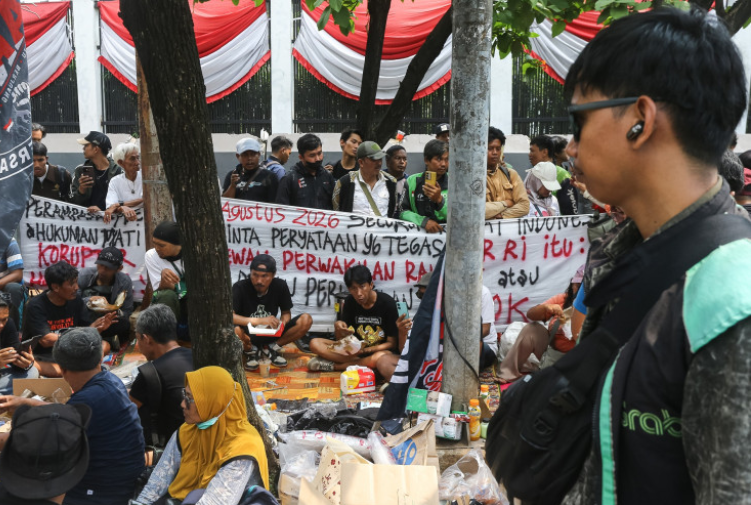
Tensions over Indonesia's anti-corruption efforts escalated on Thursday when multiple activist groups converged on the Senayan Legislative Complex in Central Jakarta, demanding rapid approval of landmark legislation that would empower authorities to seize assets suspected of being proceeds of crime. The demonstration, which drew participants from across Java and potentially beyond, reflected growing public frustration with the pace of tackling institutional graft and the high cost of living, issues that have mobilised Indonesian civil society in recent months.
The most vocal contingent came from Pati in Central Java, where residents organised under the United Pati People's Alliance had systematically mobilised supporters for the capital since the previous week. The group's determination to reach Jakarta despite official obstruction underscored the intensity of grassroots demand for legislative action. The fact that organisers needed to arrange multiple coach convoys highlighted how the movement had transcended local boundaries, though core leadership remained rooted in Central Java's activist networks.
State authorities moved swiftly to suppress the march before it materialised. Police intercepted several buses carrying protesters en route to Jakarta, while Bank Mandiri, a state-owned financial institution, took the unusual step of freezing the bank account of AMPB coordinator Supriyono. This banking action triggered public backlash and calls for boycotts of the lender, demonstrating how heavy-handed official responses can backfire domestically. Despite these obstacles, organisers announced that five additional coaches would depart for the capital, funded entirely through public donations, suggesting that suppression efforts had paradoxically strengthened resolve.
The Indonesian capital's security apparatus mobilised extensively ahead of the Thursday demonstrations. Police implemented comprehensive traffic management measures, closing both directions of Jalan Gatot Subroto from Senayan Park to the legislative complex entrance. Jakarta Police spokesperson Senior Commissioner Budi Hermanto indicated that authorities anticipated at least 500 participants, though he acknowledged the figure could rise substantially as regional groups beyond Pati prepared to participate. Officers deployed across the complex's perimeter, creating a visible security infrastructure designed to contain rather than necessarily prevent the gathering.
While law enforcement framed its approach as facilitating peaceful protest, Hermanto's public statements revealed official anxiety about potential disruption. He urged demonstrators to avoid damaging state facilities and to consider the broader implications for public safety and national stability, language that suggested authorities viewed the protest through a security lens rather than as legitimate democratic expression. The rhetoric of maintaining "Indonesia safe, peaceful and conducive" represented an attempt to delegitimise protest through appeals to order, a familiar pattern in Southeast Asian governance.
The focal point of grievance—the asset forfeiture bill—has languished in legislative limbo since its initial proposal in 2008. The legislation would constitute a dramatic expansion of state power by permitting confiscation of assets merely suspected of criminal origin, without requiring prior conviction. This mechanism represented a significant departure from conventional legal principle and offered prosecutors extraordinary leverage in investigations. The long delay had frustrated civil society organisations and anti-corruption advocates, who viewed the bill as essential infrastructure for tackling endemic graft.
However, legal experts and human rights advocates have raised substantial concerns about the bill's potential for abuse. Authoritarian regimes throughout Asia have weaponised asset forfeiture statutes against political opponents, and the absence of conviction requirements creates obvious scope for prosecutorial overreach or extortion. Indonesian legal scholars warned that hurried passage without rigorous safeguards could inadvertently furnish state officials with sophisticated tools for targeting adversaries under the guise of anti-corruption enforcement. This tension between genuine reform impulses and potential for institutional abuse remains unresolved in current legislative discussions.
House of Representatives leadership moved to defuse the pressure by expediting deliberations. Gerindra Party lawmaker Habiburokhman, who chairs Commission III overseeing legal affairs, declared that the bill required only eight additional weeks of consideration before potential passage by December. The House had already received Pati residents at the complex on the preceding Monday, signalling responsiveness to constituent pressure. This accelerated timeline reflected recognition among legislators that sustained public mobilisation represented a political liability that could damage parliamentary credibility if perceived as obstruction.
President Prabowo Subianto's administration offered explicit support for rapid passage, with Government Communications Agency head Muhammad Qodari characterising the matter as squarely within the House's domain. This positioning allowed the executive to maintain rhetorical commitment to anti-corruption while placing legislative responsibility on parliamentarians. For Malaysian observers, this dynamic illustrates how corruption and institutional accountability remain volatile political topics across Southeast Asia, capable of mobilising constituencies beyond traditional political divides.
The convergence of anti-corruption demands with grievances over cost-of-living pressures revealed how economic hardship and institutional integrity concerns reinforce each other in Indonesian political consciousness. Citizens frustrated by unaffordable necessities often attribute their predicament to corruption siphoning resources from public programmes, creating powerful narrative linkages between graft and personal welfare. This explains why protesters articulated multiple demands simultaneously rather than focusing narrowly on legislative procedure.
The Pati movement's emergence from Central Java—a region with substantial Islamic civil society infrastructure—also signified how anti-corruption messaging now resonates across Indonesia's diverse ideological communities. The unified demands for death penalties and swift asset forfeiture legislation, combined with calls for price controls, suggested that anti-graft sentiment transcends the urban middle-class constituencies traditionally associated with governance reform movements. This broadening of the anti-corruption coalition carries significant implications for Indonesia's political trajectory and may constrain future governments' ability to resist demands for more aggressive prosecutorial approaches.
Looking forward, the December deadline established by House leadership creates a concrete benchmark against which parliamentary performance will be assessed. Failure to meet this timeline risks further erosion of legislative legitimacy at a moment when public trust already remains fragile. For regional observers, the Jakarta demonstrations underscore how Southeast Asian publics are increasingly willing to mobilise around institutional governance issues, moving beyond electoral cycles to demand concrete policy delivery on anti-corruption priorities.

