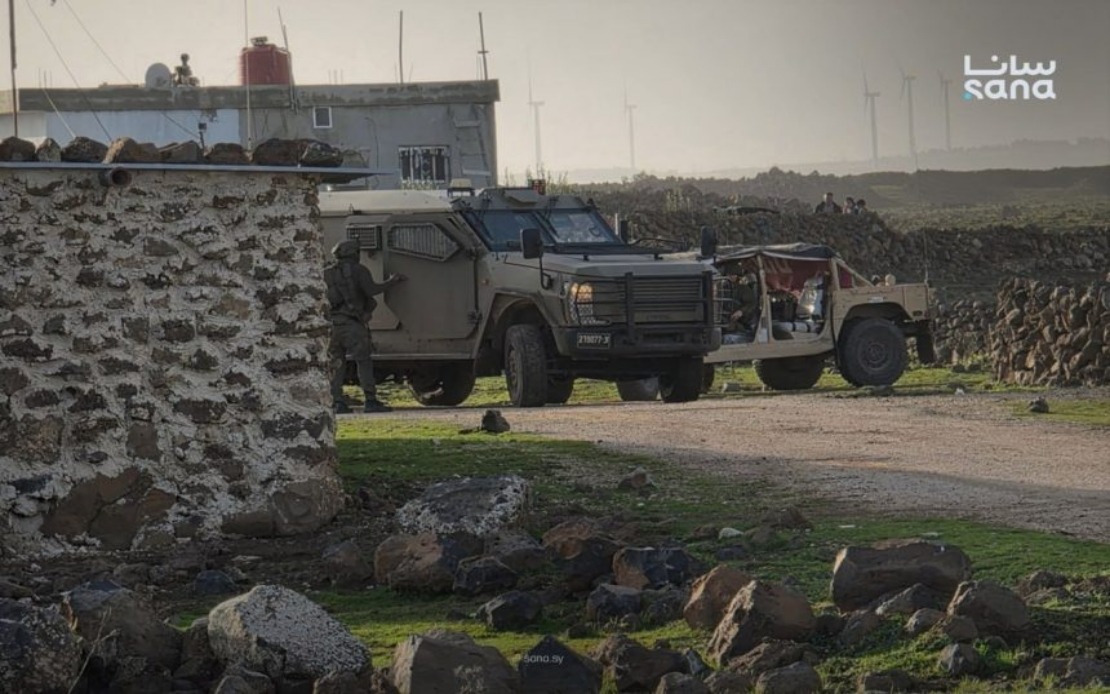
Six Israeli military vehicles crossed into Syria's southwestern Quneitra province on Saturday, pushing toward the Kudna Dam in the central countryside while reconnaissance drones conducted surveillance overhead, according to the Syrian Arab News Agency. The operation underscores the deepening security vacuum in southern Syria as regional powers jostle for advantage following the dramatic collapse of Bashar al-Assad's government in December 2024. For Malaysia and the broader Southeast Asian community, this escalation represents a critical juncture in Middle Eastern stability with potential ripple effects across global energy markets and international relations.
The incursion represents merely the latest episode in a sustained pattern of Israeli military activity across the Syrian border. Over recent months, southern Syria has become a zone of repeated violations, with Israeli forces conducting raids, establishing military checkpoints, and detaining individuals in areas nominally under Syrian jurisdiction. The frequency and brazenness of these operations have intensified noticeably, suggesting a fundamental shift in Israeli strategic calculations now that the Assad regime—which, despite decades of enmity with Israel, maintained a de facto security arrangement through the 1974 Disengagement Agreement—has been removed from power.
Israel's declaration in December that it was formally abandoning the 1974 accord marked a watershed moment. That agreement, brokered following the Yom Kippur War, had established a demilitarized buffer zone in the Golan Heights separating Israeli and Syrian forces, monitored by United Nations observers. The arrangement, imperfect as it was, had provided a mechanism for managing Israeli-Syrian tensions and preventing direct military clashes along the border for five decades. With Assad's fall and the emergence of a fractious transitional authority in Damascus, Israeli policymakers appear to have concluded that the old constraints on military action no longer apply.
The strategic implications for the region extend well beyond the immediate Israeli-Syrian dynamic. Southeast Asian observers should note that the Middle East remains pivotal to global commerce and geopolitical equilibrium. The Strait of Hormuz, through which vast quantities of oil and liquefied natural gas transit daily, lies mere miles from the Iranian border—a nation that has long supported Assad and viewed his regime as a cornerstone of regional resistance to Israeli dominance. The destabilization of Syria creates uncertainty about Iran's ability to project power and support allied militias, potentially affecting the balance of forces across the Levant and the Persian Gulf.
The power vacuum in Damascus has attracted multiple external actors with conflicting interests. Turkish forces maintain a presence in northern Syria, the United States retains troops in the east, Russian influence persists despite Moscow's diminished role, and various armed factions—some secular, others Islamist—compete for territorial control and political influence. Israel's escalating military operations suggest a deliberate strategy to expand its security perimeter and neutralize potential threats before a new Syrian government consolidates authority. The Quneitra region, historically one of the most militarized frontiers in the Middle East, remains strategically vital for controlling approaches to Israeli territory and the occupied Golan Heights.
For Malaysia, which maintains diplomatic relations with both Arab states and Israel, this situation presents diplomatic complexity. Southeast Asian nations have traditionally advocated for Arab-Israeli peace and criticized Israeli military actions in Palestinian territories and beyond. However, the geopolitical realignment following Assad's fall complicates straightforward positioning. The new Syrian reality may eventually produce a government less hostile to Israel and more open to regional accommodation—a prospect that could reshape Middle Eastern politics in unpredictable ways. Malaysian policymakers must navigate carefully between defending Palestinian and Arab interests while acknowledging the irreversibility of Assad's departure.
The humanitarian dimension deserves attention as well. Syrian civilians in border regions now face heightened military activity, with the potential for civilian casualties increasing as Israeli forces operate with fewer constraints. Reports of arrests and searches suggest that Israeli operations target not only military objectives but also individuals suspected of involvement with armed groups. Whether such detention practices comply with international humanitarian law remains contested, but the scale of operations suggests systematic rather than sporadic enforcement activities. Regional and international human rights organizations will likely scrutinize these operations closely.
The involvement of Israeli drones in the Saturday operation merits particular note. Unmanned aerial systems have become central to Israeli military doctrine, allowing reconnaissance, targeting, and strike capabilities without risking pilots. The presence of drones alongside ground vehicles suggests a coordinated operation with real-time intelligence support rather than a limited incursion. Such capabilities also signal that Israel maintains technological and operational superiority over any Syrian military elements that might challenge its actions—a disparity likely to persist regardless of Syria's internal political evolution.
The road ahead appears to offer few mechanisms for de-escalation. Unlike the Cold War era when great power competition imposed discipline on regional actors, today's multipolar system permits greater freedom of action. Israel's government, currently led by Benjamin Netanyahu, has shown little inclination to exercise restraint in Syria, particularly as domestic political pressures push toward maintaining a hard line on security. Conversely, any Syrian government desperate for international legitimacy and reconstruction assistance will struggle to mount effective resistance to Israeli operations without risking further conflict and devastation.
The longer-term implications remain uncertain but potentially consequential. If Israeli military dominance becomes permanent and accepted across the region, it could reshape Middle Eastern power dynamics fundamentally. Alternatively, if Syria stabilizes under a government backed by stronger external patrons—whether Turkey, Russia, or others—resistance to Israeli operations could intensify. Malaysia and other Southeast Asian nations should monitor these developments carefully, recognizing that Middle Eastern instability can affect everything from energy security to international law and the global rules-based order.

