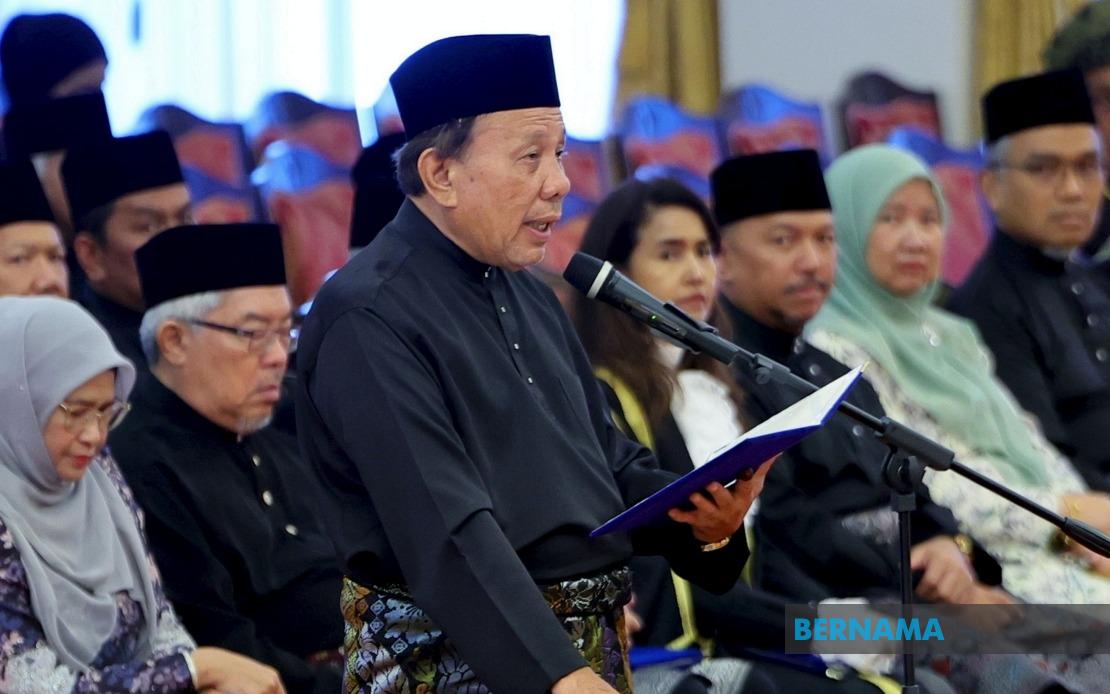
Datuk Ismail Lasim took the oath of office as Negeri Sembilan's new Menteri Besar on Friday in a ceremony at Istana Besar Seri Menanti before the Yang Dipertuan Besar Tuanku Muhriz Tuanku Munawir. The swearing-in marked the formal handover of leadership following the state's 16th election, with Ismail inheriting responsibility for steering one of Malaysia's smaller but historically significant states through its next chapter of development.
In his oath of allegiance speech, Ismail characterised the electoral mandate as more than ceremonial recognition, describing it instead as a binding obligation to demonstrate that government authority translates into tangible service. He emphasised that the confidence of Negeri Sembilan's voters demanded active listening to public concerns, equitable distribution of resources, and consistent adherence to established administrative standards. His rhetoric centred on the notion that trust, once granted, must be continuously earned through demonstrable action rather than assumed as permanent.
The newly-appointed Menteri Besar underscored his commitment to operating within constitutional frameworks that define Malaysia's system of governance. He pledged deference to the Yang Dipertuan Besar's constitutional role, affirming respect for the royal institution's place within the state administration while maintaining allegiance to both federal and state constitutional provisions. This emphasis on constitutional propriety signals Ismail's intention to position himself within established legal and institutional structures rather than pursue expansive executive latitude.
Ismail identified Negeri Sembilan's distinctive customary heritage, particularly the Adat Perpatih system rooted in consensual decision-making and collective wisdom, as a foundational element shaping his administrative philosophy. Rather than treating this traditional framework as historical artifact, he framed it as living principle warranting continuous application to contemporary governance. The Adat Perpatih's emphasis on consensus-building and equitable outcomes aligns with Ismail's stated commitment to inclusive development benefiting both urban and rural populations within the state.
Economic and social development formed a second pillar of Ismail's inaugural pledge. He committed the state government to maintaining focus on attracting quality investment, generating employment, and raising living standards whilst simultaneously strengthening education, healthcare, housing provision, and agricultural productivity. This formulation suggests recognition that investor confidence and economic growth represent necessary but insufficient conditions for successful governance, requiring complementary expansion of social welfare infrastructure to achieve broadly-shared prosperity.
Ismail's address reflected a sophisticated understanding of development metrics beyond traditional economic indicators. He argued that measuring progress solely through infrastructure projects and gross economic expansion risks overlooking dimensions critical to genuine public welfare: social cohesion, institutional resilience, and citizen confidence in administrative systems. This framing implicitly critiques narrower definitions of development that prioritise headline figures whilst neglecting institutional quality or distributional equity—an observation carrying resonance across Southeast Asia as states grapple with balancing growth trajectories against social fragmentation.
The Menteri Besar emphasised his intention to institutionalise principles of integrity, efficiency, and accountability throughout the state apparatus. His pledge to maintain civil service professionalism and dedicate resources toward institutional strengthening suggests recognition that administrative capacity and ethical standards constitute essential infrastructure for effective governance, requiring sustained investment alongside physical development. This emphasis on institutional integrity assumes particular importance in Malaysian context, where public confidence in governance structures has periodically faced erosion through corruption allegations or perceived administrative opacity.
Ismail signalled openness to critical input and alternative perspectives, framing consensus-building not as suppression of dissent but as engagement mechanism for identifying state-level priorities. His commitment to accepting constructive criticism reflects awareness that legitimate governance demands responsive engagement with organised civil society, community leadership, and constituent feedback channels. This posture distinguishes his approach from purely top-down administratively-driven governance models.
Coordination across institutional boundaries featured prominently in Ismail's vision for state administration. He pledged strengthening relationships between the royal institution, state and federal governments, civil service apparatus, private sector actors, and community leaders. This multi-institutional approach acknowledges that Negeri Sembilan's development depends on alignment among diverse power centres rather than state government operating in isolation from federal authorities or disconnected from private economic actors. For Malaysian readers, this emphasis reflects structural realities of federalism where state competencies intersect with federal responsibilities across numerous policy domains.
Ismail acknowledged his predecessor Datuk Seri Aminuddin Harun's tenure, characterising prior development initiatives as foundations upon which continuity could be built. This gracious transition language suggests political maturity in recognising that state administration benefits from institutional memory and consistency across administrations, even amid leadership changes reflecting electoral outcomes. The acknowledgment also signals Ismail's intention to avoid wholesale policy reversals that might destabilise ongoing development projects or damage investor confidence through administrative instability.
The Menteri Besar sought divine guidance and public prayers for strength and wisdom in executing his responsibilities, invoking spiritual dimensions alongside secular administrative competence. This rhetorical move, common in Malaysian political contexts, situates temporal governance within transcendent frameworks whilst implicitly acknowledging human limitations and need for moral grounding in public service. For Malaysian audiences accustomed to such formulations, the invocation reinforces traditional understanding of leadership as combining technical capacity with ethical character and spiritual foundation.
Ismail's inaugural address established baseline expectations for his administration's performance across multiple dimensions—economic development, social welfare, institutional integrity, public participation, and constitutional propriety. Coming immediately after electoral transition, his stated commitments will serve as measuring sticks against which his government's actual performance will be evaluated. The challenge ahead involves translating rhetorical commitment to transparency and public-centredness into administrative practices, resource allocation decisions, and policy outcomes that genuinely reflect stated priorities and deliver measurable improvements in Negeri Sembilan residents' quality of life.

