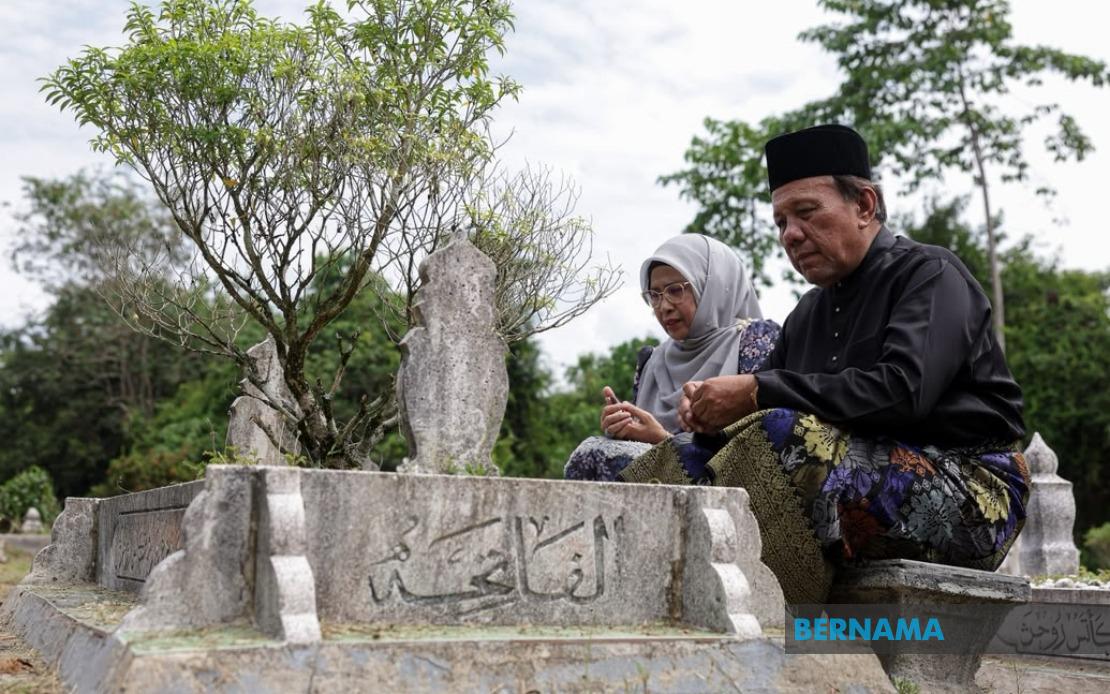
Datuk Ismail Lasim made a poignant visit to his family's burial site in Kuala Pilah on August 2, merely hours after formally assuming the position of Menteri Besar of Negeri Sembilan. Accompanied by his wife, Datin Noraishah Othman, and dressed in traditional black Malay formal wear, the newly installed chief executive paid his respects at the Tebing Tinggi Muslim cemetery. The deeply personal gesture underscores a common practice among Malaysian public figures of honouring their ancestors at moments of significant personal milestone, reflecting both cultural tradition and spiritual observance.
Ismail's swearing-in ceremony took place earlier that day at Istana Besar Seri Menanti, where he took his oath before Tuanku Muhriz Tuanku Munawir, the Yang di-Pertuan Besar of Negeri Sembilan. The 47-year-old politician, who represents the Juasseh state constituency, ascended to the state's highest executive office following the successful outcome of the 16th Negeri Sembilan state election held the previous day. His appointment marks a significant development in the political landscape of the central Malaysian state.
The Juasseh representative's parents, whose graves he visited, have long since passed. His father, the late Lasim Yaman, lived to the age of 97 before his death on March 5, 2020. His mother, the late Bedah Othman, preceded her husband in passing, having died on September 16, 2014. The cemetery visit thus connected Ismail's moment of political achievement with the family legacy that shaped his life and career.
The electoral outcome that propelled Ismail to the Menteri Besar's office reflected a decisive performance by the ruling Barisan Nasional coalition across Negeri Sembilan. The BN secured 18 of the 36 state assembly seats contested, while its coalition partner Perikatan Nasional captured seven seats. This combined strength of 25 seats granted the two-coalition partnership a commanding two-thirds supermajority in the state assembly, providing substantial legislative authority to implement their agenda without reliance on opposition support.
The achievement represented a consolidation of support for the Barisan Nasional-Perikatan Nasional arrangement in Negeri Sembilan, a state that has historically served as a bellwether for broader Malaysian political trends. The formation of this coalition government follows patterns established in other Malaysian states where both major political blocs have recognised mutual benefits in formal cooperation, whether on grounds of economic stability, administrative continuity, or strategic positioning ahead of future federal-level contests.
For Malaysian observers and regional analysts, Ismail's elevation carries implications beyond Negeri Sembilan's borders. As one of Malaysia's smaller states by population and economic output, Negeri Sembilan nonetheless influences federal political calculations. The smooth transition of power and the decisive nature of the electoral mandate provide the new administration with a stable foundation to pursue state-level development initiatives, including infrastructure projects, education programmes, and economic diversification efforts that have long been on the state government's agenda.
The choice to visit his parents' graves immediately after the swearing-in ceremony reveals something about Ismail's personal character and values orientation. In Malaysian political culture, such acts carry symbolic weight, suggesting humility, spiritual grounding, and a connection to family heritage even at moments of elevated public responsibility. The timing and public nature of the cemetery visit implicitly communicate to constituents that political office, while important, remains contextualised within broader frameworks of personal and family values.
The composition of the new state cabinet, while not detailed in immediate reports following the swearing-in, would typically include appointments from both Barisan Nasional component parties and potentially from Perikatan Nasional, depending on the negotiated coalition arrangement. Such cabinet formations in states with coalition governments often reflect careful balance between the constituent parties' respective interests, demographic representation of different communities, and the experience and expertise of individual assemblymen and assemblywomen.
Looking forward, the Ismail Lasim administration faces the familiar challenges confronting Malaysian state governments: managing fiscal resources responsibly, addressing infrastructure backlogs, improving public service delivery, and responding to constituents' economic concerns in an environment of moderate growth but persistent cost-of-living pressures. The two-thirds majority provides flexibility for policy implementation but also carries expectations from both coalition partners and the general electorate for tangible improvements in governance and development outcomes.
The August 2 ceremonies and their ceremonial aftermath represent the formal conclusion of Negeri Sembilan's electoral process and the formal commencement of a new administration. In the weeks and months following, the substance of that administration's performance would gradually become apparent through budget allocations, policy announcements, and the quality of governance delivered to the state's 1.1 million residents. Ismail's initial actions, including the respectful tribute to his parents, establish a foundational tone for his tenure as the state's chief executive.

