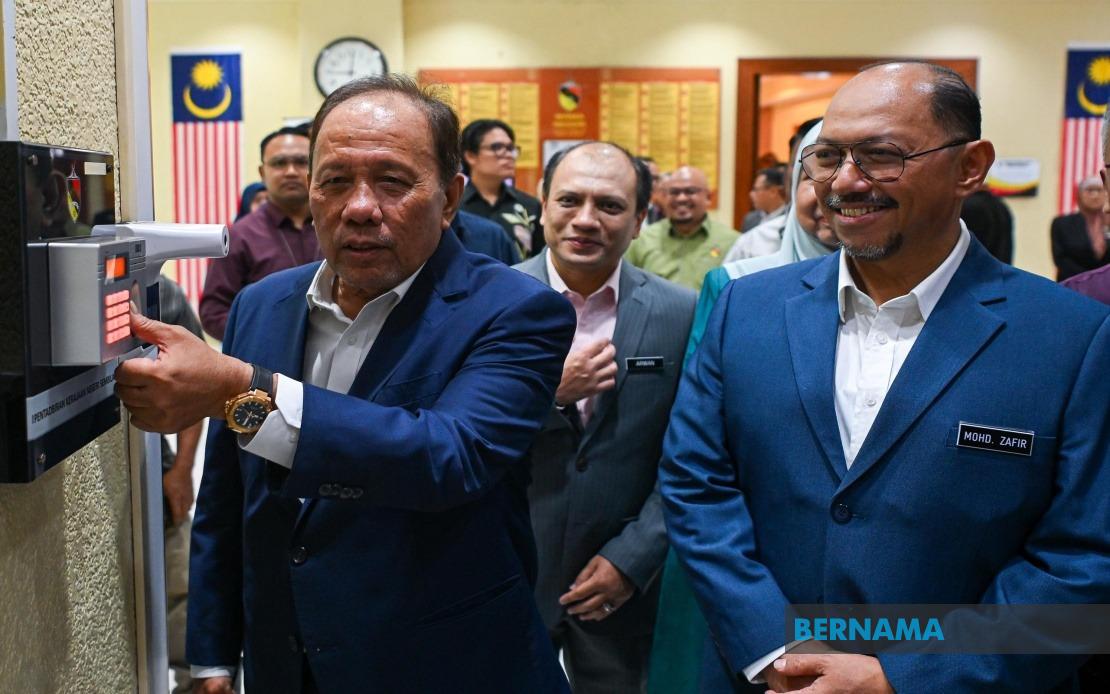
Negeri Sembilan's newly installed Menteri Besar Ismail Lasim has moved swiftly to defend the legitimacy of his appointment, insisting that the process adhered strictly to established protocols and constitutional requirements. Speaking to journalists at Wisma Negeri in Seremban on Monday, Lasim emphasised that his elevation to the state's top executive position reflected proper adherence to prescribed procedures, a statement that directly addressed mounting questions about the circumstances surrounding his assumption of office.
The defensive posture adopted by Lasim comes in response to a public challenge mounted by Tan Sri Rais Yatim, chairman of Wawasan, who has cast doubt on the legitimacy of the appointment process. Rais Yatim's concerns extend beyond procedural propriety, encompassing allegations that external forces may have improperly influenced decisions relating to Negeri Sembilan's constitutional arrangements and customary practices. Such accusations, if substantiated, could undermine public confidence in the state administration during its formative weeks.
Lasim's appointment trajectory has been notably swift. He secured the Juasseh state constituency seat during Negeri Sembilan's recent state election and was subsequently sworn before Yang Dipertuan Besar Tuanku Muhriz Tuanku Munawir at the Istana Besar Seri Menanti in a ceremony conducted the preceding Sunday. The compressed timeline between his electoral victory and assumption of the Menteri Besar position may have contributed to perceptions that procedures were either expedited or potentially circumvented, though Lasim's public assertion suggests all constitutional steps were properly observed.
The electoral context provides essential backdrop to understanding the appointment's significance. Barisan Nasional emerged as the dominant political force in the state election, capturing 18 of the 36 available seats and securing a strong working majority. Perikatan Nasional, the opposition coalition, managed to capture seven seats, leaving them substantially outnumbered. Together, both major coalitions command the two-thirds supermajority required to control state legislative business, a comfortable parliamentary position that typically presages stable governance.
For Malaysian observers, the Negeri Sembilan situation reflects broader tensions within the country's federal system regarding the appropriate balance between state autonomy and centrally orchestrated political arrangements. Questions about whether Lasim's appointment reflected genuine consensus among elected BN representatives or external direction from party headquarters in Kuala Lumpur carry implications extending beyond the state's boundaries. The involvement of Rais Yatim, a nationally prominent figure with independent political standing, suggests this is being perceived as a matter of broader constitutional significance rather than parochial state politics.
The specific allegations concerning interference with matters touching on state customs and constitutional provisions are particularly sensitive in Malaysian federalism. Negeri Sembilan maintains distinctive constitutional arrangements, including the role of the Yang Dipertuan Besar as a constituent monarch exercising real constitutional powers beyond the ceremonial functions assigned to rulers in other states. Any perception that these institutions are being subordinated to external political pressures could destabilise the delicate constitutional consensus that has underpinned the federation's stability.
Lasim's response strategy appears calculated to establish his authority and legitimacy from the outset of his tenure. By publicly reaffirming adherence to procedures and inviting scrutiny of the appointment process, he positions himself as someone with confidence in the institutional framework that elevated him to office. This rhetorical positioning may prove essential for maintaining the support of state legislators and, importantly, in preserving the dignity and prerogatives of the Yang Dipertuan Besar, whose constitutional role would be compromised if his appointment decisions were perceived as subject to external manipulation.
The opposition's decision to challenge the appointment process through public commentary rather than through formal constitutional mechanisms suggests they lack the legislative numbers to mount a serious challenge to Lasim's hold on office. With Barisan Nasional's commanding majority, any motion of no confidence would fail decisively. Instead, Rais Yatim's intervention appears designed to establish a record questioning the legitimacy of the appointment and potentially to mobilise public opinion against what he characterises as unconstitutional interference.
For the broader Malaysian political landscape, this episode illustrates ongoing tensions within the post-2018 reconfiguration of political coalitions and power distribution. Barisan Nasional's recovery of strength in state-level politics represents a significant development, yet questions persist about whether this reflects genuine electoral support or reflects behind-the-scenes dealmaking between national political actors. Negeri Sembilan's situation will be closely watched by analysts seeking to understand whether Malaysian politics is stabilising around new institutional arrangements or whether fundamental constitutional questions remain unresolved.
Lasim's early weeks in office will likely involve careful attention to demonstrating that his administration operates with full legitimacy and constitutional propriety. Any further suggestions of irregularity could undermine his authority and complicate governance during a period when building consensus around state priorities should be paramount. The appointment controversy also serves as a reminder that Malaysian federalism, despite its long historical trajectory, continues to grapple with questions about the appropriate distribution of power between national parties and state governments, between elected legislatures and traditional institutions, and between procedural regularity and substantive democratic legitimacy.

