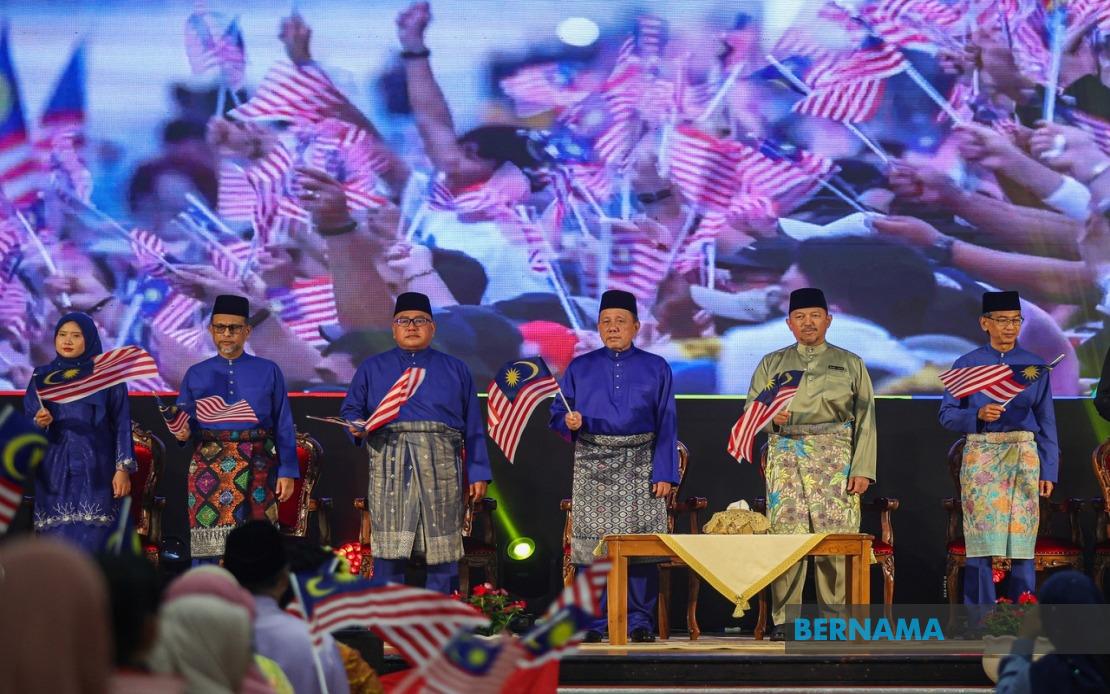
Negeri Sembilan Menteri Besar Datuk Ismail Lasim has articulated an ambitious development framework centred on institutional stability, broad-based progress and inclusive prosperity, positioning these three elements as the guiding philosophy for his new administration. Speaking at the State-Level Public Servants Assembly in Seremban, Ismail stressed that these pillars would shape how the state government navigates public expectations, streamlines its bureaucracy and enhances living standards across the state's diverse communities.
The emphasis on institutional stability reflects a deliberate pivot away from fragile political majorities that have historically characterised some Malaysian state governments. Ismail's vision prioritises the durability of constitutional frameworks, administrative systems and the state's monarchical traditions—elements he argues form the structural foundation upon which public confidence and investor trust must be built. This approach suggests recognition that sustainable development requires more than electoral dominance; it demands resilience in institutions that outlast any single administration or political cycle.
Central to this framework is the notion that progress should transcend narrow economic metrics. Rather than chasing headline gross domestic product figures alone, Ismail advocated for a development model that generates meaningful opportunities across sectors while maintaining rigorous standards for investment quality. This positioning matters for Negeri Sembilan, a state historically dependent on manufacturing, services and agricultural sectors, as it signals intention to attract investment that builds genuine competitive advantage rather than merely extracting quick returns.
The geographical equity component of Ismail's agenda carries particular weight for a state where urban-rural disparities have created pockets of inequality. By explicitly naming Felda settlements and rural areas as requiring parity with major urban centres, the administration acknowledges that prosperity concentrated in Seremban and surrounding towns leaves significant populations behind. This commitment reflects both political necessity and economic sense—rural areas represent untapped potential for agricultural value addition and agro-tourism development, sectors increasingly important as Malaysia repositions its economy.
Financial performance indicators suggest the state is tracking reasonably well. Negeri Sembilan's revenue reached RM522.4 million to date, with the administration targeting RM1 billion by 2030—a doubling in a decade that would require sustained growth and possibly improved tax collection efficiency. The state's GDP grew 2.6 per cent year-on-year to RM55.8 billion, a modest but positive trajectory driven by services and manufacturing. These figures position Negeri Sembilan as a mid-tier performer among Malaysian states, trailing larger economies like Selangor and Johor but maintaining reasonable growth relative to national averages.
The newly appointed State Executive Council represents, by Ismail's characterisation, a blend of experience and fresh perspective. The composition of such bodies typically reflects intra-party negotiations and political considerations, yet their effectiveness ultimately depends on genuine collaboration with the permanent bureaucracy. Ismail's appeal for partnership between elected officials and public servants suggests awareness that state development hinges on executing policy through a civil service that often possesses deeper institutional memory and technical expertise than elected members.
Youth employment features prominently in Ismail's development calculus, addressing a demographic reality across Southeast Asia where young people constitute an increasingly educated yet underemployed cohort. By channelling economic growth toward job creation for younger citizens, Negeri Sembilan can potentially stem brain drain to more developed states and reduce social pressures that arise when qualified graduates face limited career prospects in their home states. This has regional implications, as states that successfully retain talent create innovation ecosystems and accumulate human capital advantages.
The agricultural and rural economic sectors receive explicit attention within this framework, recognising that despite Malaysia's middle-income status, primary production remains crucial for rural livelihoods and food security. Strategic development of these sectors—through value addition, cooperative structures and technology adoption—could transform subsistence-level farming into commercially viable enterprises that anchor rural communities economically and socially.
Ismail's invocation of the Jalur Gemilang campaign alongside substantive governance priorities reflects an understanding that nation-building operates simultaneously on symbolic and material registers. National Day celebrations carry particular resonance following periodic political uncertainties at the federal level, and state-level reaffirmation of national cohesion through widespread flag-flying serves to reinforce constitutional order and civic unity at the grassroots level.
The reference to managing expectations of more than 1.2 million citizens signals realistic acknowledgment of the constraints facing state administrations. Negeri Sembilan's population, while significant, remains relatively small compared to major states, which affects both revenue capacity and the scale of projects that can be undertaken independently. This demographic reality shapes what is politically and financially feasible and explains why attracting quality external investment features centrally in the development strategy.
Looking forward, the success of this three-pillar approach depends on translating rhetoric into measurable outcomes. Institutional stability requires insulating state institutions from partisan pressures—a challenge in Malaysian politics where federalism sometimes appears to function as an extension of national political competition. Progress and prosperity demand sustained policy focus even as electoral cycles shift political attention, and balanced development requires resisting the concentrated investment patterns that typically favour economically productive urban areas over dispersed rural improvements.
For Malaysian and Southeast Asian observers, Negeri Sembilan's stated direction offers a template for how smaller or mid-tier states might construct development narratives that transcend simplistic growth metrics. By integrating institutional durability, inclusive economic expansion and geographic equity, the administration articulates a vision that acknowledges both aspirations and constraints—a realistic approach that may prove more sustainable than more grandiose blueprints that frequently falter when confronted with political and fiscal realities.

