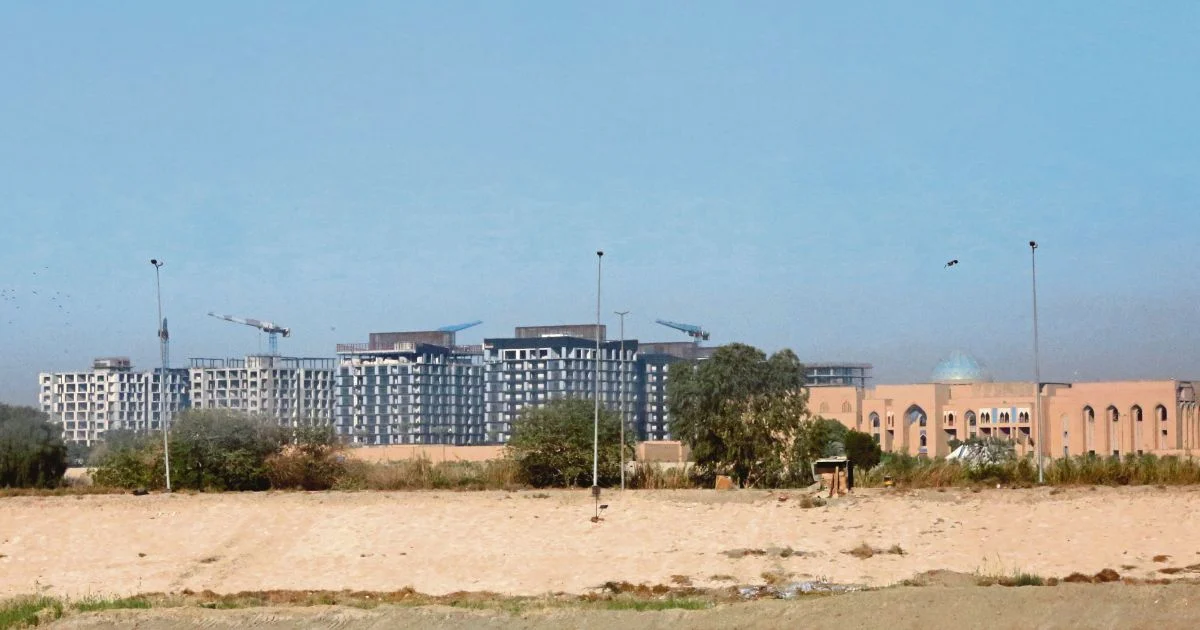
Iraqi security forces descended on Baghdad's heavily protected Green Zone in the early hours of Sunday with coordinated raids targeting multiple officials and elected representatives suspected of involvement in corruption schemes. The operation represented a significant escalation in the government's anti-graft efforts, with security personnel deployed densely throughout the compound as they carried out arrests and detention procedures across several government buildings and official residences.
The Green Zone, officially known as the International Zone, serves as the physical heart of Iraqi governance and diplomacy. Located along the Tigris River in central Baghdad, it houses the parliament building, the offices of the Prime Minister and various government ministries, as well as the heavily fortified compounds of numerous diplomatic missions. The zone's status as a secured enclave makes operations within its perimeter relatively unusual, lending particular weight to the scale and coordination evident in Sunday's raids. When security operations target these premises, they signal determined action at the highest levels of state authority.
Among those targeted were members of parliament, signalling that the inquiry extends beyond ordinary bureaucratic officeholders to include the legislative branch itself. Parliamentarians facing corruption allegations represent a particular challenge for any government seeking to demonstrate institutional reform, as such individuals typically enjoy parliamentary immunity protections. The decision to proceed with detentions despite these legal complexities underscores official determination to pursue high-profile corruption cases regardless of the political sensitivity involved.
The specific allegations driving the operation remain partially opaque, though Iraqi media reports indicate investigations focus on embezzlement, bribery, and misappropriation of public funds across multiple government agencies. The timing of the raids suggests coordination between security and investigative bodies, pointing toward sustained intelligence gathering that culminated in Sunday's enforcement action. For Malaysian observers monitoring governance challenges across the Middle East, the operation offers insights into how regional governments attempt to address systemic corruption whilst navigating deeply entrenched patronage networks.
Corruption represents one of Iraq's most intractable governance challenges. Years of conflict, institutional weakness, and political fragmentation have created environments where illicit enrichment flourishes at multiple administrative levels. International transparency watchdogs consistently rank Iraq poorly on corruption perception indices, a reality that undermines public confidence in institutions and complicates reconstruction efforts. The government's willingness to conduct visible enforcement operations in the Green Zone itself suggests recognition that corruption at senior levels demands public demonstration of accountability.
The heavy security deployment reported during the raids reflects both the operational challenge of detaining officials and the political sensitivity of such actions. Multiple security agencies likely coordinated the operation to prevent advance warning or obstruction. Such coordination remains relatively unusual in Iraqi security architecture, where different entities frequently operate under competing political patronage networks. The visible nature of Sunday's operation—with deployments noticeable enough to draw media coverage—also serves communicative functions, signalling to the public and to international observers that authorities are taking action against high-level wrongdoing.
For Iraq's government, such operations carry substantial political risk. Officials facing corruption charges often command factional support within parliament and among armed groups operating throughout the country. Detaining them may provoke retaliation through various channels, from parliamentary obstruction to more direct pressure. Successive Iraqi governments have launched anti-corruption campaigns with mixed results, with some initiatives fading when political costs mounted. The current operation's sustainability remains uncertain, though its scale suggests commitment extending beyond performative gestures.
International partners, including the United States and international financial institutions supporting Iraq's recovery, generally applaud visible anti-corruption enforcement. Such operations feature prominently in the narratives Iraq projects to justify reconstruction assistance and international engagement. However, observers distinguish between genuine institutional reform and selective prosecutions targeting political rivals. The comprehensiveness of Sunday's operation—detaining multiple officials across different agencies—suggests broader investigation rather than narrowly targeted political revenge, though such determinations require assessment of actual charges as cases develop.
For Southeast Asian nations engaging with Iraq on trade, diplomatic, and security matters, governance questions hold material significance. States considering investments in Iraqi reconstruction or deepening economic ties inevitably factor institutional reliability and rule-of-law performance into risk assessments. Highly visible corruption at senior levels complicates such calculations, making effective enforcement responses important for Iraq's regional positioning. Malaysia and other ASEAN members maintain diplomatic representation in Baghdad and economic interests in Iraqi reconstruction, rendering developments in Iraqi governance legitimacy relevant to the region's broader engagement strategies.
The operation also reflects evolving dynamics within Iraq's political landscape. Recent electoral results and intra-elite competition have created conditions where anti-corruption initiatives gain political currency as different factions seek advantage. Whether Sunday's raids represent genuine institutional development or tactical maneuvering within Iraq's fractious political ecosystem will become clearer as specific cases proceed through judicial processes. The detention of multiple officials nonetheless signals that corruption accountability has moved from aspirational rhetoric to active enforcement, distinguishing this moment from prolonged periods when corrupt officials operated with near-total impunity.

