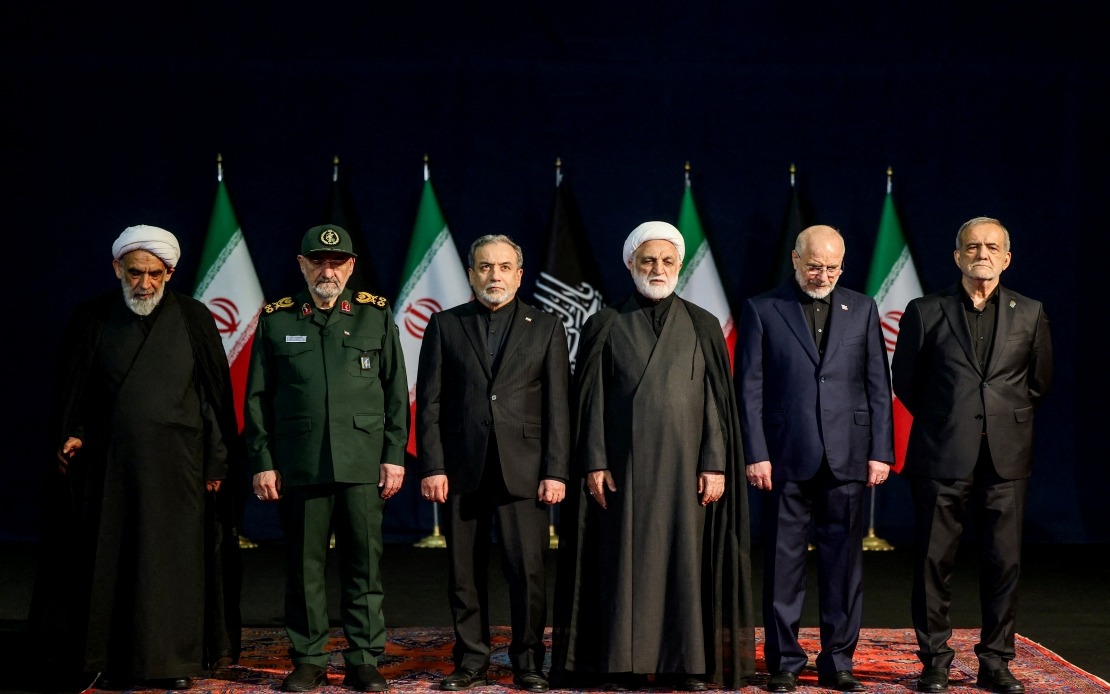
The death of Iran's Supreme Leader Ayatollah Ali Khamenei has triggered one of the Islamic Republic's most significant state ceremonies, with high-ranking officials from across Asia gathering in Tehran on Friday to pay their respects at a formal tribute event. The ceremony, held at Imam Khomeini's Mosalla prayer hall in central Tehran, underscored the global diplomatic dimensions of Iran's internal succession and the geopolitical interest in its political transition during a volatile period for the Middle East.
The gathering drew the full spectrum of Iran's political establishment, reflecting the gravity of the moment for the nation's leadership. Iranian President Masoud Pezeshkian, Parliament Speaker Mohammad Baqer Qalibaf, Judiciary Chief Gholamhossein Mohseni-Ejei, and Sadeq Amoli Larijani, who chairs the Expediency Discernment Council, all participated in the morning observance that extended throughout the day. Their unified presence conveyed a deliberate message of continuity and institutional stability at a moment when Iran's power structures faced potential upheaval.
The international dimension of the ceremony proved particularly striking, demonstrating how Khamenei's death has reverberated beyond Iran's borders and attracted attention from major regional and global actors. Pakistan sent both Prime Minister Shehbaz Sharif and Chief of Army Staff Field Marshal Syed Asim Munir, signalling the importance Islamabad places on its strategic relationship with Tehran. The presence of multiple heads of state, parliamentary speakers, and cabinet ministers from neighbouring countries reflected the interconnected nature of Middle Eastern and South Asian geopolitics, where Iran occupies a pivotal position.
Among the foreign dignitaries were Armenian Prime Minister Nikol Pashinyan and Georgian President Mikheil Kavelashvili, representing the South Caucasus states that have complex relationships with Iran spanning energy cooperation and regional security concerns. Iraqi President Nizar Amedi and Nechirvan Barzani, president of Iraq's Kurdistan Region, underscored Iran's deep influence within Iraq's political system and Kurdish affairs. Tajik President Emomali Rahmon's attendance highlighted the Central Asian dimension of Iran's strategic reach, whilst delegations from China and Russia—both major power players in the region—signalled their respective interests in Iran's political direction during an already tense international environment.
Beyond the formal state apparatus, the ceremony drew religious scholars, tribal leaders, and other figures integral to Iran's traditional power structures. This broader representation emphasized that Khamenei's passing was being treated not merely as an administrative transition but as a moment affecting the wider fabric of Iran's society and its position within Islamic leadership globally. The mixture of secular political figures, military commanders, and religious authorities reflected the hybrid nature of Iran's Islamic Republic governance model.
The timing and extended duration of the mourning observances reveal the deliberate pace at which Iran's authorities are managing the succession process. Funeral ceremonies are scheduled to continue through July 9, with major processions planned for Tehran, Qom, and Mashhad—the three cities most symbolically significant to Iran's Shia Islamic heritage and revolutionary identity. Additional rites are planned in Iraq, where Iran maintains substantial religious and political influence. This multi-city, multi-day approach allows maximum public participation and demonstrates the institutional nature of the transition.
Iranian authorities have imposed significant logistical measures to manage the ceremonial period, including public closures and airspace restrictions in Tehran and Mashhad during key dates. Thursday was declared a day of national mourning across the country, effectively halting normal business operations and signalling the gravity of the moment. These measures serve both practical functions—managing crowds and security—and symbolic purposes, emphasizing to the population and international observers the historical significance of the event.
Khamenei's death itself, occurring during a February 28 strike attributed to the United States and Israel, had already created uncertainty about Iran's succession arrangements and its capacity to maintain unified decision-making during a period of heightened regional tensions. The swift selection of his son, Mojtaba Khamenei, as the new Supreme Leader in March provided institutional continuity, but the formal tribute ceremony in July represented the first major opportunity for the regime to publicly demonstrate cohesion and stable transition mechanics to both domestic and international audiences.
For Malaysia and Southeast Asian observers, the ceremony illustrates how leadership transitions in major regional powers can attract participation from countries across Asia, reflecting the interconnected nature of contemporary geopolitics. The gathering of leaders from Pakistan, the Caucasus, the Middle East, and Central Asia—alongside delegations from Beijing and Moscow—demonstrates that Iran's internal affairs have immediate relevance for broader Asian strategic calculations. The ceremony's emphasis on institutional continuity, religious legitimacy, and international diplomatic recognition suggests that Iran's new leadership intends to project stability and maintain the nation's strategic partnerships during what could have been a destabilizing period.
The extended mourning period and international attendance also reflect changing norms around state funerals in the region, where ostentatious displays of international support serve as political statements about a nation's standing and influence. For Iran's new Supreme Leader, the attendance of multiple neighbouring heads of state provides crucial legitimacy both domestically and internationally, suggesting that major regional powers view the transition as manageable and that Iran's role in regional affairs will continue substantially unchanged. This calculated performance of continuity will likely dominate international perceptions of Iran's political transition in the months ahead.

