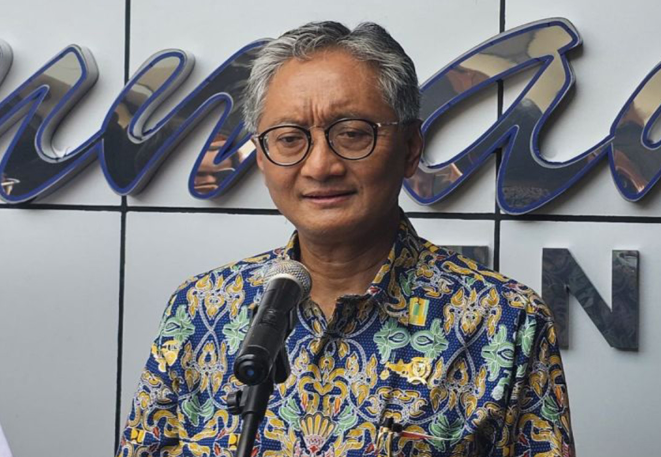
Indonesia's Public Works Ministry faces mounting internal instability following the public exposure of a confidential travel authorization that listed Minister Dody Hanggodo's wife and daughter among delegates scheduled for a July work trip to New York. The leaked document, which circulated widely on social media beginning early this month, detailed plans for eight officials to attend a United Nations body meeting from July 13 to 19, with the core UN sessions scheduled for July 16 and 17. The inclusion of family members Irma Hermawati and Aurellia Tsabitha Meidirama on the official delegation—approved in a June 29 memo by the ministry's secretary-general Apri Artoto—triggered immediate public backlash over the apparent misallocation of state resources and prompted the government to abandon the entire trip.
The revelation has become emblematic of broader tensions within the ministry's hierarchy. Almost immediately after the document went viral, unverified claims flooded social media alleging that Dody had orchestrated the reassignment of several officials to regional postings, predominantly in locations beyond Java, as a deliberate punishment for those believed responsible for the leak. These allegations point to a pattern of internal retaliation that, if substantiated, would represent a serious breach of civil service principles and proper administrative conduct. The timing of the transfers—occurring within days of the document's public exposure—lent credence to public suspicion, even as the minister categorically denied the allegation.
When pressed by journalists on Wednesday, Dody refused to characterize the personnel moves as retaliatory, instead invoking the scale of his bureaucratic authority. "I have 38,600 employees, why shouldn't I be allowed to reassign them?" he responded, according to reporting by Kompas.com. The rhetorical defense, while technically accurate regarding a minister's formal powers, sidestepped the substantive concern about the apparent nexus between the leak and the subsequent transfers. His refusal to engage more directly with the timing question has only intensified speculation among observers that the ministry's leadership is engaging in institutional retaliation. The episode underscores how even routine administrative decisions can become politically radioactive in an environment already characterized by deep mistrust.
During a formal press briefing on July 7, Apri attempted damage control by reframing the family members' inclusion as a logistical necessity rather than an act of favoritism. He stated that listing the minister's wife and daughter was required to facilitate visa processing through the Foreign Ministry, while simultaneously pledging that no state funds would finance their actual participation in the conference. This dual-track explanation—acknowledging their names on the manifest while asserting no taxpayer money would support their attendance—struck many observers as unconvincing, since the inclusion itself on an official delegation creates precedent and perception issues independent of whether budget lines explicitly covered their expenses. Apri also committed to identifying the source of the leak and threatened legal action against any official found responsible for unauthorized disclosure, a promise that has itself stoked concern about potential workplace retaliation disguised as security protocol enforcement.
The turbulence at the Public Works Ministry must be understood against the backdrop of Dody's tenure since taking office in October 2024. The 60-year-old Democratic Party politician, whose background spans engineering and business interests linked to South Kalimantan entrepreneur Andi "Haji Isam" Syamsuddin Arsyad, has initiated multiple rounds of sweeping personnel reorganization. Social media audits have documented the reassignment of more than one hundred ministry employees across his brief tenure, spanning from senior director-general positions down through lower-ranking civil service ranks. This constant churn at virtually every organizational level has created an atmosphere of perpetual uncertainty and institutional instability that extends far beyond the current controversy surrounding the travel document.
The most recent major restructuring occurred in May, when Dody appointed seven senior officials to new positions, including elevating Apri to the secretary-general role—the ministry's second-highest position—displacing his predecessor Wida Nurfaida after she had served for less than a year. That prior transition itself had followed another significant shake-up in July 2025, revealing a pattern of rapid leadership churn at the top tiers of the ministry's hierarchy. Each successive wave of reorganization compounds employee anxiety and reduces institutional memory and continuity in policy implementation. Lawmakers monitoring the ministry have begun expressing alarm about the cumulative effects of these constant reassignments on the organization's actual capacity to deliver infrastructure projects and public works services.
Representatives in Indonesia's House of Representatives have started raising formal concerns about the ministry's internal dysfunction. During a June meeting of Commission V, which oversees infrastructure matters, legislator Yasto Soepredjo Mokoagow of the Indonesian Democratic Party of Struggle (PDI-P) articulated the workforce's growing paralysis. He noted that disciplinary measures, including demotions of directors to non-structural administrative posts, had fostered widespread employee anxiety that was actively hampering program execution. "Civil servants at the ministry are now afraid to carry out programs," Mokoagow stated on June 11, warning that such a climate of fear would obstruct the implementation of critical public works initiatives. His comments reflect a growing legislative recognition that the ministry's internal turmoil is transitioning from a management issue into a public policy problem with real consequences for infrastructure development across Indonesia.
Dody's justification for the repeated reorganizations centers on his assertion that a "deep state" apparatus has metastasized within the ministry, eating away at its institutional integrity like termites hollowing out wood. According to his account, rooting out this alleged embedded resistance requires continuous structural reorganization and personnel reassignment. However, the vagueness of this "deep state" concept—never clearly defined in terms of specific policy disagreements or organizational obstacles—has raised questions about whether the frequent reshuffling reflects genuine institutional reform or represents an attempt to consolidate power through personnel loyalty. The minister has not articulated what concrete policy outcomes his reorganizations have achieved or prevented, making it difficult to evaluate whether the disruption serves stated institutional purposes.
Adding to the ministry's credibility problems, several senior officials have become ensnared in a significant corruption investigation involving water resources projects. In June, the Jakarta High Prosecutor's Office named multiple suspects in connection with the case, including the ministry's former water resources director-general Dwi Purwantoro and Yosiandi Radi Wicaksono, who previously served as acting irrigation and swamp director. The emergence of major corruption allegations affecting figures at the ministry's senior echelons strengthens the argument that institutional oversight requires thorough investigation and potential restructuring. Yet it simultaneously creates an environment where observers struggle to distinguish between legitimate anti-corruption efforts and potential abuse of disciplinary authority for factional purposes. When asked about the corruption investigation, Dody publicly committed to non-interference and pledged support for law enforcement proceedings against his subordinates, statements that may prove easier to maintain if the investigation remains distant from his immediate circle.
The ministry's dysfunction has extended into public perceptions of Dody's personal management style and leadership temperament. Video footage that has resurfaced on social media depicts the minister in contentious interactions with subordinates during ministry visits and inspections. One particularly notable recording from an April site visit to a school construction project in East Java showed Dody verbally confronting an employee, complete with finger-pointing, over what he characterized as "dumb excuses" for implementation delays or quality issues. While holding subordinates accountable for performance represents a legitimate ministerial prerogative, the public nature of such rebukes and the aggressive tone captured on video have contributed to the perception of a leadership culture characterized by intimidation rather than collaborative problem-solving. These informal recordings, spreading through social media far more readily than official ministry communications, shape public and institutional perception of the ministry's internal atmosphere more powerfully than any press release.
The convergence of these multiple crises—the travel document leak and alleged family favoritism, subsequent staff transfers and retaliation allegations, ongoing corruption investigations, and documented incidents of harsh managerial conduct—paints a portrait of a major ministry in significant institutional distress. For Malaysian observers and policymakers engaged in bilateral cooperation on infrastructure projects and development partnerships with Indonesia, these internal divisions at the Public Works Ministry raise practical questions about implementation reliability and chain-of-custody issues for collaborative initiatives. The ministry's preoccupation with internal power struggles and personnel management creates potential obstacles to the execution of joint programs and the honoring of bilateral commitments. Southeast Asia's infrastructure development agenda depends on stable, professional civil service institutions in partner nations, and the deteriorating conditions at Indonesia's Public Works Ministry merit careful monitoring by regional governments assessing the reliability of their Indonesian counterparts for ongoing and future infrastructure collaborations.

