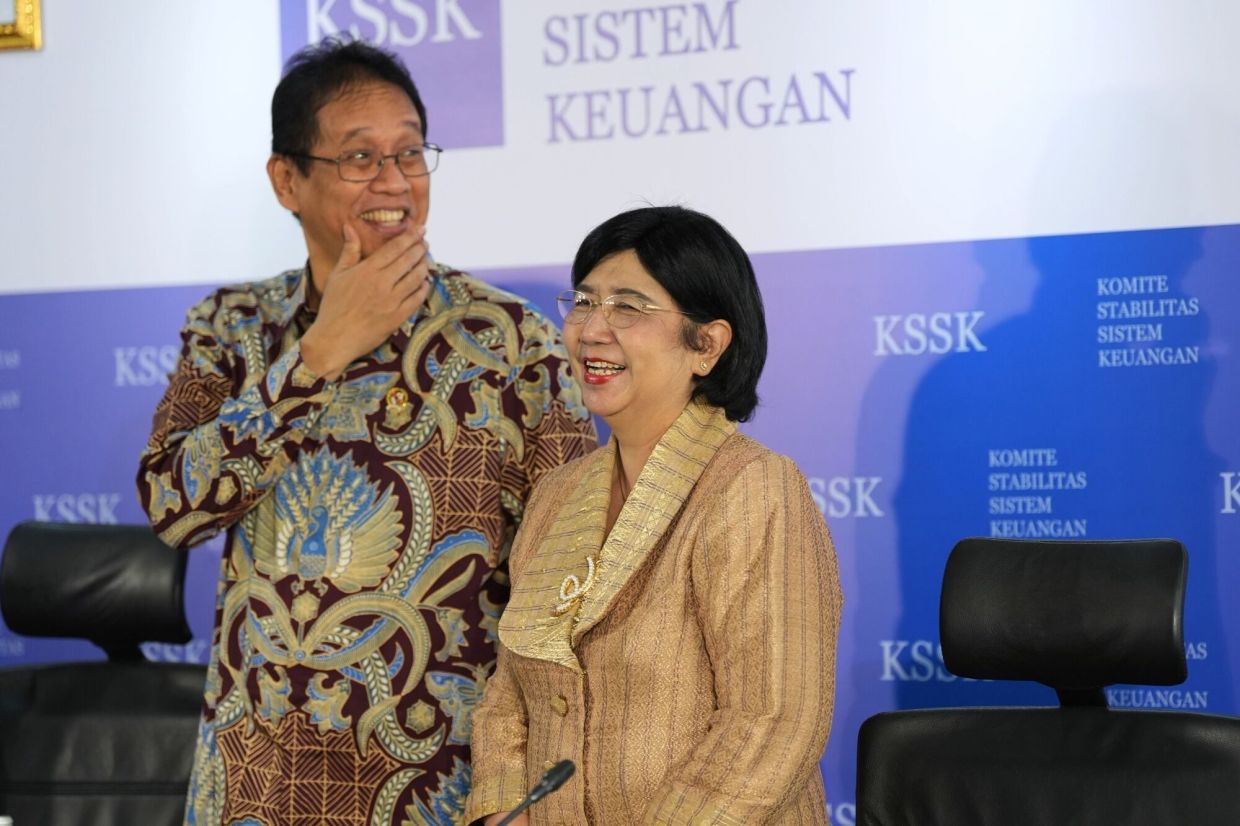
Indonesia's central bank has a new leader, and her first moves suggest a notably warmer relationship with government than her predecessor maintained. Destry Damayanti, appointed as acting governor of Bank Indonesia just two weeks ago, wasted no time signalling a collaborative approach by visiting Finance Minister Purbaya Yudhi Sadewa's office on her appointment day, before proceeding to the presidential palace. The symbolic gesture of scheduling a dedicated one-on-one meeting with the finance minister set an immediate tone that differed sharply from the more formal, institution-to-institution dealings that characterised the tenure of her predecessor, Perry Warjiyo, whose engagements with the ministry were typically orchestrated through broader government settings or regulatory committees.
President Prabowo Subianto has now formally nominated Destry as the sole candidate for the governorship, pending parliamentary approval. The appointment reflects a calculated presidential strategy to secure a central banker who combines market credibility with alignment to his administration's economic priorities. Destry's two-decade track record—including her role as deputy governor since 2019, her position as chief economist at PT Bank Mandiri, and her tenure at the Indonesia Deposit Insurance Corporation—presents her as a seasoned technocrat rather than a political appointee. Yet her professional proximity to Finance Minister Purbaya, who previously led the deposit insurer, adds another layer to what analysts view as a carefully constructed balance between institutional independence and policy coordination.
The stakes for this appointment extend well beyond Jakarta's corridors of power. Investors have grown increasingly concerned about the trajectory of Indonesia's currency and economic management under Prabowo's administration. The rupiah has deteriorated roughly 6 percent against the dollar so far this year, marking the poorest performance among Asian currencies and reflecting deeper anxieties about policy direction. These concerns stem partly from the president's populist initiatives—including universal free school meals and expanded state involvement in commodity markets—which credit rating agencies have flagged as sources of policy uncertainty. Both Fitch Ratings and Moody's have placed Indonesia's sovereign debt on negative watch, though S&P Global Ratings maintains a stable outlook, creating a somewhat mixed but decidedly cautious investor sentiment.
Destry's initial appointment triggered a modest positive market response. The rupiah extended gains to reach its strongest level against the dollar in a month, and Malaysian and other regional currency traders took note of the currency's outperformance relative to Asian peers more broadly. This reaction suggests that financial markets view her appointment as a potential stabilising force—a signal that technical competence and institutional credibility might be reasserting themselves in policy formation. Economists at Citigroup and other major institutions have expressed measured optimism, with analysts expecting policy continuity and a focus on currency stability. However, this cautious optimism is tempered by recognition that the broader institutional environment remains volatile and that Destry's real test lies ahead.
The central challenge confronting Destry involves reconciling two potentially conflicting mandates. President Prabowo has explicitly set an economic growth target of 8 percent by 2029, a figure that would require sustained fiscal stimulus and accommodative monetary conditions. Yet maintaining currency stability, containing inflation, and preserving financial system health typically demand more restrictive policies, particularly in an environment of rising global interest rates and a strengthening US dollar. Under Warjiyo's leadership, Bank Indonesia deployed a sophisticated multi-instrument approach, raising benchmark rates three times since May while simultaneously intervening in foreign exchange markets and deploying non-rate tools to support credit provision and economic activity. This juggling act requires consummate technical skill and, critically, institutional autonomy to make decisions based on economic data rather than political preferences.
Malaysian observers and regional investors should recognise that Indonesia's monetary policy decisions carry important spillover implications for Southeast Asia. The rupiah's movements affect regional trade flows, investment patterns, and currency stability more broadly. A central bank that subordinates monetary decisions to growth politics risks triggering currency volatility that would ripple through ASEAN economies and potentially complicate Malaysia's own monetary policy management. Conversely, a BI that maintains genuine independence—whilst genuinely coordinating with fiscal authorities—provides reassurance to the entire region about policy predictability and financial stability.
Irman Faiz, chief economist at PT Bank Danamon, has articulated the essential tension facing Destry with particular clarity: coordination between monetary and fiscal authorities is necessary and desirable, but policy subordination is not. This formulation captures the narrow pathway Destry must navigate. She must demonstrate willingness to work constructively with the finance minister and presidential office—indeed, her warmer relationship with Minister Purbaya may facilitate more effective policy coordination in practical terms. Simultaneously, she must establish credible boundaries around monetary decision-making, ensuring that interest rate decisions, liquidity management, and currency intervention reflect assessments of inflation, financial stability, and external vulnerabilities rather than growth targets.
Destry's credentials provide some foundation for investor confidence. Her educational background—an economics degree from the University of Indonesia and a master's in regional science from Cornell University—represents solid technical training. Her engagement with investor and analyst communities has been regular and substantive, suggesting she understands the importance of managing market expectations and maintaining communication channels with capital markets. These relationships could prove valuable if she needs to defend unpopular policy decisions or explain the rationale behind rate increases or currency intervention that might disappoint growth-focused policymakers.
Yet credentials alone cannot guarantee success. Global conditions continue to tighten the constraints within which any Indonesian central banker must operate. Rising interest rates in developed economies pull capital away from emerging markets, placing downward pressure on the rupiah regardless of BI's domestic policy choices. The strong US dollar, reflecting both Federal Reserve tightening and geopolitical risk premiums, creates headwinds for all Asian currencies. Against this challenging external backdrop, Destry must achieve domestic inflation control—which has remained relatively subdued—while simultaneously addressing President Prabowo's growth ambitions and the rupiah instability that has already alarmed investors and rating agencies.
Fakhrul Fulvian, chief economist at PT Trimegah Sekuritas Indonesia, has articulated an important perspective on the longer-term agenda confronting the central bank. Whilst preserving the stability achieved under Warjiyo remains essential, Destry should recognise that her mandate extends beyond mere preservation. The central bank must translate existing stability into improved liquidity conditions, normalisation of the yield curve that has become distorted by policy uncertainty, stronger transmission of monetary policy into real economic activity, and restoration of private-sector confidence in the investment climate. This positive agenda—moving beyond defensiveness toward genuine institutional strengthening—may paradoxically be essential to reconciling the tension between autonomy and growth objectives.
The parliamentary approval process for Destry's nomination will provide the first formal opportunity for political scrutiny of her vision for the central bank. This proceeding could illuminate how policymakers across the political spectrum view the appropriate relationship between monetary authority and elected government. Should parliament approve her nomination—as appears likely given the presidential backing—Destry's early months in office will be closely watched not merely in Jakarta but across Southeast Asia and among international investors who view Indonesia's monetary policy as a barometer for emerging market stability more broadly.

