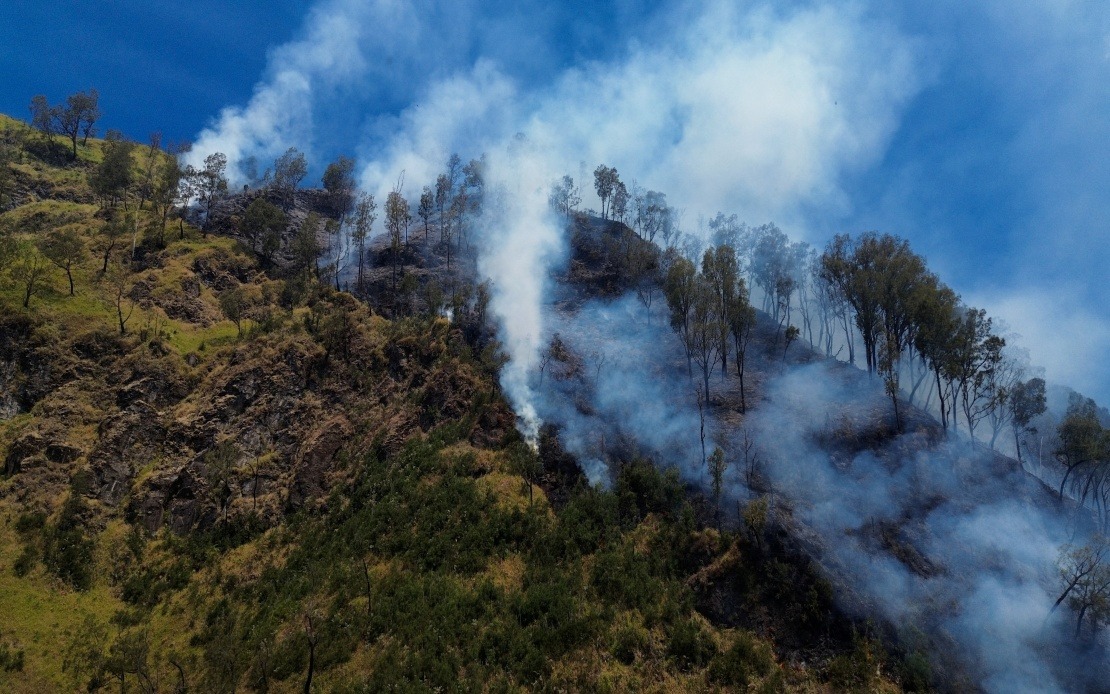
Indonesia's renowned Mount Bromo volcano has been completely sealed off from visitors as authorities intensify their response to a spreading forest fire that has engulfed large sections of the East Java landscape. The closure, implemented by the Bromo Tengger Semeru National Park authority at 10 pm on Saturday, represents a significant disruption to one of Southeast Asia's most visited natural attractions, where thousands of domestic and international tourists typically arrive daily to witness the iconic smoking crater and panoramic highland vistas.
The decision to suspend all tourism operations indefinitely stems from the urgent need to prioritise firefighting efforts and protect visitor safety as flames continue to advance across the Bromo Caldera region. The affected access points encompass five entry routes that serve the sprawling national park: Cemorolawang in Probolinggo Regency, Wonokitri in Pasuruan Regency, Jemplang and Coban Trisula in Malang Regency, and Senduro in Lumajang Regency. This comprehensive shutdown underscores the severity of the situation, as authorities have determined that maintaining any public access would significantly hamper containment operations and expose visitors to dangerous conditions.
The wildfire, which ignited on Monday, has already devastated an estimated 176.20 hectares of forest and vegetation across Probolinggo and Malang regencies, according to data released by the National Disaster Management Agency. Abdul Muhari, head of the disaster agency's information centre, reported that active hotspots were still releasing substantial smoke plumes as of Saturday evening, with monitoring teams continuing round-the-clock surveillance despite moderate wind conditions that could potentially accelerate fire spread. The persistence of burning areas highlights the challenging terrain and vegetation density that characterises the national park, where volcanic soil and endemic flora create a complex firefighting environment.
Government response has mobilised considerable aerial resources to combat the blaze, with two water-carrying helicopters—each capable of transporting 1,000 litres per sortie—deployed to support ground-based crews. The coordination between regional authorities and national disaster agencies reflects recognition of the scale and complexity of containing a fire in such a geographically significant and ecologically sensitive location. However, the continued presence of hotspots suggests that despite these interventions, the fire remains active and potentially unpredictable in its advancement patterns.
For the tourism industry, the closure represents a substantial economic impact. The Bromo Tengger Semeru National Park attracts considerable visitor numbers throughout the year, with August typically falling within the peak tourism season. Travellers who have already purchased online tickets for the closure period will be offered flexibility through rescheduling options or full refunds, a measure designed to mitigate financial losses for both tourists and tourism operators who depend on steady visitor flows. However, such compensation does little to address the broader economic ripple effects across the regional tourism ecosystem, including hotels, restaurants, and guide services that rely on park access.
The Mount Bromo incident is not an isolated event within Indonesia's current environmental crisis. Simultaneously, a separate forest fire has struck Mount Rinjani National Park in East Lombok Regency, approximately 400 kilometres away. This blaze, which consumed an estimated 30 hectares in the Sembalun Resort area, was brought under control early Saturday morning after igniting Friday evening. While the Rinjani fire has been successfully contained, its occurrence within the same timeframe as the Bromo conflagration points to broader seasonal fire vulnerabilities across Indonesia's volcanic and forest regions during the dry season.
Investigators are currently examining the origins of both the Bromo and Rinjani fires, with causes remaining officially undetermined. The timing and location of these incidents invite scrutiny regarding whether they resulted from natural phenomena such as spontaneous combustion in dry conditions, human negligence from activities within the parks, or deliberate fire-setting. Such investigations are crucial not only for accountability but also for implementing preventative measures ahead of future fire seasons, particularly as climate change patterns appear to be intensifying dry periods across Indonesian territories.
The closure of Mount Bromo carries implications extending beyond immediate tourism disruption. The national park represents an irreplaceable ecosystem harbouring endemic species and geological features of global scientific significance. Uncontrolled fire can permanently alter vegetation composition, increase soil erosion on volcanic slopes, and degrade habitats for wildlife populations that have adapted to specific ecological niches within the caldera region. Environmental recovery from such incidents can require years or decades, even with dedicated restoration efforts.
For Malaysian visitors and operators accustomed to regular access to Mount Bromo—a popular destination featured in many Southeast Asian tour itineraries—the closure signals the need for contingency planning and alternative destinations. Regional tourism boards may leverage this disruption to promote comparable volcanic attractions elsewhere, including destinations within Malaysia itself. The incident also serves as a reminder of the environmental vulnerabilities that characterise popular tourism hotspots across Southeast Asia, where climate pressures and human activity increasingly intersect with natural fire-prone ecosystems.
The timeline for reopening Mount Bromo remains uncertain, with authorities indicating that the closure will persist until firefighting operations conclude and conditions stabilise. This indefinite status reflects the unpredictable nature of large-scale forest fires in tropical environments, where weather patterns, terrain complexity, and fuel load dynamics can rapidly shift containment prospects. Until active hotspots are fully extinguished and fire risk assessments confirm safe conditions for visitor operations, the national park will remain a restricted zone, accessible only to authorised emergency personnel and scientific monitoring teams.

