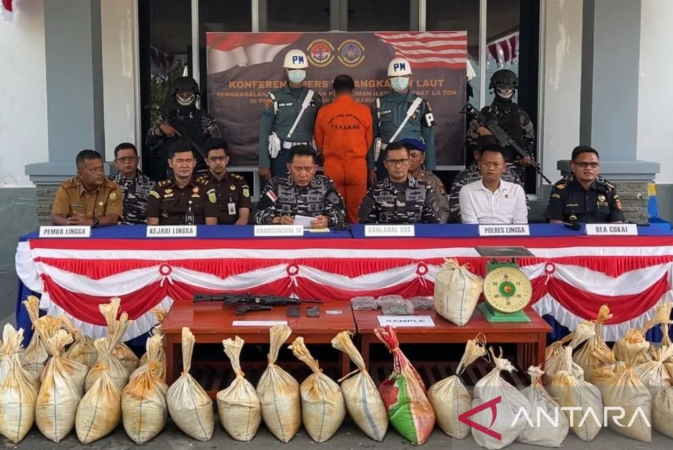
Indonesia's Navy has disrupted what appears to be a significant smuggling operation targeting Malaysia, seizing around 75.7 tonnes of illicitly mined tin sand worth approximately Rp76.04 billion (US$79,300) from the Bangka Belitung Islands, which lie off Sumatra's eastern coast. The interception marks another chapter in the persistent struggle against illegal mineral extraction in one of Southeast Asia's most resource-rich but vulnerable regions, where inadequately patrolled seas and porous borders create opportunities for organised smuggling syndicates.
The initial discovery came when Indonesian naval officers stopped a truck laden with approximately eight tonnes of tin sand at a jetty in East Belitung on August 2. Rather than treating this as an isolated incident, authorities recognised it as a potential thread in a larger tapestry of illegal activity and initiated comprehensive follow-up investigations. Vice Admiral Denih Hendrata, chief of the Indonesian Fleet Command, explained during a press conference in Tanjungpandan, Belitung, that the Navy's methodical approach transformed a single seizure into a sprawling operation that would eventually uncover the full extent of the operation.
Subsequent raids proved the initial instinct correct. On August 3, investigators descended on Lenggang village and recovered approximately 50 tonnes of tin sand, a haul substantially larger than the initial seizure. Two days later, operations uncovered another 10 tonnes carefully packed into 200 sacks at an undisclosed location. The discoveries continued on August 8 with the seizure of an additional five tonnes, bringing the cumulative total to the reported 75.7 tonnes. The staggered nature of these discoveries suggests a distributed storage and distribution network designed to minimise detection risk and compartmentalise operations.
Denih emphasised that the investigation extended well beyond simple cargo interception, noting that authorities deliberately expanded the scope to map out the criminal network and identify all participants in the smuggling chain. This approach reflects an evolution in maritime law enforcement philosophy, where disrupting supply chains requires understanding not just what is being moved, but who moves it, how they coordinate, and who ultimately receives the contraband. The complexity of such networks, particularly in tin-rich regions where legitimate and illegitimate mining operations coexist, demands sophisticated investigative work.
At the time of Hendrata's public statements, no individual suspects had been formally named or arrested, though investigations had already spread across five separate locations. This cautious approach suggests authorities were still gathering evidence and potentially attempting to prevent suspects from destroying documents or fleeing. The deliberate withholding of names also indicates coordination between multiple enforcement agencies that must align their investigative timelines before making public accusations that could compromise ongoing prosecutions.
Tin sand, the raw material from which tin is extracted, has emerged as a particularly attractive smuggling commodity because it occupies a murky regulatory space. Mining operations throughout Indonesia frequently exploit ambiguities in classification to move material without proper licensing or taxation. Malaysia, as a major global tin processor and consumer, represents a lucrative destination where illegally sourced tin can be integrated into supply chains that eventually feed legitimate smelters and manufacturers. The price differential between unregulated Indonesian extraction and formal Malaysian processing creates powerful financial incentives for smugglers.
Authorities have initiated laboratory analysis to determine the precise mineral composition and quality of the seized material, a technical step that helps establish market value and strengthens any eventual prosecution. The testing also serves an intelligence function, potentially revealing where the tin sand originated within the Bangka Belitung Islands and distinguishing between different mining operations' distinctive mineral signatures. Such forensic analysis has become increasingly important in maritime smuggling cases where precise identification of sources can expose broader environmental and regulatory violations.
Hendrata acknowledged that effectively combating the smuggling network would require cross-border cooperation with Malaysia, recognising a fundamental truth about Southeast Asian maritime crime: national borders mean little to criminal syndicates that operate across them routinely. Tracing the full extent of the operation and identifying the ultimate recipients in destination countries demands intelligence sharing, joint investigations, and coordinated enforcement actions that transcend bilateral boundaries. Malaysia's role as both a transshipment hub and end-user market makes it an essential partner in such investigations.
The seizure underscores persistent vulnerabilities in Indonesia's maritime governance despite significant Navy investments. The Bangka Belitung Islands, traditionally dependent on tin mining, have seen illegal extraction flourish as commodity prices fluctuate and formal mining operations struggle with regulation compliance costs. The region's geography—scattered islands, numerous landing points, and limited permanent enforcement presence—creates enforcement challenges that overwhelm available resources. Smugglers exploit these gaps by operating on shifting schedules and routes.
For Malaysia, the interception carries implications beyond the immediate commodity value. Malaysia's tin industry, particularly smelting and processing facilities, faces increasing pressure from environmental groups and trade partners to demonstrate supply chain integrity and commitment to responsible sourcing. The discovery of large illegal shipments destined for Malaysian markets underscores the gap between industry aspirations and ground-level realities, potentially complicating Malaysia's efforts to market itself as a responsible source of processed tin in global supply chains.
The broader regional context reveals why such smuggling persists despite enforcement efforts. Artisanal and small-scale mining across Southeast Asia generates substantial informal income for rural communities, creating constituencies resistant to stricter regulation. Larger smuggling operations leverage this social tolerance while exploiting bureaucratic inefficiencies and corruption. Stopping such operations requires not just interdiction capability but also addressing the economic vulnerabilities that make smuggling attractive to both operators and communities hosting illegal mining sites.
The investigation's expansion across multiple locations and potential cross-border dimensions suggests authorities are taking a strategic rather than tactical approach to the problem. Success will depend not merely on prosecuting individual smugglers but on dismantling the commercial relationships, transportation infrastructure, and financial mechanisms that enable systematic illegal tin sand movement to Malaysia. The coming weeks will reveal whether the initial seizure represents an isolated victory or the opening salvo in a sustained campaign against organised mineral smuggling in the region.

