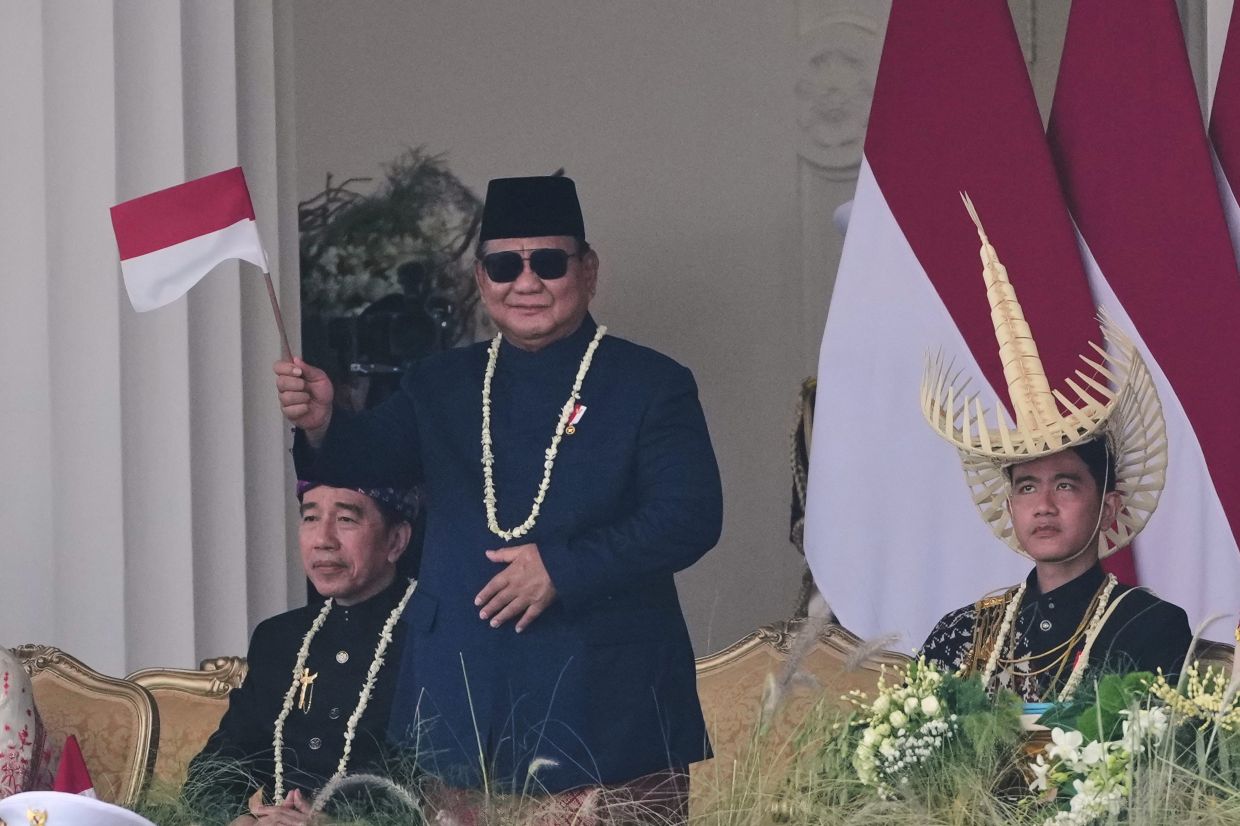
President Prabowo Subianto presided over Indonesia's 81st Independence Day commemoration in Jakarta on Monday, August 17, conducting the nation's flag-hoisting ceremony at Merdeka Palace while the country grappled with the aftermath of a catastrophic earthquake that struck Flores Island in East Nusa Tenggara (NTT) just two days earlier. The timing of the independence celebration underscored the dual reality facing Indonesia: a solemn moment for national reflection coupled with an urgent humanitarian crisis demanding government attention across multiple fronts.
The president appeared in formal traditional dress, sporting a navy beskap paired with a black peci and adorned with a jasmine garland as he assumed his role as the ceremony's official inspector. The Jakarta commemoration unfolded through a carefully choreographed sequence of cultural performances and a ceremonial parade, featuring a gilded carriage bearing a replica of Indonesia's iconic red-and-white flag alongside the original text of the country's historic proclamation of independence. The carriage processed from the National Monument to Merdeka Palace under the protection of 114 cavalry troops and 45 motorcycle-mounted military police officers drawn from the presidential security contingent.
Despite the celebratory pageantry, the ceremony's atmosphere remained subdued and reflective. President Prabowo led attendees in a moment of silence to honour the contributions and sacrifices of Indonesia's national heroes, and he specifically urged the gathered crowd to offer prayers for fellow citizens affected by recent natural disasters. This gesture acknowledged the elephant in the room—the tragedy unfolding hundreds of kilometres away that had already claimed dozens of lives and upended the existence of thousands more.
The earthquake that struck Flores early Saturday morning proved among the region's most devastating seismic events in recent memory. The 7.7-magnitude quake unleashed tremendous destruction across the island, killing 53 people and damaging or destroying hundreds of residential and commercial structures. The initial shock triggered a cascade of aftershocks, with the National Disaster Mitigation Agency (BNPB) documenting nearly 1,000 tremors of varying intensities rippling through the area in the days following. The scale of displacement was equally alarming, with approximately 5,400 residents forced to abandon their homes as structural damage rendered buildings unsafe for habitation. Health officials reported more than 130 injured persons, the majority suffering fractures and broken bones consistent with collapsed buildings and falling debris.
The seismic activity persisted even as the nation observed Independence Day. On Monday morning—the very day of the Jakarta ceremony—another significant earthquake registering 5.8 magnitude struck in the waters near Flores, occurring at a depth of 10 kilometres with its epicentre positioned roughly 39 kilometres north of NTT according to measurements from the Meteorology, Climatology and Geophysics Agency (BMKG). This continued trembling heightened anxiety among survivors and complicated rescue and recovery operations, as aftershocks of such magnitude posed dangers to both rescue workers and partially collapsed structures still housing trapped persons.
The earthquake's impact resonated directly in the capital's Independence Day proceedings. State Secretary Prasetyo Hadi revealed that several cabinet ministers had deliberately absented themselves from the Jakarta ceremony to maintain direct oversight of the disaster response effort in NTT. This absence included Coordinating Human Development Minister Pratikno, Home Minister Tito Karnavian, Public Works Minister Dody Hanggodo, and Deputy Health Minister Benjamin Paulus Octavianus—senior officials whose departmental responsibilities covered crucial aspects of emergency management, infrastructure assessment, and medical coordination.
Prasetyo framed the ministerial absences not as a diminishment of the Independence Day occasion, but rather as an expression of national solidarity. He stated that the celebration of independence carried a corresponding responsibility to ensure that affected citizens received proper care and support during their moment of greatest vulnerability. This framing reflected a deliberate policy choice: acknowledging that patriotic duty extended beyond ceremonial observance to encompass the practical protection and relief of fellow nationals facing acute suffering.
When questioned whether President Prabowo himself might travel to NTT to survey the damage and console victims—a customary executive response to major disasters—Prasetyo indicated that no final decision had been made. He cautioned that authorities would first assess the evolving situation on the ground before determining whether a presidential visit was feasible or advisable. The statement suggested that officials were prioritising operational considerations, potentially concerned about whether a high-level presidential delegation might complicate ongoing rescue efforts or divert resources from emergency response operations.
The Flores earthquake presents a significant challenge for the Prabowo administration, which took office only weeks before the disaster struck. The government's handling of the response will likely define public perception of the new presidency's competence in managing national crises. The decisions made in these early days regarding resource allocation, coordination between agencies, and the balance between ceremonial obligations and emergency response will set precedents for how future disasters are addressed.
For the broader region, the Flores earthquake serves as a sobering reminder of Southeast Asia's precarious location along the Pacific Ring of Fire. Indonesia, positioned along multiple tectonic plate boundaries, faces recurring seismic hazards that demand continuous investment in early warning systems, building code enforcement, and disaster preparedness infrastructure. The scale of displacement and injury from this single earthquake highlights vulnerabilities in rural and semi-rural disaster response capabilities, issues that extend across much of Southeast Asia where population density in vulnerable zones remains high despite known seismic risks.
The commemoration of independence amid catastrophe also reflected deeper tensions inherent in governing an archipelago as geographically dispersed and demographically diverse as Indonesia. The ability to simultaneously conduct national ceremonies while managing humanitarian emergencies across distant provinces tests governmental coordination and resource allocation. Success requires not just the commitment of senior officials but also functional administrative systems capable of responding at speed to sudden crises—a capacity that remains inconsistently developed across Indonesia's various regions.
As the nation proceeded with its Independence Day rituals, the contrast between Jakarta's controlled pageantry and Flores's ongoing suffering underscored the challenges facing any Indonesian government. The coming weeks would reveal whether the administration's prioritisation of emergency response over ceremonial grandeur translated into effective relief and reconstruction, setting the tone for how this administration would be remembered in managing the inevitable disasters that geography and geology will continue to impose upon the archipelago.

