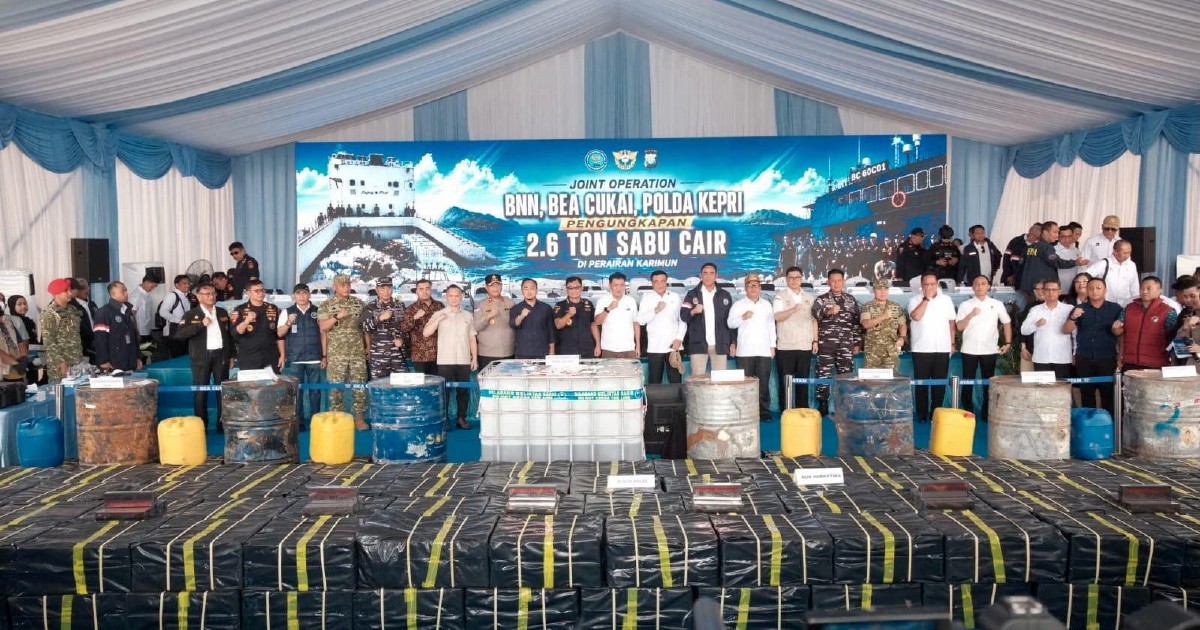
Indonesian law enforcement has apprehended 10 nationals from Myanmar in connection with one of the region's largest liquid methamphetamine seizures, authorities announced Friday. The haul of 2.6 metric tonnes discovered aboard a vessel flying a Tanzanian flag underscores the persistent challenge Southeast Asian nations face combating transnational drug trafficking networks that exploit maritime routes and vessel registrations from distant countries.
The operation reflects Indonesia's intensifying efforts to interdict synthetic drug flows passing through its territorial waters and ports. Liquid methamphetamine represents a particularly dangerous form of illicit narcotics, as its concentrated state allows traffickers to move greater quantities with less visible bulk than crystal or powder formulations. The discovery of such a substantial shipment aboard a single vessel illustrates how criminal syndicates employ industrial-scale production and distribution methods to saturate regional markets.
The use of a Tanzanian-flagged ship highlights a recurring tactic among transnational criminal organisations: registering vessels under flags of convenience from distant nations with weaker regulatory oversight or corruption vulnerabilities. This practice complicates enforcement by creating jurisdictional ambiguities and reducing the likelihood that port state authorities will conduct rigorous inspections. Indonesian officials have increasingly focused on disrupting these maritime trafficking corridors, recognising that many synthetic drugs entering Southeast Asian countries originate from clandestine laboratories in Myanmar's border regions.
Myanmar's role as a major production hub for methamphetamine has intensified significantly over the past decade, driven by conflicts that have destabilised rural areas and created ungoverned spaces where criminal enterprises operate with minimal state interference. The country's porous borders and established smuggling networks make it a natural transit point for drugs destined for Indonesia, Malaysia, Thailand, and ultimately Australia and other markets. The arrest of 10 Myanmar nationals suggests this particular trafficking operation involved direct participation from source country operatives rather than relying solely on intermediaries.
For Indonesian authorities, this seizure represents visible progress in their drug war, providing tangible evidence of interdiction capabilities to communities affected by methamphetamine addiction. Indonesia faces severe public health consequences from synthetic drug proliferation, with methamphetamine use concentrated among younger demographics in urban centres. Each major seizure removes stock intended for local distribution networks and disrupts supply chains that feed addiction across the archipelago.
The operation's success also underscores the importance of Indonesia's maritime surveillance capabilities and port security protocols. As Southeast Asia's largest nation by area and population, Indonesia must police vast ocean expanses and numerous shipping lanes where smugglers routinely attempt to penetrate. Enhanced cooperation between naval forces, coast guard units, and customs authorities has gradually improved detection rates, though enormous volumes of legitimate cargo still provide cover for illicit shipments.
Regional drug enforcement agencies have strengthened intelligence sharing and joint operations in recent years, recognising that unilateral efforts prove insufficient against networks spanning multiple countries. The Tanzanian vessel incident exemplifies how trafficking routes have internationalised, with criminal organisations recruiting crew members and operatives from various nations to evade detection by any single country's security apparatus. Indonesian cooperation with international partners, including information exchanges with Tanzanian authorities regarding vessel registration anomalies, helps identify suspicious maritime activity.
The arrested individuals now face serious narcotics charges under Indonesian law, which carries severe penalties including lengthy prison sentences for trafficking offences involving large quantities. The legal proceedings will likely extend over months or years, during which investigators will attempt to extract information about supply chains, distribution networks, laboratory locations in Myanmar, and customer networks throughout Southeast Asia. Such intelligence proves invaluable for law enforcement agencies seeking to map criminal organisations and identify key nexus points for disruption.
Beyond the immediate arrests and seizure, this incident illustrates the broader context of drug production migration within the region. As enforcement pressure intensifies in some areas, criminal enterprises relocate operations or adjust trafficking routes, often establishing new production facilities in remote Myanmar border zones. The international community faces a complex challenge: addressing the underlying factors driving production, including rural poverty, conflict, and governance failures, while simultaneously interdicting active smuggling operations through enhanced border security and maritime surveillance.
Indonesia's announcement of this major bust reflects pressure from multiple directions—domestic demand for results in its drug war, regional expectations for security cooperation, and international scrutiny of Southeast Asia's role in global illicit drug markets. The seizure and arrests provide temporary relief, removing a significant shipment from distribution networks and incapacitating operatives. However, without complementary efforts addressing production sites, corruption enabling trafficking, and addiction treatment capacity, such enforcement victories remain episodic responses to a fundamentally structural problem affecting multiple nations throughout Southeast Asia.

