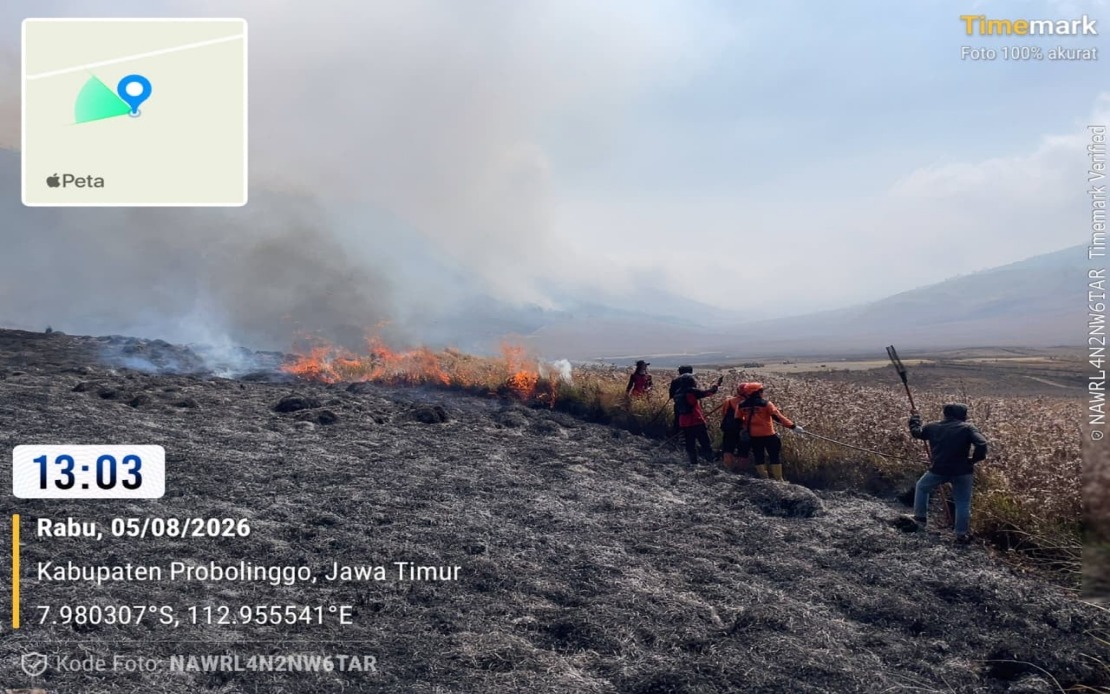
A significant wildfire at Mount Bromo in East Java has prompted Indonesian disaster management authorities to mobilise aerial firefighting resources, underscoring the escalating environmental challenges facing the volcano's fragile ecosystem. The blaze, which ignited on Monday, has spread across approximately 60 hectares in East Java's Probolinggo and Malang regencies, with the National Disaster Management Agency (BNPB) confirming the deployment of two water-bombing helicopters to assist ground crews in extinguishing the flames. Abdul Muhari, head of the BNPB's Disaster Data, Information and Communication Centre, detailed the scale and distribution of the fire in a statement released Thursday, revealing that about 10 hectares have been scorched in Probolinggo Regency while the remaining 50 hectares span the Bromo Tengger Semeru National Park within Malang Regency.
The decision to deploy aerial assets reflects the operational challenges posed by Mount Bromo's topography. Ground-based firefighting teams have struggled to access hotspots located on the volcano's steep slopes, where conventional firefighting equipment proves ineffective. The helicopter water-bombing operations represent a critical escalation in response efforts, targeting these inaccessible areas that remain active despite earlier progress in containing the main fire front. By Wednesday afternoon, authorities had brought most of the blaze under control through coordinated ground efforts, yet persistent hotspots continued to threaten further spread throughout the night and into Thursday.
Beyond the immediate aerial intervention, Indonesian disaster authorities are preparing additional countermeasures to complement existing firefighting strategies. The BNPB is preparing a Weather Modification Operation, contingent upon atmospheric conditions proving favourable for implementation. This technique, which has been employed in previous Indonesian wildfire situations, involves seeding clouds to induce rainfall over affected areas, potentially accelerating containment efforts. Such operations require precise meteorological windows and represent a significant commitment of resources and expertise by Indonesia's disaster management apparatus.
The ongoing emergency has forced the Bromo Tengger Semeru National Park Authority to implement partial closures across the Mount Bromo tourist area, restricting visitor access until further notice. This decision, while disruptive to the tourism sector that heavily depends on Mount Bromo's accessibility, prioritises firefighting operations and safeguards public safety. The national park remains one of East Java's premier tourist attractions, and prolonged closures carry economic implications for the surrounding communities dependent on visitor spending. The temporary restrictions demonstrate the severity authorities perceive regarding the ongoing threat.
Investigations into the fire's origin have tentatively pointed to abandoned camping equipment as the probable culprit, with authorities suggesting that hikers may have left their campfire insufficiently extinguished before departing the area. However, the formal investigation remains ongoing, and officials have not definitively confirmed the trigger mechanism. This preliminary assessment aligns with patterns observed in previous Indonesian wildfire incidents, where human activities in forested regions contribute disproportionately to fire initiation, particularly during dry seasons when vegetation becomes exceptionally combustible.
The Mount Bromo incident carries broader significance for Indonesia's ongoing struggle against uncontrolled wildfires, a recurring seasonal challenge that affects air quality across Southeast Asia. The volcanic landscape of East Java, while ecologically distinctive, presents particular firefighting difficulties that standard ground-based approaches frequently fail to address adequately. The concentration of this blaze within a national park underscores how protected areas remain vulnerable to environmental hazards despite their conservation status and enhanced oversight.
For Malaysia and other Southeast Asian nations, the Mount Bromo situation illustrates the transnational dimensions of wildfire management. Large-scale fires in Indonesia, particularly those affecting national parks and mountainous regions, can influence regional atmospheric conditions and air quality indexes that extend into neighbouring countries. The deployment of helicopters and consideration of weather modification operations demonstrates the technological and logistical investments required to manage landscape-scale fire emergencies in Southeast Asia's complex terrain.
The incident also highlights the tension between tourism development and environmental protection in Indonesia's premier natural attractions. Mount Bromo's accessibility and popularity make it susceptible to human-caused fires, yet restrictions on visitor access generate economic pressures on local communities. Balancing recreational access with fire prevention strategies requires ongoing coordination between national park administrators, tourism operators, and local stakeholders.
As the situation develops, the effectiveness of the helicopter water-bombing campaign will provide evidence regarding the viability of aerial firefighting for future Mount Bromo incidents. The integration of conventional ground efforts, aerial operations, and potential weather modification represents a comprehensive management approach, though the inherent challenges of volcanic terrain and seasonal fire risk suggest that preventing future ignitions through visitor education and enforcement may prove ultimately more cost-effective than emergency response measures. Indonesian authorities' multi-layered response strategy reflects lessons learned from previous environmental emergencies and demonstrates the sophistication of regional disaster management capabilities.

