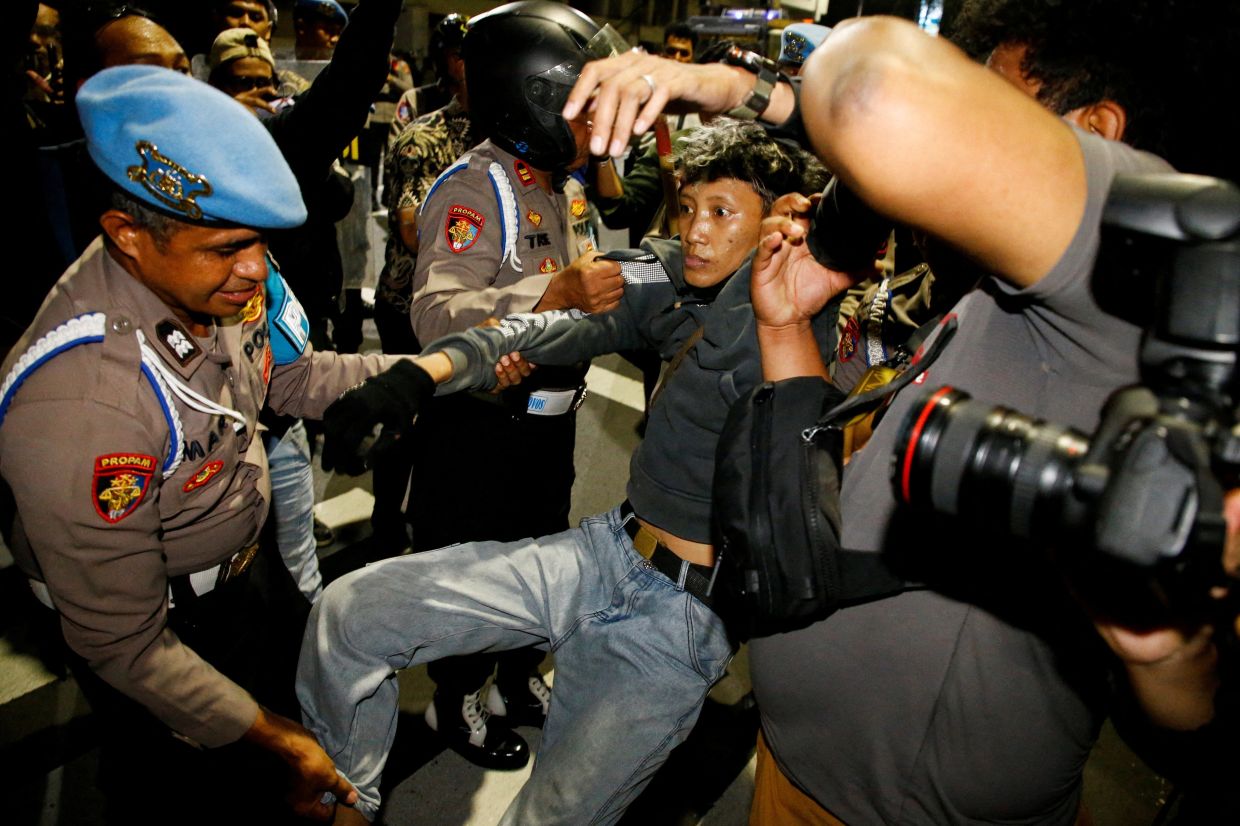
Indonesian police have initiated criminal proceedings against four individuals in connection with an anti-government rally held in Surabaya on Friday, marking the latest escalation in a broader wave of civil unrest sweeping the Southeast Asian nation. The charges were announced on Sunday by Surabaya police chief Luthfie Sulistiawan, who disclosed that the suspects face allegations of property destruction and assault against law enforcement officers. The incident underscores mounting public frustration over two major policy decisions that have destabilised the government's standing with citizens across multiple demographic groups.
The demonstration in Surabaya, Indonesia's second-largest city, drew approximately 100 participants who assembled outside a government building to voice their opposition to a substantial fuel price increase and the controversial free school meals programme. The gathering reflected broader grievances that have catalysed protests across the country's major urban centres. Eyewitnesses estimated the crowd size, with some demonstrators escalating their actions by throwing objects including firecrackers and rocks at authorities, prompting police to employ what officials characterised as "firm actions" to break up the assembly.
The government's decision to raise non-subsidised petrol prices by roughly 30 per cent earlier in June triggered the initial spark for these demonstrations. The move was framed by policymakers as a necessary fiscal measure to ease budgetary constraints amid global energy market turbulence stemming from the Middle East conflict. However, this rationale has failed to gain traction with ordinary Indonesians who depend on affordable fuel for transportation, commerce, and daily living expenses. The timing proved particularly contentious, arriving when household costs were already elevated across multiple sectors.
Indonesia's unique position as an oil-producing nation that paradoxically remains a net petroleum importer has long complicated its energy policy. Despite possessing substantial crude reserves, the country's domestic refining capacity cannot meet demand, necessitating expensive foreign purchases to supplement production. The government maintains an extensive fuel subsidy system to shield citizens from volatile global prices, yet these subsidies impose severe strain on state finances. The recent price adjustment represented an attempt to balance fiscal sustainability with political viability, though the decision ultimately failed to achieve either objective.
Beyond fuel costs, the government's free school meals initiative has crystallised public discontent into a broader movement challenging the administration's competence and integrity. Launched as a flagship programme to address child malnutrition across Indonesia's lower-income communities, the scheme quickly became ensnared in corruption allegations and food safety crises. Tens of thousands of people have reportedly fallen ill since implementation began, with investigations revealing systematic quality control failures and suspected embezzlement of programme funds. Student activists have seized on these revelations to mobilise demonstrations primarily in Jakarta, where tertiary students have organised large-scale protests demanding immediate programme suspension.
The government has already partially suspended the meals initiative following mounting pressure and documented health incidents. Yet critics contend that the multi-billion-dollar commitment remains fundamentally flawed, arguing that comprehensive reform or outright termination represents the only viable path forward. The combination of rising fuel prices and perceived mismanagement of a signature social programme has coalesced into formidable political headwinds for the administration. The convergence of these grievances across diverse constituencies—from transport workers to students to ordinary families—suggests structural dissatisfaction rather than narrow sectional complaint.
During the Surabaya incident, police arrested 24 individuals at the protest site, though authorities released the vast majority without pressing charges. The decision to formally charge only four participants while releasing others suggests selective prosecution, though official statements have not clarified the criteria for differentiation. Additionally, six detainees remain under investigation after authorities discovered traces of controlled substances in their systems, a detail that may prove contentious if prosecution proceeds without addressing questions about evidence handling and presumption of innocence.
The enforcement response reflects broader tensions between authorities' authority to maintain public order and concerns about proportionality in applying criminal law to political expression. The characterisation of the demonstrators' actions as sufficiently destructive and violent to warrant prosecution invites scrutiny, particularly given that estimates suggest only a minority of participants engaged in object-throwing. Such selective charging could harden public opinion against the government if perceived as punishment for dissent rather than legitimate law enforcement.
For Malaysia and other Southeast Asian nations observing Indonesia's domestic turmoil, the situation carries implications for regional stability and economic dynamics. Fuel price volatility in the region's largest economy inevitably influences neighbouring markets and cross-border commerce. Moreover, sustained civil unrest in Jakarta and other cities could dampen investor confidence across the region and complicate diplomatic engagement. The underlying issues—managing subsidy systems, combating institutional corruption, ensuring food safety in mass programmes—represent challenges common to developing Southeast Asian states grappling with rapid urbanisation and competing fiscal demands.
The incident in Surabaya also reflects Indonesia's ongoing navigation of democratic participation and internal security priorities. As a substantial democracy with constitutionally guaranteed protest rights, Indonesia must balance citizens' freedom to assemble with legitimate governmental needs to prevent violence and property damage. The charges announced by police suggest authorities are attempting to draw that line by prosecuting individuals alleged to have crossed from peaceful demonstration into property destruction. Whether this calibration satisfies public expectations for both accountability and respect for civil liberties remains an open question as additional charges loom and the political situation continues evolving.

