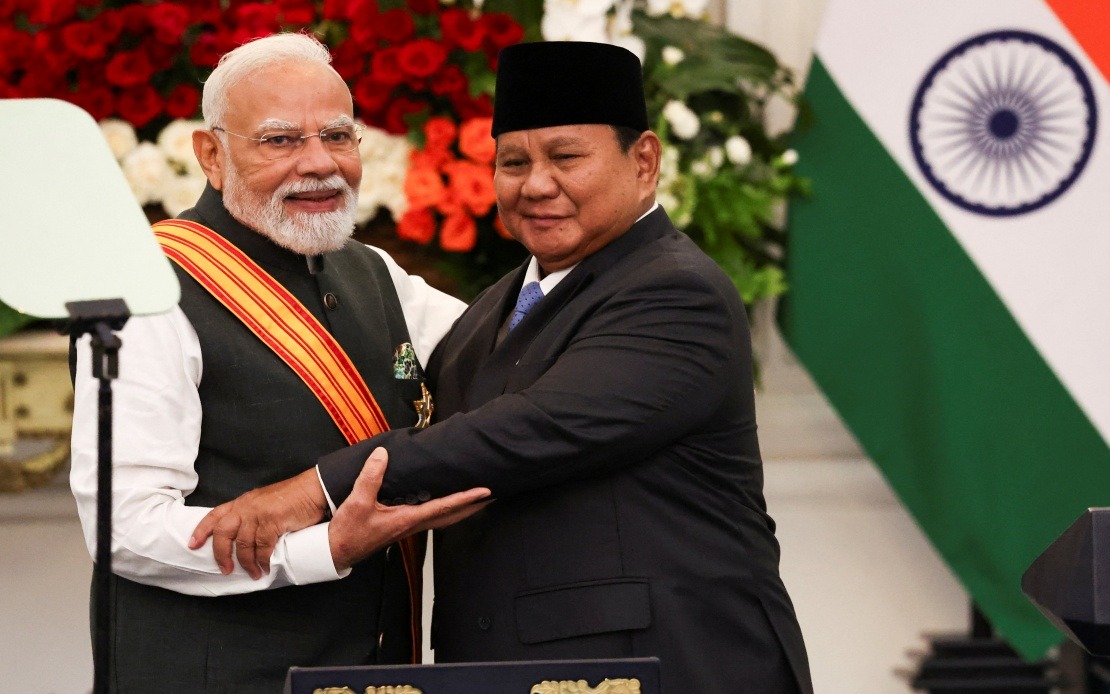
Indonesia's President Prabowo Subianto has conferred the nation's most prestigious award on Indian Prime Minister Narendra Modi, an honour that underscores the strategic importance both countries place on their relationship. The conferral took place during Modi's state visit to Jakarta, marking a significant diplomatic moment for the two regional powers as they continue to recalibrate their partnership in an increasingly multipolar Asia.
Prabowo emphasised that the award recognises Modi's exceptional leadership and the tangible contributions he has made toward elevating Indonesia-India relations to the level of a Comprehensive Strategic Partnership. Speaking at a joint press conference at the Merdeka Palace following bilateral discussions, the Indonesian president highlighted Modi's ongoing commitment to fostering deeper cooperation across multiple sectors and dimensions of bilateral engagement.
The recognition also acknowledges Modi's instrumental support for various development initiatives and projects that have benefited Indonesia's economic and social progress. By framing the honour in terms of concrete developmental cooperation, Prabowo signalled that India's relationship with Indonesia extends beyond traditional diplomatic courtesies into substantive partnership on infrastructure, technology, and capacity-building efforts relevant to Southeast Asian development trajectories.
Modi's visit represents a reciprocal gesture, following Prabowo's trip to India earlier in the year. This pattern of high-level exchanges reflects both nations' determination to maintain momentum in their strategic engagement, a particularly significant undertaking given the complex geopolitical environment of the Indo-Pacific region where Indonesia and India both exercise considerable influence.
Historically, Indonesia has bestowed this highest state honour sparingly, with India's first Prime Minister Jawaharlal Nehru being among the few recipients. Prabowo noted that Nehru received the award in recognition of his pioneering role in strengthening bilateral ties and his foundational contributions to the Non-Aligned Movement, a historical parallel that positions Modi within a continuum of transformative Indian leadership from Indonesia's perspective.
The timing of this award carries particular weight given contemporary geopolitical considerations. Indonesia's pursuit of expanded participation in BRICS represents an important strategic direction, and Prabowo explicitly acknowledged India's supportive stance on this initiative. This alignment suggests that India views Indonesia's enhanced profile within BRICS as complementary to regional stability and the development of non-Western institutional frameworks.
The Comprehensive Strategic Partnership framework that both nations have adopted provides a flexible architecture for cooperation spanning defence, economic integration, maritime security, and cultural exchange. Unlike narrower bilateral frameworks, this designation signals preparedness to deepen engagement across virtually all domains of mutual interest, reflecting the multifaceted nature of contemporary state relations in Asia.
Indonesia and India share profound historical and cultural connections that predate modern nation-states, with centuries of trade, religious exchange, and intellectual influence binding their societies. Prabowo's reference to these deep foundational ties suggests that contemporary strategic cooperation, while important, is grounded in enduring civilisational commonalities that provide stability and legitimacy to the relationship.
For Malaysia and other Southeast Asian nations, the India-Indonesia partnership dynamic carries significant implications. Both countries occupy pivotal positions within ASEAN and the broader Indo-Pacific architecture, with Indonesia as the regional bloc's largest economy and most populous nation, and India as a major extra-regional power increasingly integrated into Southeast Asian strategic calculations. The strengthening of New Delhi-Jakarta ties may influence regional alignment patterns and the balance of influence among external powers competing for relevance in Southeast Asia.
Modi's state visit, elevated by this ceremonial recognition, demonstrates India's sustained commitment to Southeast Asian engagement beyond the traditional "Look East" or "Act East" policies that characterised earlier strategic formulations. Instead, it reflects a more sophisticated understanding of partnership as requiring reciprocal investment, high-level attention, and institutional depth.
The award also signals Indonesia's confidence in the durability and mutual benefit of its relationship with India, particularly as Jakarta navigates complex relationships with multiple powers. By according this exceptional honour, Prabowo reinforced Indonesia's preference for strategic autonomy while deepening specific partnerships that align with national development objectives and regional aspirations.
Looking forward, the strengthening Indonesia-India nexus may catalyse broader Southeast Asian engagement with New Delhi, potentially influencing how other regional states calibrate their relationships with India as both a development partner and geopolitical actor. The institutional depth that ceremonies like this honour represent often precedes practical cooperation initiatives across trade, defence, and technology domains.

