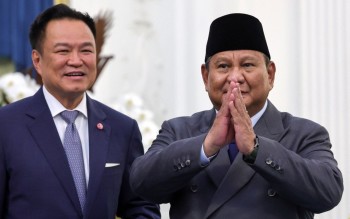
Indonesia has set its sights on achieving US$20 billion in annual bilateral trade with Thailand by 2030 following the formal adoption of a comprehensive strategic partnership roadmap during high-level talks this week. The framework agreement, which covers the period from 2026 to 2030, was sealed when Thai Prime Minister Anutin Charnvirakul visited Jakarta for his first official engagement with Indonesian leadership since assuming office last September. The accord signals renewed momentum in strengthening economic ties between Southeast Asia's two largest economies and reflects both nations' commitment to deepening their partnership beyond traditional diplomatic channels.
The meeting between President Prabowo Subianto and Prime Minister Anutin represented the second formal leaders' consultation since the two countries elevated their relationship to a full Strategic Partnership during Prabowo's visit to Bangkok in 2024. The timing of Anutin's Jakarta visit also marked a significant milestone, as it constituted the first official visit by a Thai prime minister to Indonesia in 15 years, underscoring the importance both governments place on revitalizing their bilateral engagement. At the Merdeka Palace, the two leaders reviewed progress on shared priorities and mapped out an ambitious agenda for the coming years, setting the stage for what officials hope will be a transformative period in Indonesia-Thailand cooperation.
Central to the new roadmap is the establishment of the Indonesia-Thailand Joint Trade Commission, described by Prabowo as an unprecedented institutional mechanism in the two countries' economic relationship. This body, which will operate at the commerce minister level, is designed to function as a dedicated forum for identifying business opportunities and systematically addressing trade barriers that have historically constrained bilateral commercial flows. The creation of this commission acknowledges that achieving the US$20 billion target will require sustained governmental engagement alongside private sector participation, and represents a structural shift toward more proactive trade management between the neighbours. By institutionalizing trade discussions at the ministerial level, both countries are signalling their determination to move beyond ad-hoc engagement to create lasting frameworks for economic cooperation.
Thailand currently ranks as Indonesia's fourth-largest trading partner within the ASEAN bloc, a position that Prime Minister Anutin argued understates the real potential of their combined economic weight. Anutin's comments at the bilateral meeting stressed that given the size and sophistication of both economies, current trade volumes do not adequately reflect what is achievable. This perspective challenges both governments to pursue more aggressive market-opening measures and to remove structural impediments that have prevented their trade relationship from reaching its full potential. For Malaysia and other regional players watching these developments, the Indonesia-Thailand trade push carries implications for regional supply chain dynamics and competitive positioning within ASEAN's broader economic architecture.
Food security emerged as a cornerstone of the new partnership framework, with both countries identifying significant complementarities in their agricultural sectors. Thailand has offered to maintain its role as a reliable supplier of high-quality rice to Indonesia while simultaneously seeking expanded market access for Thai agricultural products, meat, dairy goods, and farming equipment. Particularly noteworthy is Thailand's ambition to dramatically increase fertiliser imports from Indonesia, seeking to grow annual urea purchases from the current baseline of approximately 60,000 tonnes to several hundred thousand tonnes. This appetite for Indonesian fertiliser reflects both Thailand's growing agricultural demand and Indonesia's substantial production capacity, creating a natural economic partnership that could benefit farmers and agribusiness operators across both nations while strengthening regional food supply resilience in an era of global agricultural uncertainty.
Energy cooperation constitutes another pillar of the strategic roadmap, with both countries committed to convening a dedicated Indonesia-Thailand Energy Forum to fortify mutual energy security and accelerate the transition toward renewable and sustainable power generation. The forum is intended to facilitate collaboration not only at the governmental level but also between private enterprises operating in the energy sector, recognizing that the energy transition requires coordinated action across public and private domains. For a region increasingly concerned about climate change impacts and energy independence, the willingness of Indonesia and Thailand to coordinate their energy strategies carries broader significance, potentially influencing how other ASEAN members approach sustainable energy cooperation and the pace of regional decarbonization efforts.
The digital economy also features prominently in the new partnership, with particular emphasis on promoting transactions conducted in local currencies to enhance the efficiency and cost-effectiveness of bilateral trade and investment. This initiative aligns with broader regional and global movements toward reducing reliance on third-country currencies in intra-regional commerce and has potential ramifications for how other Southeast Asian partnerships structure their financial arrangements. By encouraging direct currency transactions between Indonesian rupiah and Thai baht, both countries aim to reduce foreign exchange costs, improve settlement efficiency, and foster greater integration of their financial systems. Such measures, if successfully implemented, could serve as a model for other ASEAN pairs seeking to deepen economic interdependence while reducing vulnerability to currency fluctuations.
The halal industry emerged as an unexpected but strategically important domain for cooperation, with both leaders emphasizing the potential to develop integrated regional and global halal value chains. Thailand has specifically called for renewal of the mutual recognition agreement on halal certification, which is scheduled to expire in November, underscoring the importance of maintaining unified standards and certifications across the two countries. For Muslim-majority Indonesia and Thailand, the halal industry represents not merely a commercial opportunity but also a cultural and religious endeavour that can position Southeast Asia as a leader in this expanding global market. The push to strengthen halal cooperation demonstrates how trade partnerships can transcend purely economic considerations and incorporate values-based dimensions that resonate with both societies.
Beyond the bilateral framework, the leaders welcomed several specific commercial agreements negotiated between private entities and government agencies, including a tourism and connectivity arrangement between the Tourism Authority of Thailand and TransNusa, as well as an organic waste processing initiative involving Bio-Axel and Pro Konsilium. These subsidiary agreements illustrate how strategic frameworks create enabling conditions for operational partnerships that generate tangible benefits for businesses and communities. The memorandum of understanding on education signalled recognition that long-term economic integration depends on developing human capital capable of managing increasingly complex cross-border relationships, from supply chain management to digital technology implementation.
For Malaysian observers and policymakers, the Indonesia-Thailand strategic roadmap carries several important implications. The bilateral initiative demonstrates how two major ASEAN economies are moving decisively to deepen integration, potentially reshaping regional competitive dynamics and supply chain structures. The emphasis on creating institutional mechanisms like the Joint Trade Commission suggests that informal cooperation channels may be giving way to more formal, structured arrangements. Should the Indonesia-Thailand partnership succeed in reaching its US$20 billion target, it could establish a template for how other ASEAN pairs approach bilateral economic cooperation and might prompt comparable initiatives between other member states seeking to unlock unrealised trade potential.
The roadmap's sectoral focus—encompassing food security, energy, digital economy, and halal industries—reflects shared priorities that extend beyond pure trade maximization and speak to broader regional challenges including climate change, food sovereignty, and sustainable development. As ASEAN navigates an increasingly complex geopolitical environment and seeks to maintain unity amid external pressures, examples of substantive intra-regional cooperation offer powerful counterweights to fragmentation narratives. The Indonesia-Thailand partnership, if executed successfully, could reinvigorate ASEAN's collective credibility and demonstrate that regional integration remains a viable strategy for advancing shared prosperity and resilience.

