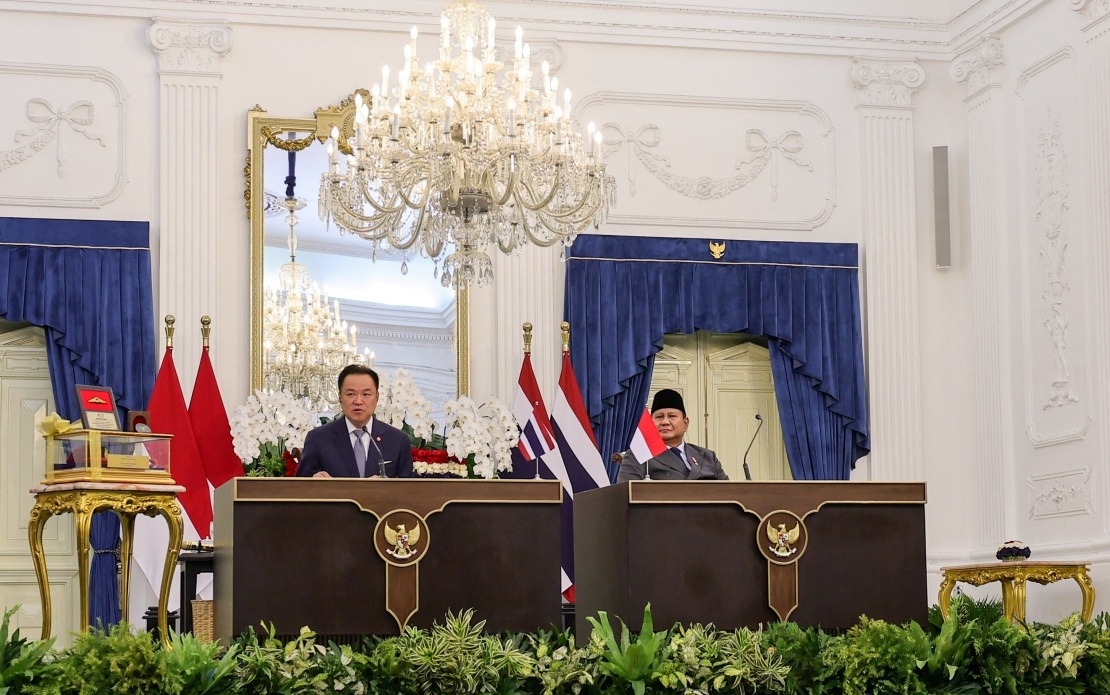
Indonesia and Thailand have reaffirmed their commitment to ASEAN-led peace initiatives in Myanmar, signalling renewed diplomatic momentum for resolving one of Southeast Asia's most intractable conflicts. The pledge emerged from Monday's high-level consultation between Indonesian President Prabowo Subianto and Thai Prime Minister Anutin Charnvirakul at Jakarta's Merdeka Palace, marking a significant moment in bilateral relations and regional stability efforts. The meeting underscored both nations' determination to maintain ASEAN's unity and central role in addressing Myanmar's crisis through the Five-Point Consensus, the bloc's proposed roadmap for restoring peace that has stalled amid persistent violence and humanitarian deterioration.
The Five-Point Consensus, adopted by ASEAN in April 2021, calls for an immediate ceasefire, dialogue among all Myanmar stakeholders, humanitarian assistance, and support for ASEAN's mediation efforts. Despite three years of diplomatic engagement, implementation has proven challenging amid competing interests and entrenched positions from Myanmar's military junta and various opposition forces. Indonesia and Thailand's renewed commitment reflects acknowledgment that ASEAN's credibility as a regional organization depends on demonstrating tangible progress in Myanmar, where the military coup in February 2021 triggered armed conflict that has killed thousands and displaced hundreds of thousands. For Malaysian policymakers and regional observers, this bilateral alignment is noteworthy because it indicates persistent solidarity among ASEAN's larger economies in maintaining the bloc's stated neutrality while pursuing inclusive dialogue solutions.
Beyond Myanmar, the two nations identified an equally pressing challenge: transnational crime networks operating across Southeast Asian borders. President Prabowo emphasized that Indonesia and Thailand would intensify joint efforts to dismantle criminal syndicates engaged in online fraud, human trafficking, and drug smuggling—crimes that increasingly transcend national boundaries and threaten regional security. The bilateral agreement establishes closer intelligence-sharing protocols, coordinated financial tracking, joint investigations, and enhanced law enforcement cooperation. This represents a pragmatic recognition that traditional borders offer little protection against digital-era criminal operations, particularly online scam networks that exploit victims across multiple countries simultaneously. For Malaysia, which has emerged as both a source and transit point for transnational crime victims, this Indonesian-Thai framework offers a template for deeper multilateral coordination within ASEAN.
Particularly significant is Thailand's role in facilitating the repatriation of nearly 1,000 Indonesian victims of online fraud syndicates, demonstrating the scale of the problem affecting ordinary citizens across the region. President Prabowo specifically thanked the Thai government for this humanitarian intervention, highlighting how transnational crime has shifted from an abstract security concern to a matter affecting thousands of families. The two nations agreed to establish a Transnational Referral Mechanism aimed at accelerating victim identification, protection, and safe repatriation. This institutional framework reflects lessons learned from previous anti-trafficking initiatives and represents a more systematic approach to addressing the human cost of cross-border criminal enterprise. Malaysian authorities engaged in similar victim protection efforts may find the referral mechanism useful as a model for coordinating regional responses.
Thai Prime Minister Anutin proposed substantial defence industry cooperation, including the supply of 36 amphibious wheeled armoured vehicles to Indonesia. This arms agreement signals confidence in bilateral military-industrial cooperation and reflects Thailand's interest in deepening defence partnerships beyond traditional security dialogues. The proposal also demonstrates how security cooperation can encompass commercial defence relationships, generating economic benefits while strengthening interoperability between allied forces. For Indonesia, acquiring advanced amphibious vehicles enhances maritime security capabilities across its vast archipelago, a strategic priority given the nation's extensive coastline and maritime vulnerabilities. Anutin's proposal for expanded defence industry collaboration suggests Thailand views Indonesia as a key partner for regional military modernization, with potential benefits for both economies.
Anutin's inaugural visit to Indonesia since assuming office in September 2025 marks a symbolic milestone: the first Thai prime ministerial visit to Jakarta in 15 years. This diplomatic gap, spanning multiple Thai administrations, underscores how political instability in Bangkok historically disrupted senior-level bilateral engagement. The restoration of regular high-level consultations signals stabilization of Thai domestic politics and renewed commitment to substantive regional diplomacy. For Southeast Asian observers, the resumption of frequent prime ministerial visits between major ASEAN economies suggests the bloc is recalibrating its diplomatic posture toward more proactive engagement on regional challenges. The 15-year gap also reflects how domestic political turbulence in one ASEAN member can ripple through regional institutional relationships, a concern relevant to Malaysia's own diplomatic interests.
The bilateral agenda extended to maritime security cooperation, with both nations committing to regular joint military training and information sharing. Maritime security remains critical for Indonesia and Thailand given their extensive coastal waters, contested territorial claims, and vulnerability to piracy and illegal fishing. Thailand's proposals for combating online scam operations, human trafficking, and wildlife trafficking demonstrate recognition that security threats now span traditional military concerns and transnational criminal activity. The inclusion of wildlife trafficking reflects growing regional awareness of environmental crime's interconnection with organized crime syndicates, an issue of particular concern for Malaysia given its biodiversity and the poaching of endangered species. By bundling military training, maritime cooperation, and crime-fighting initiatives into a comprehensive security agenda, both nations are constructing a holistic bilateral framework addressing 21st-century security challenges.
The timing of this consultation reflects broader regional recalibration following changes in key ASEAN capitals. Prabowo's election in Indonesia and Anutin's consolidation of Thai leadership create space for renewed bilateral attention and policy coordination. Both leaders face domestic pressures to demonstrate governance competence and regional leadership, making success in Myanmar peace efforts and transnational crime prevention politically valuable. For Malaysia, these developments suggest ASEAN's larger economies are coalescing around security cooperation frameworks that could eventually expand into broader regional mechanisms. The Indonesian-Thai partnership, if effectively implemented, could establish standards for bilat defence and security cooperation that other ASEAN members adopt, gradually strengthening the bloc's capacity to address shared transnational threats. However, success depends on sustained political will transcending leadership transitions and resource allocation that extends beyond rhetoric into operational implementation.

