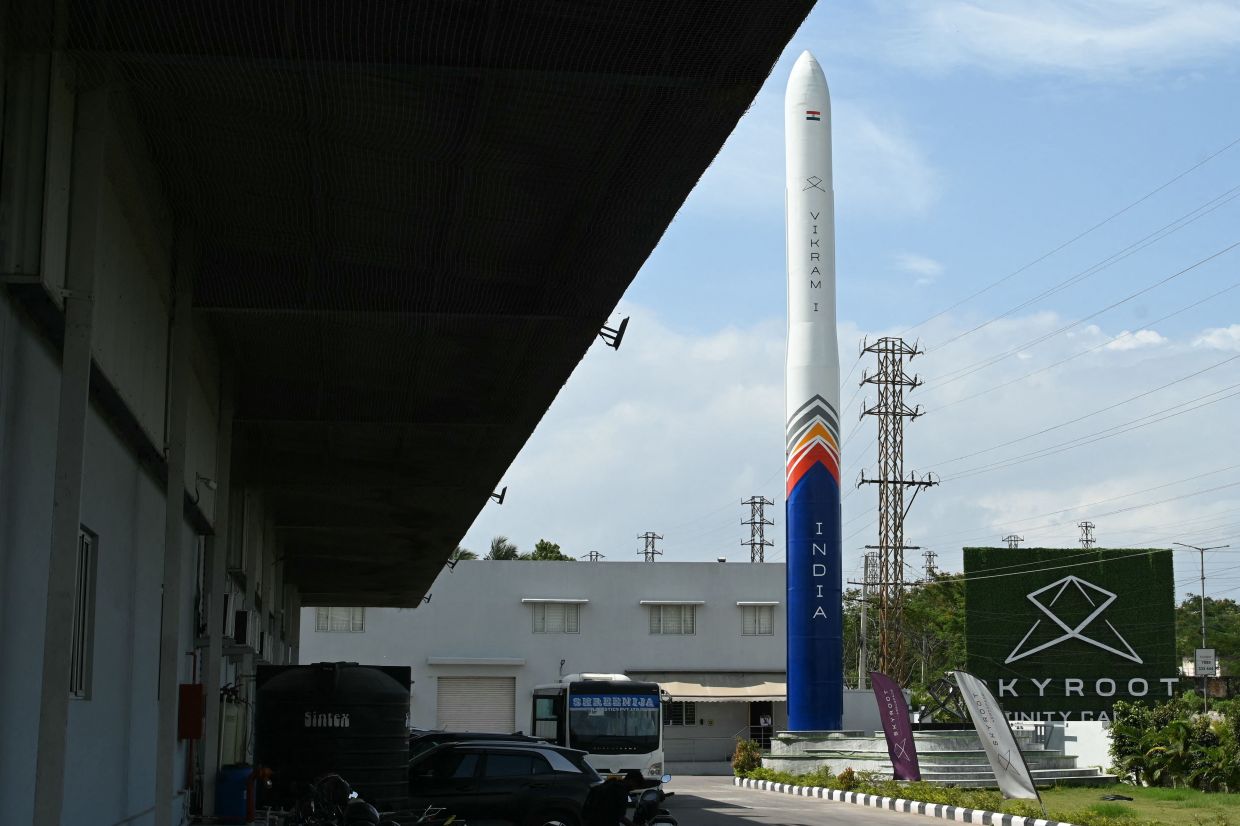
India stands at the threshold of a transformative moment in its space ambitions as Skyroot Aerospace prepares for the maiden flight of Vikram-1, the country's inaugural privately developed orbital-class rocket, scheduled for launch sometime between mid-July and early August from the Sriharikota spaceport. This milestone represents far more than a single technological achievement; it encapsulates the dramatic evolution of India's space sector since the government opened the industry to private investment in 2020, catalysing the emergence of over 400 space startups competing to establish India's footprint in the global commercial space economy.
India's space economy, currently valued at US$8.4 billion, has undergone remarkable transformation over the past four years, evolving from a government monopoly into a vibrant ecosystem encompassing launch services, satellite manufacturing, propulsion systems, and Earth observation capabilities. The Department of Space has articulated an ambitious growth trajectory, projecting the sector will expand to $44 billion by 2033 and reach $100 billion by 2040, figures that underscore New Delhi's determination to position India as a serious player in the increasingly competitive global space industry. This expansion reflects not merely aspirational thinking but rather builds upon tangible achievements that have established India's credentials as a reliable space faring nation.
India's heritage of successful missions provides the foundation for current private sector confidence. The nation's 2014 achievement as the first Asian country to successfully place a spacecraft in orbit around Mars demonstrated technological sophistication, whilst the Chandrayaan lunar programme has yielded successive milestones culminating in the 2023 rover landing that made India the fourth nation to achieve an unmanned lunar touchdown. The upcoming fourth Chandrayaan mission, scheduled for 2027, will push boundaries further by attempting to retrieve lunar samples, whilst a Venus orbital mission planned for 2028 signals India's intention to participate in deep-space exploration traditionally reserved for spacefaring superpowers.
Beyond these headline-grabbing achievements, India has methodically built its space infrastructure and expertise over decades. Since launching its first satellite on a Soviet rocket in 1975, ISRO has cultivated a reputation for cost-efficiency, a competitive advantage that has enabled the organisation to capture significant market share in commercial satellite launches. The agency has successfully deployed more than 430 foreign satellites, generating over $600 million in revenue, whilst simultaneously launching 144 of its own satellites into orbit. This dual capability—serving both commercial clients and national interests—has positioned ISRO as an attractive partner for nations and private entities seeking affordable, reliable launch services.
The infrastructure supporting this expansion is itself expanding. India's primary spaceport at Sriharikota on Andhra Pradesh's southeast coast is undergoing significant expansion, whilst a second spaceport is under construction at Kulasekarapattinam in Tamil Nadu's southernmost region. These dual facilities will provide launch capacity for the anticipated surge in commercial activity, reducing bottlenecks and enabling India to accommodate greater demand from both domestic startups and international clients seeking access to orbit. This infrastructure investment reflects deliberate strategic planning to capture growing demand in the satellite launch market, where established players like SpaceX have demonstrated the commercial viability of frequent, rapid-turnaround launch operations.
The private companies now entering India's space sector represent diverse specialisations and business models. Skyroot Aerospace's focus on small-satellite launch vehicles directly addresses a market segment experiencing explosive growth, as constellations of miniaturised satellites increasingly replace traditional larger platforms for communications, Earth observation, and scientific applications. Pixxel is positioning itself in the geospatial intelligence market, offering observation satellites for agricultural monitoring, environmental management, and disaster response—applications with direct relevance to Southeast Asian nations facing climate vulnerability and agricultural pressures. Bellatrix Aerospace and Agnikul Cosmos are advancing propulsion and manufacturing technologies, with the latter's investment in three-dimensional printing of rocket engines suggesting India intends to embrace additive manufacturing in space applications, potentially reducing costs and accelerating development timelines.
For regional observers in Southeast Asia, India's space sector expansion carries particular significance. The region's archipelagic geography, exposure to climate hazards, and agricultural dependencies create substantial demand for satellite-based Earth observation services that Indian companies are positioned to supply. Moreover, the emergence of Indian commercial space capabilities offers Southeast Asian nations alternatives to existing launch providers, potentially improving service accessibility and pricing. The technological spillovers from India's space industry—particularly advances in materials science, precision engineering, and systems integration—may eventually benefit broader regional industrial development.
Crucially, India's space sector does not exist in isolation from broader strategic considerations. The defence research and development establishment, military services, and civilian space agency maintain substantial overlap, with multiple companies simultaneously supplying both civil and defence sector clients. Launch vehicles, propulsion systems, satellite technology, avionics, and guidance systems all represent dual-use technologies applicable to India's expanding missile and military drone programmes. The Defence Research and Development Organisation maintains active coordination with ISRO, whilst private companies benefit from surging military demand for advanced avionics and navigation systems. This defence-space nexus reflects global patterns wherein space capabilities increasingly underpin national security postures, though the specifics of India's civil-military integration warrant careful attention from regional security analysts.
India's international partnerships further demonstrate the sector's maturation and diplomatic reach. Collaborations with the National Aeronautics and Space Administration, the European Space Agency, and individual partners including France, Germany, Italy, Japan, and Saudi Arabia position India within networks of advanced space-faring nations. These partnerships facilitate technology transfer, scientific collaboration, and mutual capacity building, whilst Russia's support for India's human spaceflight preparations signals continued Russia-India space cooperation despite broader geopolitical tensions. Such partnerships simultaneously provide Indian companies exposure to international standards and practices, potentially accelerating their development toward globally competitive capabilities.
The Vikram-1 launch represents not merely a commercial milestone but rather a validation of India's strategic decision to open its space sector to private enterprise. Skyroot's success—or alternatively, detailed analysis of any setback—will provide crucial feedback regarding whether India can nurture commercially viable private space companies capable of competing internationally. The lessons from this maiden orbital-class launch will reverberate through India's nascent space startup ecosystem, potentially accelerating or moderating growth depending on outcomes. For regional observers, the launch outcome also carries symbolic significance as an indicator of India's technological trajectory and its capacity to sustain innovation-driven development.
India's space sector ambitions must be situated within the broader context of global competition for commercial space dominance. Established players including the United States, China, and European consortiums have already captured substantial market shares, whilst emerging competitors in Japan, South Korea, and potentially Southeast Asia are developing indigenous capabilities. India's competitive advantages—substantial technical talent pools, cost efficiency, and ISRO's operational experience—must be leveraged whilst private firms remain disciplined regarding commercialisation timelines and pricing strategies. The sector's projected growth to $100 billion by 2040 reflects optimistic projections that require sustained government support, continued private investment, and operational execution by enterprises still establishing their track records.
Looking forward, India's space sector trajectory will likely influence regional technological competition and cooperation patterns. Successful Indian commercial space ventures may catalyse similar private sector developments in other South and Southeast Asian nations, potentially creating a more competitive regional space ecosystem. Alternatively, if Indian companies establish dominance in small-satellite launch services and Earth observation applications, they may position India as a regional space technology leader. For Malaysia and other Southeast Asian economies, monitoring India's space sector developments offers insights into developmental pathways for advanced technology sectors and the policy frameworks most conducive to nurturing innovation-driven private enterprise within national strategic priorities.

