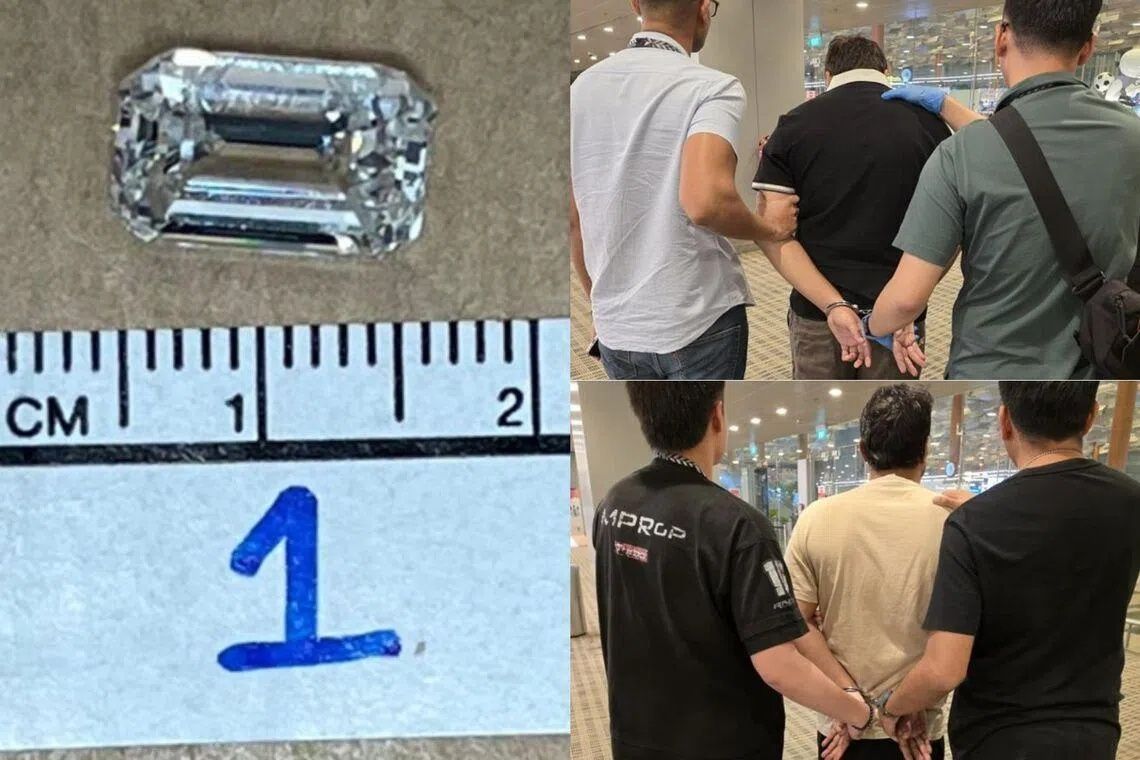
An Indian national has received a prison sentence exceeding two years for executing a carefully planned theft of a diamond valued at nearly S$200,000 from a Chinatown jewellery establishment in Singapore. Mangroliya Manojkumar Kurjibhai, 41, was convicted after pleading guilty to the June 19 heist at Dianoche jewellery store on Kreta Ayer Road, which involved swapping a genuine gemstone for a professionally crafted fake one. His accomplice, Serasiya Milan Ramnikbhai, 30, remains the subject of ongoing court proceedings following their arrest at Changi Airport the same evening as they attempted to flee the country.
The operation demonstrated a level of criminal sophistication that has raised questions about airport security vulnerabilities and the international coordination of jewellery theft rings targeting Southeast Asia's shopping districts. Court documents reveal the pair meticulously prepared for the crime weeks before arriving in Singapore on June 19, commissioning a counterfeit diamond in India that precisely matched the specifications and serial markings of the genuine stone they intended to steal. While the court proceedings did not explicitly detail how the tourists identified their target, the level of advance planning suggests either prior reconnaissance or information obtained through networks engaged in precious stone trafficking across the region.
The execution of the theft unfolded with remarkable audacity during the afternoon of June 19. Serasiya concealed the counterfeit diamond within his mouth before the pair entered the store at approximately 3pm. Mangroliya then requested to examine the 4.95-carat diamond, valued at US$154,000 or just over S$199,000, while strategically asking the sales manager to retrieve multiple additional items, ensuring the staff member repeatedly left his position. This deliberate distraction technique provided the crucial window for the exchange to occur. When the moment arrived, Mangroliya instructed Serasiya to execute the swap, whereupon the accomplice expelled the fake stone and concealed the genuine diamond in his mouth before departing the store alongside his partner.
The theft might well have succeeded had the jewellery store not possessed surveillance infrastructure and trained personnel. Store management reviewed the CCTV footage immediately following the customers' departure and subjected the discarded counterfeit to examination using optical gemstone identification machinery, quickly confirming the substitution. This rapid detection set in motion a chain of events that would culminate in the perpetrators' capture before they could leave Singapore's borders. The sophistication of their advance planning stood in stark contrast to the operational failure that followed, as they apparently underestimated either the vigilance of the jewellery store staff or the efficiency of police coordination at the nation's primary airport.
Following their departure from the store, the two tourists checked out of their hotel accommodation and proceeded to book a flight to India, seemingly confident they would clear immigration without incident. However, law enforcement authorities had already been alerted by the jewellery store, and border officials apprehended both individuals at Changi Airport Terminal 3 at approximately 9pm that evening. Officers recovered the genuine diamond from Serasiya's haversack during the airport arrest, securing the evidence necessary for prosecution. The swift interception of the suspects at the border represented a significant achievement in preventing the theft's successful completion and the removal of the stolen asset from Singapore's jurisdiction.
Mangroliya's sentencing on July 17 to two years, two months and two weeks' imprisonment reflects the severity with which Singapore's courts treat jewellery theft, particularly when premeditation and international coordination are demonstrated. State Prosecuting Officer Yip Cheng Yee presented the facts of the case to the court, establishing the defendants' guilty plea and the incontrovertible evidence of their culpability. The sentencing guidelines for theft under Singapore law provide for imprisonment up to seven years and financial penalties, meaning Mangroliya received a sentence substantially below the maximum available, possibly reflecting his guilty plea and lack of prior convictions. The ongoing proceedings against Serasiya suggest the courts may consider his role as secondary to Mangroliya's apparent leadership of the criminal enterprise.
The incident exposes concerning vulnerabilities within regional security frameworks that organised jewellery theft networks may seek to exploit. Chinatown remains one of Southeast Asia's premier shopping destinations, attracting both legitimate and criminal visitors seeking high-value merchandise. The fact that foreign nationals could execute an international theft conspiracy with such apparent ease raises questions about intelligence-sharing mechanisms between regional police forces and the effectiveness of border security protocols in identifying known or suspected jewellery traffickers. Tourism authorities in Singapore and other Southeast Asian nations increasingly face the challenge of balancing visitor hospitality with security measures designed to prevent organised retail crime.
For Malaysia and other neighbouring economies, the case carries particular significance given the region's interconnected tourism infrastructure and the movement of goods and people across porous borders. Jewellery theft rings operating across Southeast Asia often exploit inconsistent regulatory standards and intelligence-sharing gaps between jurisdictions. Malaysian retailers in shopping destinations like Kuala Lumpur's Pavilion KL and Malls in Bukit Bintang may face similar risks from transnational criminal networks. The Singapore case demonstrates the critical importance of implementing surveillance technology, staff training programmes, and rapid law enforcement response mechanisms to counter such threats.
The reliance on counterfeit gemstones as substitutes in theft schemes reflects evolving criminal methodologies designed to evade detection. Rather than crude snatch-and-grab operations, sophisticated networks now invest in professionally manufactured fake stones that can temporarily deceive casual visual inspection, creating crucial time delays before victims discover the substitution. This evolution demands correspondingly advanced detection capabilities and staff expertise within the jewellery retail sector. Many Southeast Asian jewellery stores, particularly independent operators or smaller establishments, may lack the optical gemstone identification equipment that proved decisive in this case, potentially rendering them more vulnerable to similar schemes.
The broader implications for travel and tourism throughout Southeast Asia warrant consideration. International visitors continue to comprise a significant portion of retail customers in high-end jewellery stores across major urban centres, and the vast majority engage in legitimate transactions. However, the identification and interdiction of criminal travellers requires careful balancing between security vigilance and the maintenance of welcoming environments for legitimate tourists. Chinatown's distinctive character and concentration of precious stone retailers make it an attractive destination for both shoppers and criminals, necessitating enhanced coordination between tourism authorities, retail establishments, and law enforcement agencies.
The case also highlights the transnational dimensions of organised retail theft, with criminal networks operating across multiple countries to plan, execute, and distribute stolen merchandise through international trafficking routes. Intelligence agencies tracking such activities in the Southeast Asian region have documented similar patterns involving Indian nationals, suggesting possible connections to larger criminal organisations based on the subcontinent. The cooperation between Mumbai-based counterfeiters who manufactured the fake diamond and the on-ground operatives who executed the theft indicates a division of labour and specialisation consistent with organised criminal enterprises.
As investigations into Serasiya's role continue through Singapore's courts, the broader question of how regional authorities might better coordinate responses to jewellery theft remains open. Enhanced information-sharing protocols between police forces, cross-border training programmes, and public awareness campaigns targeting legitimate travellers could collectively reduce the viability of such schemes. For retailers throughout Southeast Asia, the case reinforces the value of investing in security infrastructure, staff training, and rapid communication with authorities. The successful apprehension of these perpetrators at the airport before international departure demonstrates that well-coordinated border security protocols remain an essential final line of defence against international jewellery trafficking.

