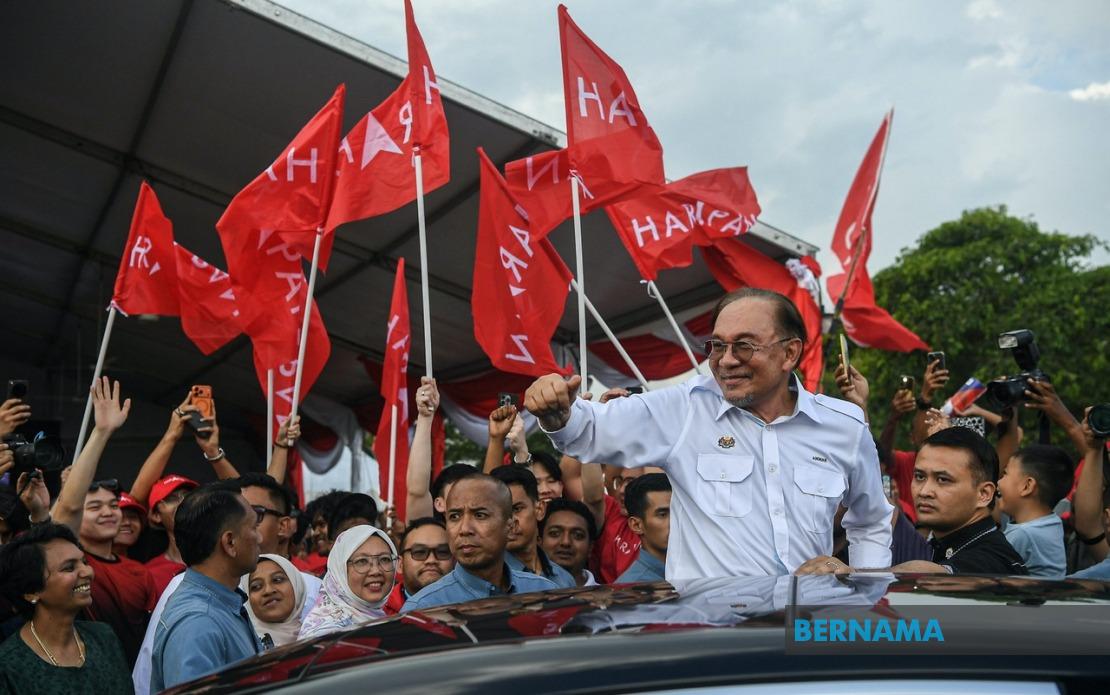
As Johor prepares for its state election, a senior Pakatan Harapan figure has urged the Indian community to make voting decisions based on verifiable government performance rather than campaign promises. Dr Gunaraj George, a member of PKR's Central Leadership Council, contends that the Unity Government under Prime Minister Datuk Seri Anwar Ibrahim has restored what the Tamil-speaking community refers to as "Nambikei"—confidence in Malaysia's political direction.
The appeal comes at a moment of shifting political dynamics in Johor, where the Indian community's electoral behaviour could prove decisive. Gunaraj's framing reflects a broader Pakatan Harapan strategy to position itself not merely as an alternative to previous governments, but as one delivering tangible outcomes aligned with the Malaysia MADANI framework. This agenda emphasises unity, justice and equitable opportunity across Malaysia's diverse population, a messaging approach that attempts to move beyond traditional race-based political appeals that have dominated Malaysian electoral contests for decades.
Central to Gunaraj's argument is the proposition that contemporary Malaysian politics must transcend ethnic categorisation. He notes that Prime Minister Anwar Ibrahim has maintained consistency on this principle throughout his political career, viewing Malaysia's plural society as requiring policy-driven governance rather than communal rhetoric. This represents a departure from how major political coalitions have typically courted minority communities, suggesting that the Unity Government's sustainability depends partly on demonstrating material benefits alongside ideological positioning.
Since assuming office three years ago, the government has directed several funding mechanisms toward Indian community advancement. The Malaysian Indian Community Transformation Unit, or MITRA, received RM50 million in supplementary allocation atop its existing RM100 million budget. Tekun Nasional, the government's entrepreneurship scheme targeting Indian business operators, was expanded to RM100 million. The Amanah Ikhtiar Malaysia programme for women entrepreneurs received a parallel RM100 million commitment. These allocations, though substantial, must be contextualised within the broader budget and the depth to which funds reach beneficiaries on the ground.
Educational investment has also featured prominently in the government's messaging to the Indian community. In January, Prime Minister Anwar announced RM50 million directed toward Tamil vernacular school development—a historically contentious area where the Indian community has long advocated for improved infrastructure and teaching resources. The framing of this allocation as "historic" reflects both the significance the government wishes to attribute to it and acknowledgment of long-standing grievances within Tamil-medium educational institutions across Malaysia.
Beyond targeted fund allocation, the government emphasises broader socio-economic programmes including skills training, educational assistance schemes and entrepreneurial opportunities. These initiatives aim to address structural disadvantages the Indian community has experienced, particularly regarding access to economic participation and professional advancement. However, Gunaraj's pitch to evaluate these programmes on merit rather than sentiment suggests that perception gaps may exist between policy intention and community experience—a gap that could determine electoral behaviour.
Gunaraj's message implicitly critiques opposition parties for relying on "old political tactics" and "empty promises", signalling that Pakatan Harapan views the Indian electorate as increasingly discerning. This assessment may reflect genuine shifts in voting patterns, or it may represent aspirational framing designed to influence perceptions of inevitability around PH support. The claim that the community has "become more mature in making political choices" functions both as observation and as a subtle pressure to align voting behaviour with the implied sophistication Gunaraj attributes to this electorate.
The timing of Gunaraj's remarks coincides with active campaigning for the 16th Johor state election, where Pakatan Harapan is contesting all 56 seats through a coalition arrangement: PKR fields 20 candidates, Amanah 19, and DAP 17. This distribution reflects agreed power-sharing among coalition partners, though it also demonstrates tensions around seat allocation that periodically surface in Malaysian coalition politics. The Indian community's concentration in specific constituencies, particularly in urban and semi-urban Johor areas, means their voting patterns could disproportionately influence results in marginal seats.
For Malaysian readers beyond Johor, this contest carries broader implications regarding how federal coalitions maintain voter coalitions during state-level contests. The Indian community's political positioning has traditionally swung significantly between elections, responding to specific grievances and perceptions of whether particular governments advance their interests. Gunaraj's appeal to results-based evaluation rather than sentiment-based voting reflects recognition that sustaining coalition support requires demonstrable delivery on commitments.
The appeal also reflects calculations about competing narratives within Indian community politics. Opposition parties typically emphasise historical marginalization and frame themselves as more sympathetic to community-specific concerns. Pakatan Harapan's counter-argument—that inclusive, multiracial governance ultimately benefits all communities more than competitive ethnic politics—requires visible evidence of implementation and benefit distribution. The question for voters remains whether allocated funds translate into measurable improvements in education quality, entrepreneurial success rates and household economic circumstances.
Gunaraj's statement ultimately positions the upcoming election as a choice between two political philosophies: one organised around communal interest aggregation and emotional appeals, the other centred on policy performance and cross-community inclusivity. Whether the Indian community in Johor accepts this framing, and whether they perceive the government's initiatives as substantive rather than symbolic, will shape not merely the state election outcome but broader patterns of coalition stability in Malaysian politics heading toward the next general election.

