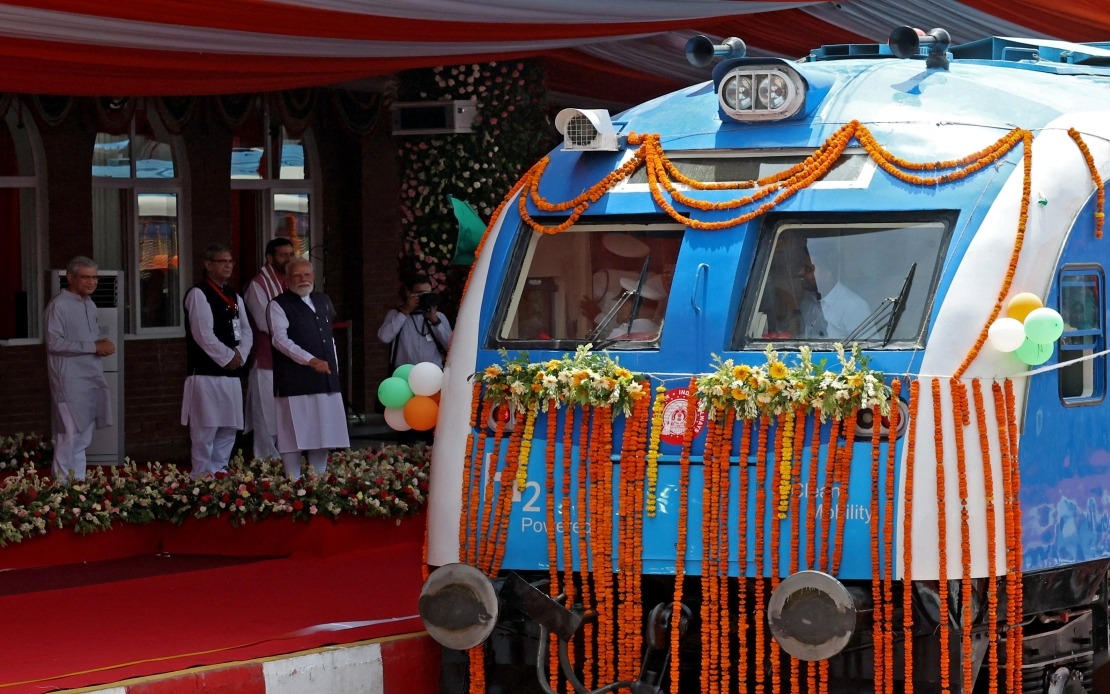
India has taken a significant step towards sustainable transportation infrastructure by launching its first hydrogen-powered train, a milestone that positions the country alongside technology leaders in the race toward decarbonised rail networks. Prime Minister Narendra Modi formally inaugurated the service on Friday, with the 10-coach train now scheduled to operate on the 89-kilometre Jind-Sonipat corridor in Haryana state. The introduction of this indigenously developed hydrogen fuel cell system represents a watershed moment for Indian railways, traditionally reliant on diesel locomotives that contribute substantially to the nation's transport sector emissions.
The technological architecture underlying this advancement centres on a 1,200-kilowatt Proton Exchange Membrane Fuel Cell, a sophisticated system that generates electricity through controlled chemical reactions between hydrogen and oxygen. Unlike conventional diesel engines that release carbon dioxide and particulate matter into the atmosphere, this fuel cell produces only water vapour and heat as byproducts—a fundamental transformation in railway propulsion methodology. For Indian passengers and environmental advocates alike, the implication extends beyond mere technological curiosity; it demonstrates that large-scale public transport can transition away from fossil fuel dependency without sacrificing operational performance or passenger comfort.
The specifications reflect careful engineering calibration for Indian railway conditions. The train operates at a maximum velocity of 75 kilometres per hour with a design ceiling of 110 km/h, parameters that balance efficiency with practical constraints of existing track infrastructure in Haryana. These operating parameters are particularly relevant for India's railway modernisation strategy, which must accommodate dense passenger networks and varying terrain across the subcontinent. The engineering achievement gains additional significance when considered against the backdrop of India's commitment to carbon neutrality targets and its renewable energy expansion goals.
By launching this hydrogen-powered service, India joins a notably exclusive club of technological sophistication. China, Germany, Japan, and the United States have already integrated hydrogen trains into their respective networks, yet each implementation reflects specific national circumstances and energy strategies. Germany's hydrogen fleet operates extensively in Lower Saxony, while Japan has conducted trials on multiple routes. India's entry into this sphere signals that green rail technology is no longer confined to wealthy developed economies, and that emerging markets can leapfrog conventional diesel-based infrastructure. This development carries particular resonance across Southeast Asia, where several nations grapple with similar challenges of modernising transport networks whilst managing environmental obligations.
The Haryana corridor selection merits examination beyond mere administrative convenience. This route connects significant population centres and represents a testing ground for technology transfer and operational learning. If performance metrics prove favourable over an extended evaluation period, the infrastructure and expertise gained could facilitate expansion to other high-traffic Indian railway corridors. Such expansion potential would multiply the environmental benefits and demonstrate scalability across India's 68,000-kilometre railway network, the fourth largest globally.
For Malaysian and broader Southeast Asian policymakers, India's hydrogen train serves as instructive precedent. The region's transport infrastructure remains heavily dependent on diesel-powered rail and road networks, creating substantial carbon footprints as populations and freight demands accelerate. India's demonstration that hydrogen technology can be indigenously developed rather than merely imported offers an important lesson in technological autonomy and capability building. It suggests that regional economies need not perpetually depend on technology transfers from wealthy nations, but can cultivate engineering expertise and manufacturing capacity domestically.
The economic implications warrant careful analysis. Hydrogen production, distribution, and storage infrastructure require significant capital investment and technological expertise. India's decision to pursue indigenous development suggests that authorities view the long-term cost advantages as justifying upfront investment. As hydrogen fuel cells become more prevalent globally, manufacturing economies of scale should progressively reduce per-unit costs, making the technology more accessible to nations with constrained budgets. Southeast Asian governments observing India's trajectory may find economic justification for similar investments, particularly as climate commitments intensify and diesel fuel volatility increases operational expenses.
Operational durability and maintenance requirements represent practical considerations that extend beyond initial commissioning. Hydrogen fuel cell systems demand different maintenance protocols than diesel locomotives, requiring technician retraining and supply chain reorganisation. India's railways, employing over a million personnel, will need systematic upskilling programmes to manage these systems effectively. The success of this first service thus hinges not merely on technological functionality, but on institutional capacity to sustain and expand hydrogen operations across the network. This institutional dimension often receives insufficient attention in discussions of green technology adoption, yet proves critical to long-term viability.
The timing of India's hydrogen train launch coincides with accelerating global climate commitments and renewable energy expansion. India's renewable energy capacity additions have positioned the country as a serious climate policy actor, despite its coal-dependent power generation. By demonstrating that advanced green technology can be deployed in rail transport—a sector accounting for roughly three per cent of global transport emissions—India strengthens its climate diplomacy positioning and builds domestic constituencies supportive of broader decarbonisation efforts. The symbolic significance of Prime Minister Modi flagging off the service underscores government commitment to these objectives at the highest political levels.
Looking forward, the Jind-Sonipat route will generate operational data regarding hydrogen fuel cell performance in Indian climatic conditions, ranging from extreme heat to monsoon moisture. This real-world testing ground provides invaluable insights that could inform hydrogen technology deployment across the tropics and subtropics, regions where much of the developing world's population resides. Success here would demonstrate that hydrogen technology transcends temperate-climate applications and possesses genuine universal applicability, fundamentally altering assumptions about technological possibilities for emerging economies pursuing sustainable development pathways.

