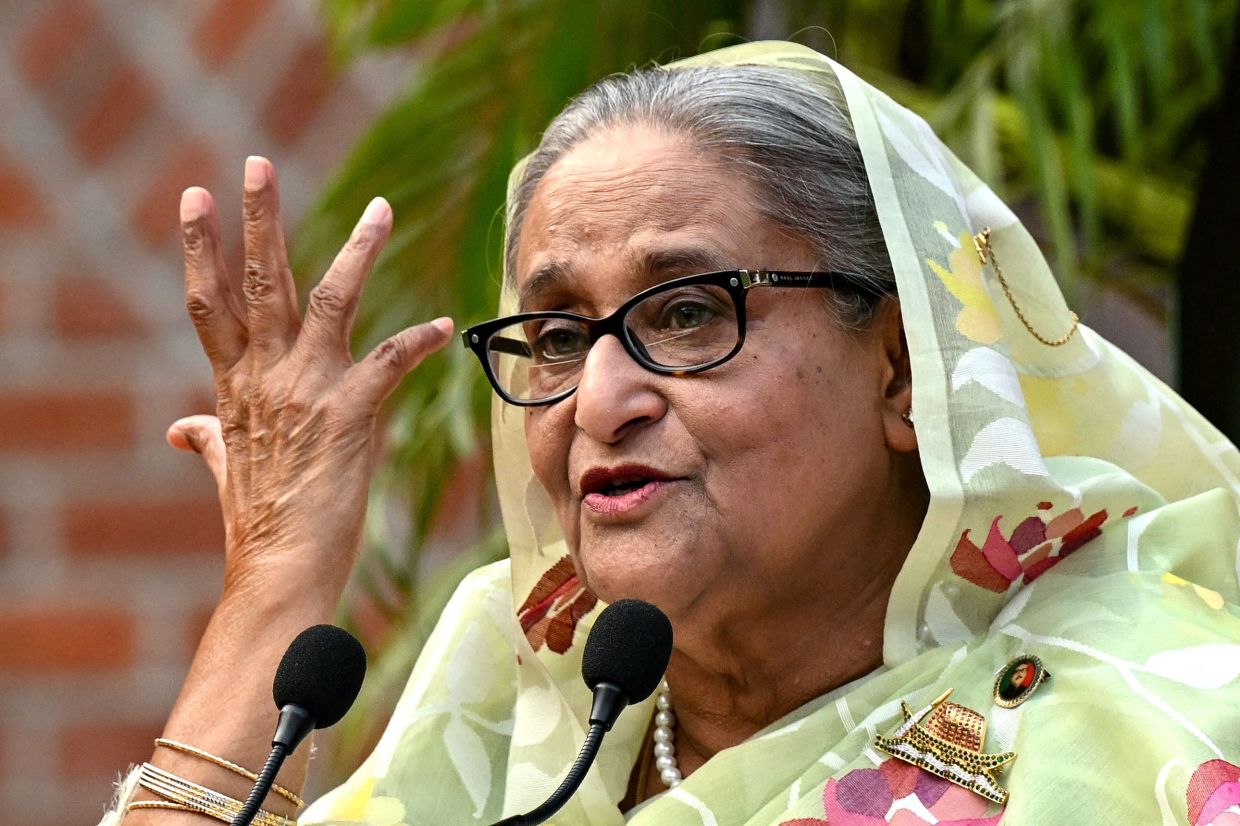
India's external affairs ministry has clarified that New Delhi bears no responsibility for an upcoming virtual address by Bangladesh's exiled former Prime Minister Sheikh Hasina, pushing back against pressure from Dhaka to take a clearer stance on the event. The address, scheduled for August 5, will be hosted by the Foreign Correspondents' Club of South Asia in the Indian capital and marks the second anniversary of the student-led uprising that unseated Hasina's administration in 2024. Indian foreign ministry spokesperson Randhir Jaiswal emphasised that the event is being organised entirely by a private media entity, with the government maintaining strict neutrality and declining to endorse any statements made at the forum.
Bangladesh had previously sought explicit clarification from New Delhi regarding its position on Hasina's planned remarks, concerned that allowing such political activity by a fugitive could undermine the two nations' efforts to rebuild bilateral relations. The timing reflects broader diplomatic sensitivities between the neighbours, whose ties have deteriorated significantly since Hasina's departure. Alongside the address, Hasina's son Sajeeb Wazed Joy and other speakers are expected to participate in the event, marking what would be Hasina's first public appearance since fleeing to India following the tumultuous student protests.
Meanwhile, Bangladesh's information establishment has taken aggressive steps to control domestic narratives around Hasina and limit the reach of her messaging within the country. Information Adviser Zahed Ur Rahman issued a stern warning to all Bangladeshi media outlets on Tuesday, cautioning them that broadcasting, publishing, or otherwise amplifying Hasina's forthcoming speech would violate a December 2024 order issued by Bangladesh's International Crimes Tribunal. This directive broadly prohibits the dissemination of any statements, interviews, audio recordings, or video messages attributed to the former prime minister across traditional and digital platforms.
The severity of Hasina's legal predicament provides crucial context for understanding both her exile and Dhaka's determination to curtail her influence. In 2025, she was sentenced to death in absentia for crimes against humanity, a conviction stemming from her government's violent response to the student demonstrations. Hasina has categorically rejected the verdict as legally invalid and devoid of legitimacy. At 78 years old, she has remained under protection in India since fleeing Bangladesh, though she has signalled intentions to return from exile around December and face the courts—a development that would represent a significant test of how Bangladesh's new administration manages its most politically significant opponent.
Hasina's legal team and political allies have signalled defiance in the face of Dhaka's efforts to suppress her voice. Abu Obaidha Arin, one of Hasina's advisers, declared that the New Delhi event will proceed as planned, contending that Bangladesh's attempts to silence dissent cannot silence voices operating beyond the country's jurisdiction. This stance reflects a broader strategy by Hasina's supporters to maintain her political relevance and platform while challenging what they characterise as the illegitimacy of proceedings against her.
The content of Hasina's virtual remarks remains undisclosed, with her aides declining to provide details of what she intends to communicate. However, previous statements to international media outlets have indicated that Hasina and colleagues from her Awami League party are considering a coordinated return to face the courts, which analysts view as a potential challenge to the current political settlement in Bangladesh. Such a move would force Prime Minister Tarique Rahman's government to navigate treacherous constitutional and diplomatic waters.
Dhaka has continued escalating diplomatic pressure on New Delhi regarding Hasina's presence and activities on Indian soil. Bangladesh's State Minister for Foreign Affairs Shama Obaed Islam has repeatedly conveyed concern to Indian counterparts that Hasina and other senior Awami League figures are conducting political activities and issuing statements from India, which Dhaka views as an infringement on its sovereignty and a complication for bilateral relations. The fresh tension underscores the fragile state of India-Bangladesh ties, which have been strained since Hasina's ouster and the subsequent political transition.
Despite these immediate frictions, both governments have recently signalled a desire to move past the turbulence of recent years. Bangladesh's new political leadership, following February's electoral transition, has indicated willingness to rebuild the relationship with India. However, the Hasina situation remains a persistent irritant, reflecting deeper questions about how Bangladesh can manage its largest neighbour's role while asserting its own political autonomy. India's studied neutrality on the virtual address appears calculated to avoid further antagonising Dhaka whilst maintaining the principle that private entities can organise events without state sanction.
The international dimensions of this dispute extend beyond bilateral India-Bangladesh relations. The Foreign Correspondents' Club of South Asia's decision to host Hasina's remarks highlights how exile politics increasingly unfolds across borders, with digital platforms and international media institutions amplifying voices that national governments seek to contain. For Bangladesh, the challenge of managing a former leader operating from abroad while maintaining legal proceedings against her represents a novel problem in the country's political evolution.
Regional observers note that the situation illustrates broader tensions within South Asia regarding the movement of political figures across borders and the limits of state authority in the digital age. Hasina's planned address, viewed alongside Bangladesh's increasingly restrictive media orders, reflects a government determined to control domestic discourse while acknowledging the limitations of such control in an interconnected world. The unfolding developments will likely influence how other South Asian nations grapple with similar circumstances involving exiled political leaders.

