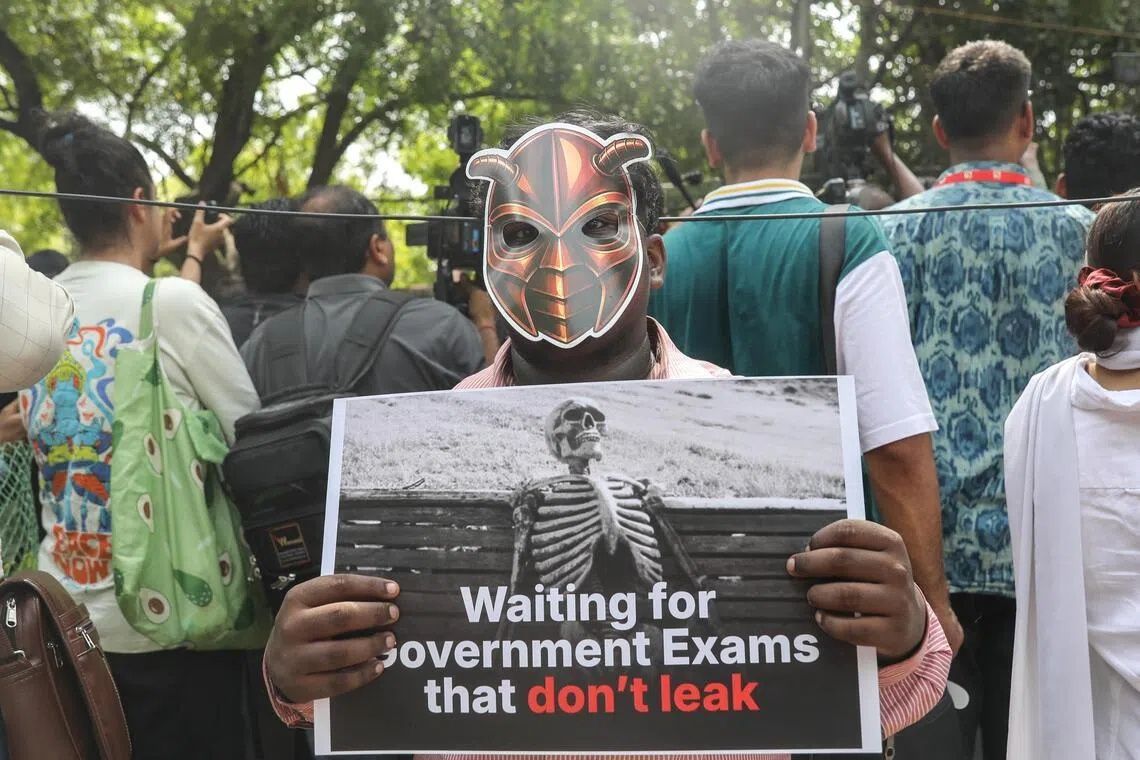
India's higher education system faces a critical moment as 2.2 million aspiring medical students prepare to sit a fresh examination on Sunday under extraordinarily stringent security protocols. The retest comes after the original National Eligibility cum Entrance Test scheduled for May was completely invalidated following a breach that exposed examination papers, sparking widespread demonstrations and calls for institutional reform at the highest levels of government.
The fallout from the initial leak extended far beyond disappointed test-takers. Student organisations and parents mobilised across the country to voice their frustration, with Indian media reporting that several teenagers took their own lives in the aftermath. The crisis reached such proportions that it triggered broader questioning of the country's examination infrastructure and competence of educational administrators, culminating in public demands that Education Minister Dharmendra Pradhan step down from his position.
The contamination of the testing process proved especially damaging because of the enormous stakes involved. The National Eligibility cum Entrance Test functions as the sole gateway to India's medical colleges, with millions of candidates vying annually for merely 100,000 undergraduate places across the nation. The astronomical competition ratio has spawned a sprawling coaching industry worth billions of rupees and created lucrative opportunities for criminal syndicates willing to traffic in stolen examination materials and organised cheating networks.
Authorities have responded with what they describe as an unprecedented enforcement operation. More than 200,000 officials, drawn from police forces and civil administration, have been mobilised specifically to oversee Sunday's examination. The National Testing Agency, which administers the test, has implemented what it characterises as a comprehensive "multi-layered security framework" designed to prevent any recurrence of the breach. The framework incorporates biometric identity verification at examination centres, artificial intelligence-powered camera systems capable of detecting suspicious behaviour in real-time, and satellite-based GPS tracking of question paper bundles throughout their distribution chain.
The government has also taken the unusual step of restricting access to Telegram, the encrypted messaging platform favoured by India's tech-savvy youth. Officials determined that cheating networks had systematically exploited the application to circulate leaked questions and coordinate fraud schemes among organised groups. The National Testing Agency explicitly cited this pattern when justifying the week-long restriction on the service, arguing that the platform had become an essential tool enabling examination fraud at scale.
However, the validity of the Telegram restriction has drawn scepticism from unexpected quarters. Pavel Durov, the chief executive and founder of Telegram, publicly questioned whether blocking a single application would meaningfully address the underlying problem. He contended that criminals would simply migrate their operations to alternative messaging services, and that the genuine vulnerability lay not with any particular technology but rather with insiders—individuals with access to examination materials who were actively facilitating leaks. His analysis highlights the systemic nature of the challenge India confronts, suggesting that security hardware and restrictions on communications platforms cannot substitute for institutional integrity and oversight of people holding sensitive positions.
The investigation into the leak itself has already produced tangible results. India's Central Bureau of Investigation, the nation's premier federal detective agency, has arrested the individual identified as orchestrating the paper breach. Remarkably, the alleged mastermind held credentials as a chemistry lecturer, indicating that educational insiders were directly complicit in compromising examination security. This revelation has intensified scrutiny of how educational institutions vet staff with access to confidential test materials and what systems exist to monitor their conduct.
Preceding the NEET scandal, Indian higher education had already faced a separate but parallel crisis involving the computerised marking system deployed for high school board examinations taken by nearly two million students. Thousands of candidates and their families alleged that the automated grading methodology had produced erroneous results, with some reporting that marks were credited to wrong students or that their performance assessments bore no correlation to their actual responses. The combination of the medical entrance test fraud and the high school marking breakdown created a perception of systemic dysfunction across India's educational assessment infrastructure.
The mounting frustration with institutional failure has mobilised a peculiar form of political protest. A satirical movement calling itself the "Cockroach People's Party" emerged in May and has accumulated millions of social media followers in just weeks. While primarily humorous in intent, the movement has channelled genuine public anger by directly demanding Pradhan's removal, reflecting how deeply the examination crises have eroded public confidence in educational leadership and governance.
For Malaysian and Southeast Asian observers, these developments carry important implications. India's challenges with examination integrity, corruption within educational institutions, and the difficulty of securing sensitive processes against internal threats resonate across the region. Many countries in Southeast Asia operate similarly competitive entrance examination systems with analogous vulnerabilities to corruption and fraud. The Indian crisis illustrates both the potential consequences of allowing such systems to deteriorate through inadequate oversight and the political costs when institutional failures affect millions of young people simultaneously. The massive security operation being deployed for Sunday's retest, despite legitimate questions about its effectiveness, demonstrates how governments respond when public confidence in core educational processes has been shattered.
%22%2F%3E%3C%2Fpattern%3E%3C%2Fdefs%3E%3Crect%20width%3D%22100%25%22%20height%3D%22100%25%22%20fill%3D%22url(%23ph3i46gg)%22%2F%3E%3Crect%20width%3D%22100%25%22%20height%3D%22100%25%22%20fill%3D%22url(%23ph3i46gp)%22%2F%3E%3Ctext%20x%3D%2250%25%22%20y%3D%2250%25%22%20text-anchor%3D%22middle%22%20dominant-baseline%3D%22central%22%20fill%3D%22rgba(255%2C255%2C255%2C0.95)%22%20font-family%3D%22Georgia%2C%20'Times%20New%20Roman'%2C%20serif%22%20font-weight%3D%22700%22%20font-size%3D%22320%22%20letter-spacing%3D%22-0.02em%22%3E24%3C%2Ftext%3E%3C%2Fsvg%3E)
%22%2F%3E%3C%2Fpattern%3E%3C%2Fdefs%3E%3Crect%20width%3D%22100%25%22%20height%3D%22100%25%22%20fill%3D%22url(%23ph2u52ag)%22%2F%3E%3Crect%20width%3D%22100%25%22%20height%3D%22100%25%22%20fill%3D%22url(%23ph2u52ap)%22%2F%3E%3Ctext%20x%3D%2250%25%22%20y%3D%2250%25%22%20text-anchor%3D%22middle%22%20dominant-baseline%3D%22central%22%20fill%3D%22rgba(255%2C255%2C255%2C0.95)%22%20font-family%3D%22Georgia%2C%20'Times%20New%20Roman'%2C%20serif%22%20font-weight%3D%22700%22%20font-size%3D%22320%22%20letter-spacing%3D%22-0.02em%22%3EData%3C%2Ftext%3E%3C%2Fsvg%3E)
%22%2F%3E%3C%2Fpattern%3E%3C%2Fdefs%3E%3Crect%20width%3D%22100%25%22%20height%3D%22100%25%22%20fill%3D%22url(%23ph7ag3g)%22%2F%3E%3Crect%20width%3D%22100%25%22%20height%3D%22100%25%22%20fill%3D%22url(%23ph7ag3p)%22%2F%3E%3Ctext%20x%3D%2250%25%22%20y%3D%2250%25%22%20text-anchor%3D%22middle%22%20dominant-baseline%3D%22central%22%20fill%3D%22rgba(255%2C255%2C255%2C0.95)%22%20font-family%3D%22Georgia%2C%20'Times%20New%20Roman'%2C%20serif%22%20font-weight%3D%22700%22%20font-size%3D%22170%22%20letter-spacing%3D%22-0.02em%22%3EMalaysia%3C%2Ftext%3E%3C%2Fsvg%3E)