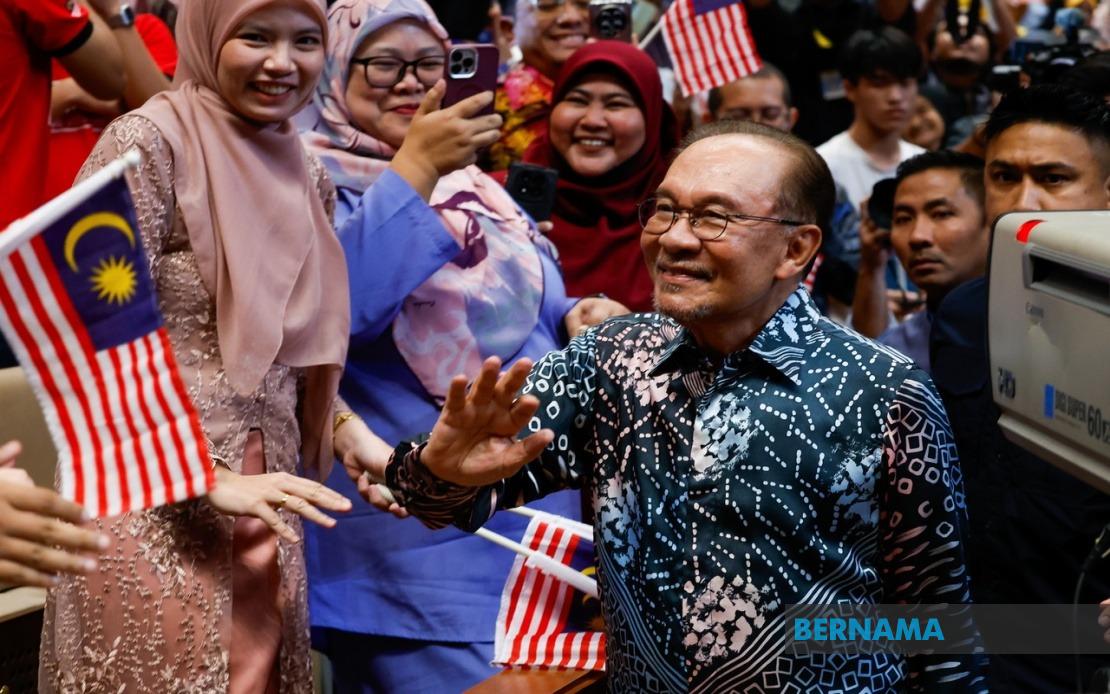
Prime Minister Datuk Seri Anwar Ibrahim has made a compelling case for reimagining national independence not as a historical achievement confined to textbooks, but as a living principle that must be actively cultivated within every citizen's consciousness. Speaking at the Putrajaya International Convention Centre during the National Day address, he positioned the psychological and spiritual dimensions of independence as the genuine frontier facing Malaysia's continued development and social cohesion.
Anwar's framing represents a subtle but significant departure from conventional National Day rhetoric. Rather than celebrating the 1957 transition from colonial rule as a completed historical event, he presented independence as an ongoing challenge that demands continuous renewal. This perspective suggests that the real work of building a sovereign nation extends far beyond the institutional frameworks—the constitutions, parliaments, and administrative structures that were formally transferred at independence. Instead, he contended that the deeper task involves embedding a sense of genuine autonomy and self-determination within the personal worldview of every Malaysian.
The Prime Minister articulated a vision in which this independence of spirit transcends demographic boundaries. He explicitly rejected sectarian divisions, insisting that unity cannot be constructed along lines of ethnicity, geography, or administrative division. This formulation carries particular weight in the Malaysian context, where communal identities have historically shaped political mobilization and policy outcomes. By anchoring unity to the principle of shared independence rather than shared ethnicity or region, Anwar positioned himself against fragmentation, while simultaneously endorsing the constitutionally established position of Malays and Bumiputeras as the foundation of the social contract.
The significance of Anwar's emphasis on generational continuity warrants closer examination. His reference to how each successive generation must embrace and transmit this independence spirit suggests concern that without deliberate effort, younger Malaysians may inherit the formal machinery of statehood without internalizing its underlying principles. In an era of rapid globalization, digital connectivity, and shifting social values, this intergenerational transmission cannot be assumed automatic. The challenge becomes pedagogical and cultural—how institutions, families, schools, and civic organizations can effectively instill such values in populations increasingly influenced by transnational forces.
The call for united action in defending rights and upholding justice serves as the practical corollary to Anwar's philosophical argument. Independence framed as a personal virtue gains concrete meaning only when citizens actively exercise agency in protecting their own freedoms and those of their fellow citizens. This framing positions Malaysians not as passive recipients of governance but as active participants responsible for maintaining democratic standards and constitutional guarantees. The implicit message acknowledges that institutions alone cannot safeguard rights—vigilant citizenry must remain engaged and assertive.
For Malaysian readers, particularly those concerned with the trajectory of democratic institutions and social stability, Anwar's emphasis carries both inspirational and cautionary dimensions. The optimistic reading suggests a commitment to inclusive national-building that transcends communal boundaries. The more critical interpretation might note the tension between affirming Malay-Bumiputera primacy while simultaneously calling for undifferentiated unity, a balancing act that has consistently challenged Malaysian political leadership.
The address, delivered with Deputy Prime Minister Datuk Seri Dr Ahmad Zahid Hamidi, Communications Minister Datuk Seri Fahmi Fadzil, and Chief Secretary to the Government Tan Sri Shamsul Azri Abu Bakar in attendance, carries weight as an official statement of government philosophy at a significant national commemoration. The presence of senior cabinet figures underscores the administration's commitment to this particular articulation of national purpose, suggesting that independence-of-spirit messaging may feature prominently in coming months of policy communication and civic engagement initiatives.
The broader regional context adds another layer to this discourse. Southeast Asian nations collectively grapple with questions of national resilience, social cohesion, and citizen participation in an era of economic competition and geopolitical flux. Malaysia's experience navigating multicultural democracy while maintaining institutional stability offers lessons both within and beyond its borders. An emphasis on internalized independence—citizens who think critically, exercise agency responsibly, and defend collective welfare—represents a framework that could potentially strengthen civic culture across the region's diverse societies.
For observers tracking Malaysian political development, Anwar's articulation suggests an intellectual approach to governance that privileges ideational and cultural foundations over purely institutional reform. Whether this emphasis translates into concrete policy initiatives—curricular changes, civic education programs, institutional reforms promoting transparency and accountability—will significantly determine whether the message functions as transformative vision or inspirational rhetoric. The test of such pronouncements typically lies not in their initial articulation but in the mechanisms through which governments embed such principles into the daily functioning of state institutions and the lived experience of citizens.

