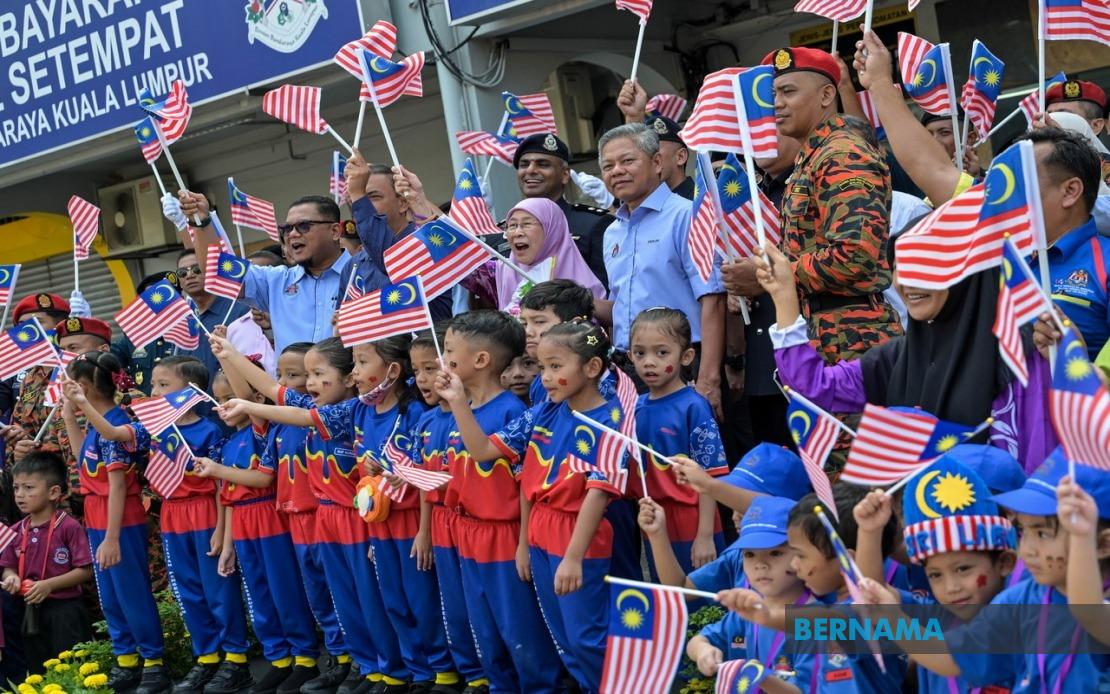
The Prime Minister's wife, Datuk Seri Dr Wan Azizah Wan Ismail, has underscored the need to treat national independence not merely as an annual occasion for patriotic displays, but as an ongoing commitment that binds society together and sustains the nation's stability. Speaking at the Semarak Merdeka Programme in Kuala Lumpur on August 12, she stressed that true appreciation of independence requires recognising it as a shared duty among all citizens to preserve the country's peace, unity and social harmony.
Dr Wan Azizah moved beyond the conventional rhetoric of National Day celebrations, arguing that independence carries profound meaning rooted in the struggles and sacrifices of earlier generations who fought to establish Malaysia as a sovereign nation. Rather than reducing the occasion to ceremonial gestures such as shouting "Merdeka" or displaying the Jalur Gemilang flag, she encouraged Malaysians to reflect on the historical struggles that underpinned the achievement of independence and the ongoing responsibility this imposes on contemporary society.
Speaking in her capacity as Member of Parliament for Bandar Tun Razak, Dr Wan Azizah advocated for transforming the annual independence celebration into a meaningful forum where citizens could honour the sacrifices of past generations while simultaneously recommitting themselves to building a more united, economically prosperous and socially progressive community. This perspective aligns with efforts to deepen public understanding of national values beyond surface-level patriotic expressions.
The event's focus on this year's National Day theme, "Malaysia Madani: Jiwa Merdeka", reflected contemporary policy priorities aimed at elevating living standards, ensuring equitable access to opportunities across demographic groups, and reinforcing national cohesion. This thematic framework suggests government messaging is attempting to link independence not to abstract ideals but to tangible improvements in citizens' daily lives and shared prosperity.
Dr Wan Azizah highlighted Bandar Tun Razak as a microcosm of Malaysia's multicultural identity, noting that its approximately 191,000 residents comprise 60 per cent Malays, 24 per cent Chinese and 8 per cent Indians according to the Malaysian Population and Housing Census. She characterised this demographic composition as emblematic of a vibrant, cohesive community where different ethnic and religious groups coexist, thereby illustrating how the principles of national unity can function at the grassroots level.
Beyond the ceremonial aspects of the programme, Dr Wan Azizah visited three families residing in the Seri Pulau Pinang and Desa Tun Razak People's Housing Projects to distribute assistance from the Social Security Organisation (PERKESO) and the Federal Territories Islamic Religious Council (MAIWP). This component of her engagement highlighted the government's attempt to link national values with concrete social welfare initiatives targeting vulnerable populations.
One beneficiary, K. Moganavalli, 39, received a one-off Funeral Management Benefit of RM3,000 and a monthly Survivor's Pension of RM1,118.33 from PERKESO following the sudden death of her husband, Edwin Anthony Dass, 38, on August 2. Previously employed as a lorry and Grab driver, his passing left Moganavalli, a full-time homemaker, responsible for supporting their three young children. She expressed profound gratitude for the financial support, which she described as crucial during a period of considerable personal distress and economic vulnerability.
Another recipient, Khalijah Binti Nazir, 64, exemplified the challenges faced by vulnerable segments of Malaysia's population. As a single parent who abandoned employment to provide care for two children, one of whom experiences hearing impairment, she depends on a combination of social assistance programmes to meet household expenses. Her monthly income comprises RM800 from Baitulmal assistance, RM300 distributed via Boost eWallet, and RM150 under the Sumbangan Asas Rahmah (SARA) scheme, supplemented by RM100 monthly in SARA assistance allocated to her son.
These individual cases underscore how independence and national development, in practical terms, depend on functioning social safety nets that provide economic security to citizens facing unexpected hardship or structural disadvantage. The distribution of assistance to families at affordable housing projects situated within an urban parliamentary constituency demonstrates how government welfare mechanisms attempt to operationalise the concept of "Malaysia Madani" at the community level.
The presence of Prime Minister's political secretary Datuk Azman Abidin at the programme suggests high-level government investment in communicating messages about national values and social responsibility during the Merdeka season. This coordination between political leadership and grassroots social welfare delivery reflects an apparent strategic effort to frame independence not solely through historical or patriotic lenses, but through demonstrable commitment to improving circumstances for economically marginalised households.
For Malaysian readers, Dr Wan Azizah's emphasis on independence as shared responsibility carries particular relevance in an era when social fragmentation along various lines—economic, generational, and regional—poses challenges to national cohesion. Her framing suggests that sustaining national unity requires active cultivation through both symbolic recognition of historical struggles and contemporary commitment to equitable development and social protection.

