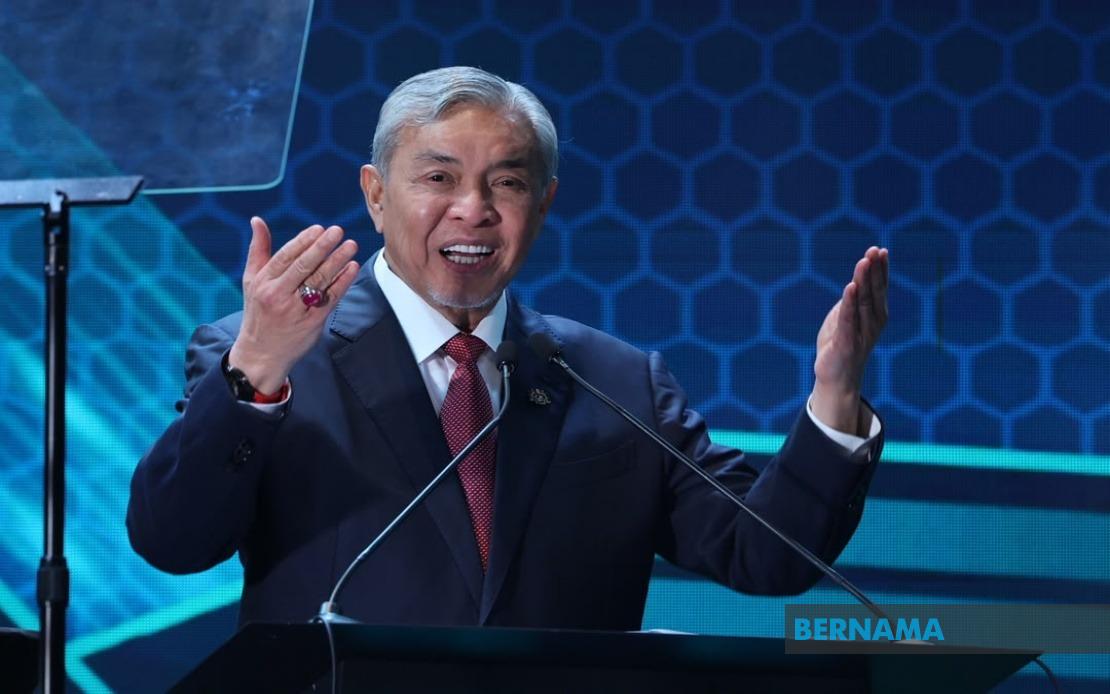
Deputy Prime Minister Datuk Seri Dr Ahmad Zahid Hamidi has called for a fundamental reimagining of Malaysia's Immigration Department, shifting its focus from a purely regulatory body into an institution that actively catalyses economic expansion while maintaining robust national security. Speaking at the 2026 Immigration Day celebration in Cyberjaya on July 21, Ahmad Zahid articulated a strategic vision that positions the department as a pivotal player in the nation's competitive positioning in an increasingly complex global landscape.
The cornerstone of this transformation rests on a four-point mandate that Ahmad Zahid framed as the department's "strategic compass" for the coming years. These priorities—facilitating economic growth, strengthening national security and sovereignty, accelerating digital transformation and service innovation, and enhancing integrity with professionalism and humanitarian values—represent a deliberate departure from legacy thinking that confined immigration services to border control and documentation. Rather than isolated piecemeal reforms, Ahmad Zahid emphasised that genuine institutional change demands alignment across every policy framework, system architecture and operational decision throughout the organisation.
On the economic dimension, Ahmad Zahid made a pointed observation about the direct correlation between bureaucratic efficiency and national competitiveness. He argued that every procedural delay, every unnecessary complication in the visa or entry process, and every layer of administrative friction ultimately undermines Malaysia's ability to attract foreign investment and global talent. He drew a comparative reference to the United Arab Emirates, which deliberately integrated immigration policy with investment attraction strategies, including its Golden Visa programme offering residency periods of up to ten years. This strategic alignment has yielded tangible results for the UAE, which recorded foreign direct investment totalling RM196.6 billion in 2025 and now ranks ninth globally as an investment destination for four consecutive years. The implicit message is clear: Malaysia cannot afford to view immigration administration as separate from its broader economic development objectives.
Beyond the economic case, Ahmad Zahid placed significant emphasis on evolving security threats that demand a fundamental recalibration of the department's enforcement approach. He characterised contemporary security challenges as fundamentally different from those of a decade ago, noting that criminal and hostile actors now operate across borders with temporal irrelevance. Human smuggling networks have grown increasingly sophisticated and coordinated, while human trafficking operations have become substantially more complex in their methodologies and operational scope. Under this threat environment, merely reactive enforcement proves inadequate; Ahmad Zahid called for intelligence-driven, data-informed security operations that leverage seamless coordination among all national enforcement agencies.
Central to this security modernisation is the strategic deployment of advanced technology. Ahmad Zahid outlined a vision for JIM that harnesses big data analytics, artificial intelligence systems, predictive modelling tools, digital identity platforms, biometric systems and intelligent border infrastructure. The goal extends beyond operational speed—processing applications faster, for instance—to fundamentally transform institutional cognition and decision-making quality. By embedding technology into the department's operational fabric, Ahmad Zahid suggested that JIM could achieve decisions that are simultaneously faster, more analytically rigorous and more secure, thereby elevating service standards to international benchmarks.
The third pillar of Ahmad Zahid's mandate addresses digital transformation more broadly. He emphasised that technology adoption must not be merely instrumental but transformative, enabling the department to "think smarter, act more precisely and deliver world-class services." This framing suggests a cultural shift alongside technological implementation—a recognition that modernisation requires not just new tools but new mindsets about how work should be conducted and evaluated.
Understanding institutional culture and ethical standards, Ahmad Zahid devoted considerable attention to the integrity and humanitarian dimensions of the transformation agenda. He exhorted all JIM personnel to maintain strict procedural compliance, exercise sound judgement in decision-making and demonstrate the moral courage to make ethically correct decisions even when facing pressure or complexity. These values, he stressed, form part of the department's identity and reputation—JIM is recognised not merely as a law enforcement body but as an institution embodying professionalism, integrity and humanitarian concern. This positioning matters significantly in regional and international contexts, where perceptions of Malaysian immigration administration influence investment decisions and talent acquisition.
Ahmad Zahid's framing of the four-point mandate as producing "One Direction for Immigration Transformation" underscores his insistence on institutional coherence rather than fragmented initiatives. Genuine transformation, he argued, cannot emerge from isolated projects or temporary programmes; it requires comprehensive implementation woven throughout the organisation's entire operational structure. This systemic approach has implications for how the department allocates resources, trains personnel, designs incentive structures and evaluates performance.
The strategic significance of Ahmad Zahid's address extends beyond immigration administration itself. His positioning of JIM as simultaneously a "bulwark of national sovereignty, a catalyst for economic competitiveness and a symbol of public trust" reflects broader questions about how Malaysia conceives its development priorities and institutional capabilities. In Southeast Asian context, where regional competition for investment and talent intensifies annually, countries that successfully harmonise security imperatives with economic openness gain competitive advantage. Ahmad Zahid's mandate suggests Malaysia recognises this imperative and is attempting to recalibrate institutional arrangements accordingly.
The presence of Chief Secretary to the Government Tan Sri Shamsul Azri Abu Bakar, Public Service Department director-general Tan Sri Wan Ahmad Dahlan Abdul Aziz and Immigration director-general Datuk Zakaria Shaaban at the event signalled whole-of-government commitment to the transformation agenda. This inter-agency attendance underscores that immigration modernisation cannot succeed in departmental isolation but requires coordination and support across the public service apparatus.
For Malaysian business and investment communities, Ahmad Zahid's emphasis on reducing unnecessary bureaucratic friction in immigration processes carries tangible implications. Multinational corporations, expatriate talent and foreign investors frequently cite immigration efficiency as a decision factor in location selection. By committing to streamlined, intelligent immigration administration, Malaysia positions itself more competitively against regional peers pursuing similar talent and capital attraction strategies.
The transformation agenda also carries implications for regional migration patterns and ASEAN labour mobility initiatives. As Southeast Asian nations increasingly engage in cross-border talent movements facilitated through frameworks like the ASEAN Comprehensive Investment Agreement, immigration departments that combine efficiency with security capacity become strategic assets. Ahmad Zahid's mandate positions JIM as attempting to navigate this complex terrain, balancing openness with vigilance.

