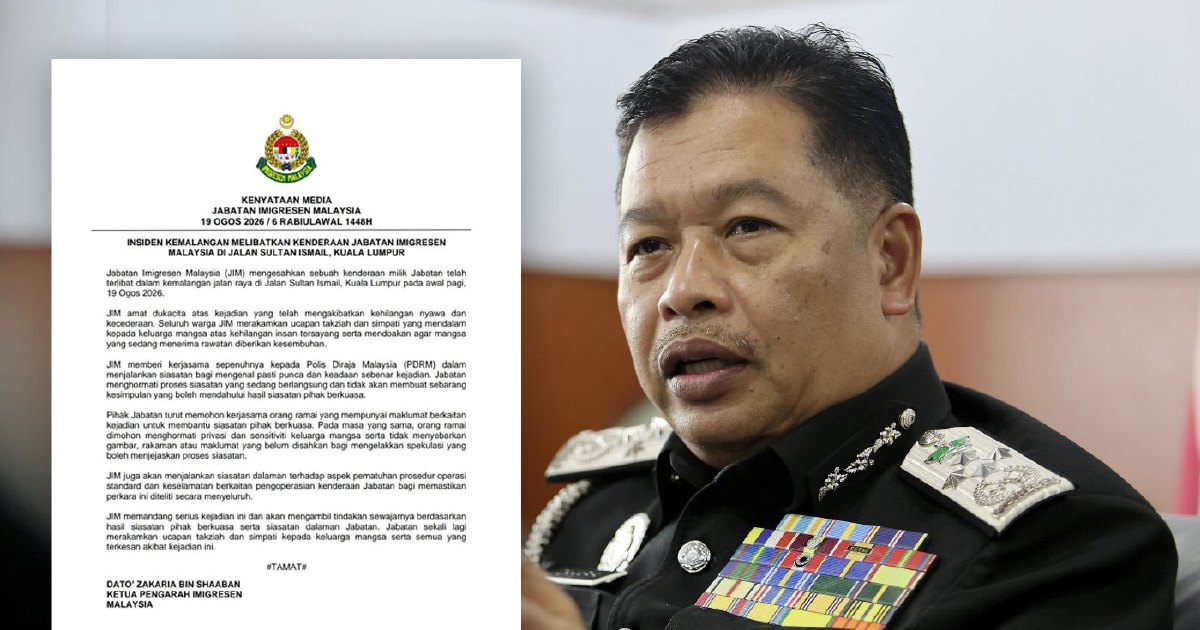
The Immigration Department has launched a formal internal investigation into a fatal traffic accident involving one of its vehicles that occurred early this morning on Jalan Sultan Ismail in central Kuala Lumpur. The inquiry will focus specifically on whether departmental standard operating procedures and established safety protocols were properly followed in the lead-up to and circumstances surrounding the collision.
Fatal road accidents involving government vehicles often prompt scrutiny from both the agencies themselves and the public regarding operational practices. Such incidents raise broader questions about vehicle maintenance schedules, driver training standards, and whether safety measures are rigorously applied across all government departments. The Immigration Department's decision to investigate internally demonstrates an acknowledgement that procedural adherence warrants examination whenever loss of life occurs on public roads.
Jalan Sultan Ismail, a major arterial route connecting central Kuala Lumpur to residential and commercial districts, experiences substantial traffic flow throughout the day and evening. Accidents on this thoroughfare inevitably disrupt vehicular movement and heighten awareness of road safety among commuters. The precise circumstances of this morning's collision remain to be fully clarified through the investigation process.
Internal departmental probes of this nature typically examine multiple dimensions of operational practice. These investigations generally review whether drivers had undergone mandatory safety training, whether vehicles had completed required maintenance checks, whether speed limits and traffic regulations were observed, and whether any systemic factors may have contributed to the accident. The scope often extends to evaluating whether existing SOPs adequately address identified risks.
For the Immigration Department specifically, vehicle safety standards carry particular importance given that the organisation regularly deploys personnel in field operations throughout the country. Ensuring that transportation protocols meet rigorous safety criteria reflects the department's broader obligation to protect both its workforce and the general public during operations. Any deficiencies identified through this investigation could necessitate departmental-wide policy adjustments.
The Malaysian government has increasingly emphasised road safety as a national priority, with multiple agencies collaborating to reduce accident fatalities. Government departments are expected to model exemplary safety practices within their own operations as part of this collective effort. When accidents occur involving official vehicles, the resulting inquiries contribute to an evolving understanding of what effective safety governance requires at the departmental level.
Beyond the immediate investigation, such incidents often generate wider discussions about vehicle fleet management across government bodies. Questions arise regarding whether agencies have adequate resources for regular vehicle servicing, whether driver rotation policies account for fatigue management, and whether routes and timing of journeys are planned with safety as a primary consideration. The Immigration Department's investigation findings may therefore influence practices across other government departments.
The timing of the accident on Jalan Sultan Ismail early in the morning suggests it occurred during the early commute period when traffic patterns are transitioning from night-time to daytime volumes. Visibility conditions, traffic density, and pedestrian activity all vary significantly at different times of day and may have been relevant factors. The investigation will need to document these contextual circumstances in addition to procedural compliance issues.
For residents and workers in the Jalan Sultan Ismail area, the incident serves as a reminder of the constant hazards present on busy urban thoroughfares. Accidents involving government vehicles sometimes receive heightened public attention compared to incidents involving private vehicles, partly because questions of institutional accountability arise naturally when loss of life occurs during official operations. This scrutiny, while sometimes uncomfortable for agencies, can drive meaningful improvements in safety culture.
The Immigration Department's commitment to examining its own practices demonstrates recognition that organisations must look inward when serious incidents occur rather than attributing outcomes solely to external factors. Such accountability mechanisms, when properly executed, can identify gaps in existing procedures and lead to meaningful corrective actions. However, the actual value of internal investigations depends substantially on the thoroughness of the process and the willingness to implement findings transparently.
Road safety remains a persistent challenge across Malaysia, with traffic fatalities continuing to represent a significant public health concern. When government agencies conduct rigorous investigations into accidents involving their own vehicles, the lessons learned can potentially be scaled across the broader public sector. This institutional learning process, replicated across multiple departments, contributes incrementally to systemic improvements in how government operations prioritise safety.
Preliminary information regarding the accident is limited at this early stage, and full details regarding those involved and the precise sequence of events will likely emerge as the investigation progresses. The Immigration Department has indicated its intention to conduct this inquiry thoroughly, which suggests the findings may be shared publicly once the process concludes, allowing broader stakeholders to understand what occurred and what preventative measures might be implemented moving forward.

