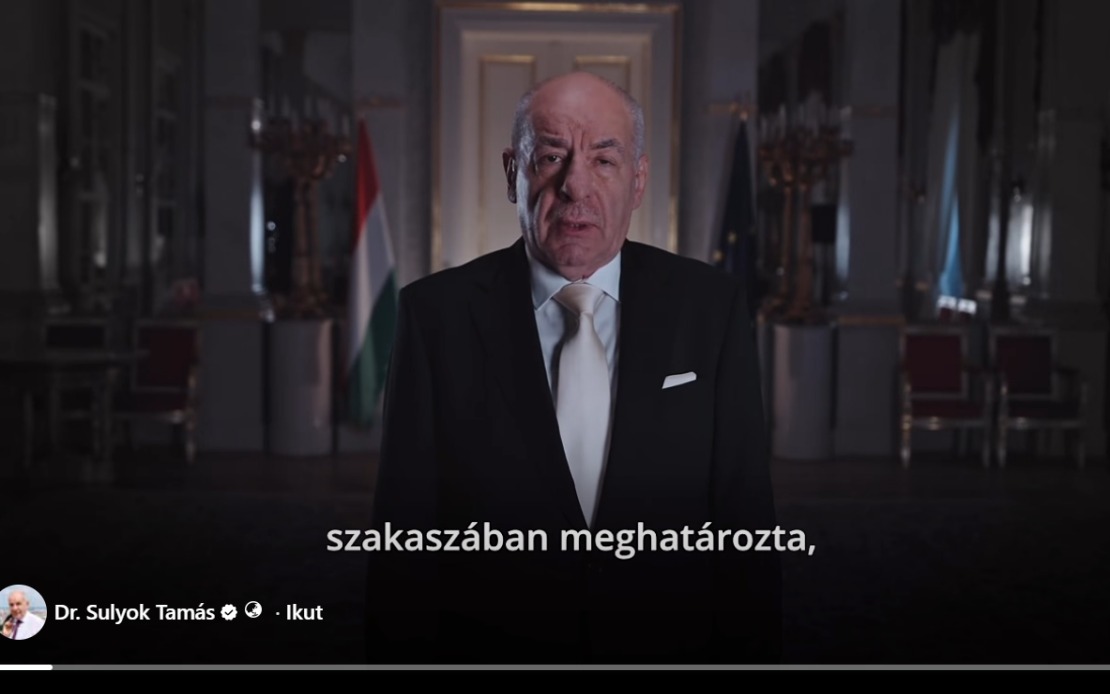
Hungary's political crisis has reached its conclusion after President Tamás Sulyok capitulated to an ultimatum from new Prime Minister Péter Magyar, agreeing to countersign constitutional amendments that will force him from office. The announcement on July 19 marks the dramatic end to days of hesitation by Sulyok, who had initially resisted the parliamentary move to remove him despite facing the prospect of impeachment proceedings. By accepting the constitutional changes, Sulyok cleared the path for sweeping political reforms that the Magyar government intends to implement as part of its broader agenda to reshape Hungary's institutional landscape following the April ouster of former Prime Minister Viktor Orbán's long-standing political influence.
The constitutional amendment itself passed through parliament last Monday, setting off a clock that gave Sulyok five days to formally countersign the document or face removal through impeachment. Rather than allow that confrontation to unfold, Sulyok chose compliance, recognizing the mathematical reality that parliament held sufficient political capital to enforce its will regardless of his resistance. His decision became effective on the Monday following his announcement, creating an immediate vacancy in the presidency and triggering a succession process defined by constitutional protocol.
Parliamentary speaker Agnes Forsthoffer assumes the constitutional powers and responsibilities of the presidency during this interregnum period, serving as acting head of state until a new president is elected. Hungarian constitutional procedure mandates that parliamentary members must select the successor within thirty days, maintaining institutional continuity while the selection process unfolds. This arrangement reflects Hungary's parliamentary system of governance, where the head of state operates as a figurehead with limited executive authority compared to the prime minister, who holds substantially greater political power.
Magyar, who assumed the prime ministership following Orbán's departure, publicly confirmed that Sulyok had indeed countersigned the constitutional amendments and that his presidency would terminate at the previously announced date. The Prime Minister framed these institutional changes as restorative rather than destructive, positioning them as measures designed to restore democratic safeguards and protect citizens from authoritarian consolidation. In a Facebook statement, Magyar emphasized that the reforms would restore limited government principles and enable the recovery of state assets, reversing what his administration characterizes as the systematic erosion of democratic norms during Orbán's tenure.
Sulyok's formal objections to the procedure proved ultimately performative. Despite his public assertion that parliament's decision to remove him constituted an unconstitutional action, he acknowledged possessing no viable legal mechanism to contest the amendment's validity. Constitutional scholars had already assessed that Hungary's constitutional court might theoretically challenge the procedural mechanics of the amendment but lacked substantive grounds to overturn parliament's political determination. This absence of judicial recourse left Sulyok with an untenable choice between dignified capitulation and futile resistance that would merely delay the inevitable.
In a video address distributed through social media, Sulyok articulated concerns about the diminished institutional independence of Hungary's presidency under the amended constitutional framework. He observed that under the new arrangements, every future head of state would remain subordinate to executive pressure and parliamentary majorities, lacking meaningful oversight capacity. His complaint highlighted a fundamental tension within Hungarian governance: the presidency has been systematically weakened to the point where it cannot independently check executive or legislative overreach, reducing the office to ceremonial status while concentrating power within parliamentary and governmental structures.
The constitutional reforms extend considerably beyond the presidential removal, encompassing far-reaching modifications to Hungary's political architecture. These amendments represent the Magyar administration's opening legislative salvos in its declared commitment to reconstruct Hungarian democracy according to principles it characterizes as more pluralistic and protective of civil liberties. The government argues these changes are essential to undo institutional distortions accumulated during the previous regime's extended tenure in office.
For regional observers in Southeast Asia, Hungary's political upheaval offers cautionary lessons regarding institutional fragility and democratic vulnerability. The case demonstrates how constitutional safeguards can prove inadequate against determined majorities, particularly when political actors prioritize immediate objectives over procedural norms. Malaysia's own federal system contains analogous tensions regarding the distribution of executive, legislative, and ceremonial authority, making Hungary's experience potentially instructive for understanding how institutional imbalances can concentrate power dangerously.
The removal of Sulyok also illustrates the broader European realignment occurring in post-communist states as political coalitions shift and generational changes reshape governance preferences. Orbán's political influence, while diminished in immediate Hungarian contexts, continues reverberating across Central and Eastern Europe, where his political model had attracted considerable emulation. The reassertion of parliamentary supremacy in Hungary signals potential tectonic shifts in regional political trajectories that could influence European Union dynamics and transatlantic relations more broadly.
Looking forward, the thirty-day window for selecting Sulyok's successor will reveal important information about Magyar's political consolidation and the extent to which parliamentary consensus exists regarding democratic reconstruction. The identity and background of the incoming president may signal whether the current political moment represents a temporary correction or a sustained realignment toward more pluralistic governance. Given Hungary's historical experiences with institutional instability and the stakes involved in presidential selection, the succession process will likely attract substantial international scrutiny alongside domestic political attention.

