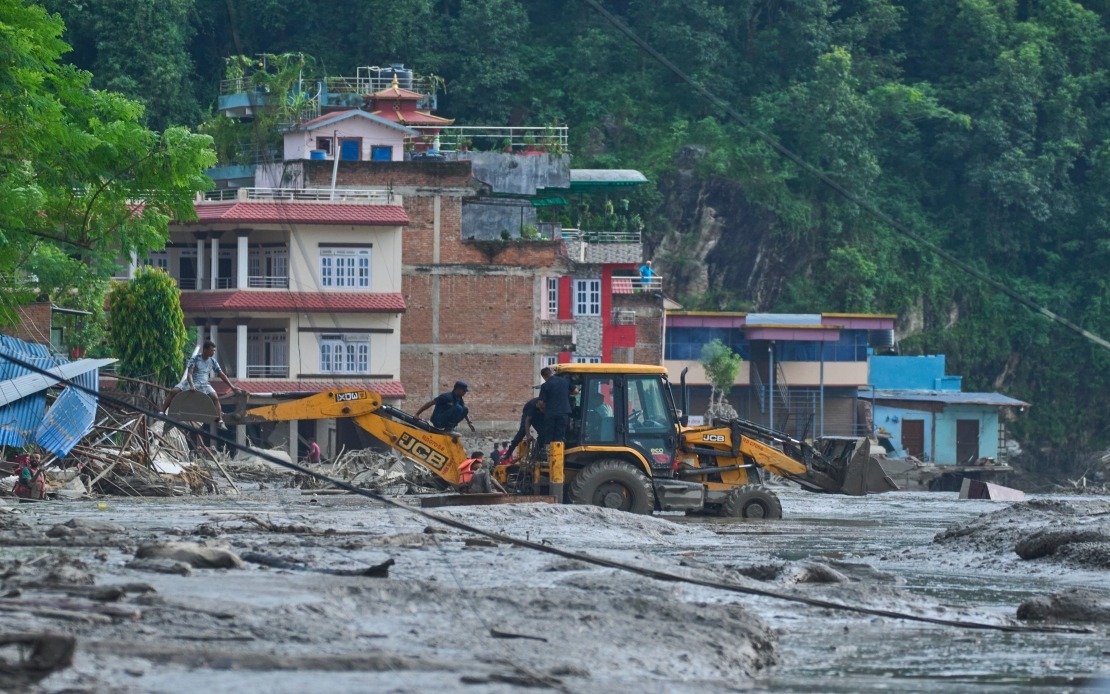
A catastrophic weather event unfolding across the Nepal-China border region has left at least 160 people dead and more than 680 unaccounted for, according to official reports from both nations. The disaster, triggered by flash floods and accompanying mudslides, represents one of the most severe natural disasters to affect the border zone in recent years. Nepalese police confirmed that rescue teams had recovered 157 bodies by Wednesday, while 54 individuals had been successfully extracted from inundated areas. Chinese state media indicated an additional three fatalities in the Xizang Autonomous Region, known internationally as Tibet, with 265 persons reported missing on the Chinese side of the border.
The missing persons encompass an exceptionally diverse demographic spanning multiple nationalities and occupations. Among those unaccounted for are 44 military personnel, 28 police officers, 13 armed police members, and 60 civilian workers engaged in hydropower project construction, according to the Nepalese Prime Minister's Office. The figure of missing tourists and travellers initially stood at 484, comprising 391 foreign nationals and 93 Nepalese citizens. Victims' nationalities represent at least eight countries, including Malaysia, Australia, the United Kingdom, South Africa, India, and the Netherlands. The South Korean Foreign Ministry reported eight of its nationals unaccounted for and a further ten stranded by the disaster, underscoring the international dimensions of this tragedy.
The geographical epicentre of destruction in Nepal spans three districts: Rasuwa, Dhading, and Chitwan. The Rasuwagadhi area, which serves as a primary border crossing and popular staging point for trekking expeditions into the renowned Langtang region, suffered particularly severe impacts. Many of the missing tourists were traversing routes toward Mount Kailash and Lake Mansarovar in China or pursuing trekking activities when the disaster struck. On the Chinese side, a catastrophic mudslide near Gyirong Port—a major bilateral border crossing in Xigaze City—devastated the region and severed multiple critical connections. Road access, telecommunications infrastructure, and electrical supplies all suffered extensive damage, hampering initial rescue coordination efforts.
The physical infrastructure damage documented thus far reveals the disaster's extraordinary severity. Nepali government assessments confirm that at least 19 bridges have been washed away entirely, whilst 40 kilometres of road network sustained destruction. Thirteen hydropower projects, representing significant investments in the region's energy infrastructure, were damaged or destroyed. Nepalese Foreign Minister Sishir Khanal provided parliamentary testimony describing widespread obliteration of hydropower installations, government facilities, and transportation systems. This destruction extends far beyond immediate casualty figures, threatening the region's economic viability and development trajectory for months or years to come.
Both nations have mobilised substantial rescue resources responding to the unfolding emergency. Nepalese authorities deployed personnel from the Nepal Police, Armed Police Force, and Nepal Army across affected districts, equipped with helicopters, drones, and specialised river rescue equipment including inflatable rafting boards. Chinese authorities similarly launched comprehensive search and rescue operations, with President Xi Jinping explicitly ordering all-out recovery efforts and directing officials to evacuate persons at risk and provide urgent medical care to minimise additional casualties. The dual-front nature of these operations required coordination across the border, complicating logistical arrangements but demonstrating both governments' commitment to addressing the catastrophe.
Medical infrastructure across Nepal mobilised urgently to manage casualties and injured survivors. Government hospitals and facilities operated by security agencies in Kathmandu were cleared and prepared to receive influxes of patients requiring trauma care, emergency surgery, and critical treatment. The sheer volume of missing persons suggested that casualty figures would likely increase as rescue operations progressed and recovery efforts shifted from active search phases toward victim identification and body recovery.
Regional powers responded swiftly with diplomatic statements and concrete assistance. Indian Prime Minister Narendra Modi telephoned his Nepalese counterpart Balendra Shah, conveying official condolences and pledging comprehensive humanitarian support. India immediately despatched ten tonnes of disaster relief supplies, essential medicines, and humanitarian assistance to Nepal's assistance operations. Additionally, Samrat Choudhary, the chief minister of Bihar state in eastern India, initiated heightened vigilance measures including round-the-clock embankment monitoring and intensive night patrols in sensitive districts, anticipating potential spillover effects from the Nepalese crisis into Indian territories.
The Rasuwagadhi corridor holds particular significance within South Asian geography and travel patterns. Beyond its role as a major commercial border crossing, it functions as a transit point for pilgrimage tourism directed toward Mount Kailash and Lake Mansarovar, sites of profound religious importance across multiple faith traditions. The Langtang trekking region represents one of Nepal's most commercially vital tourism destinations, attracting international visitors throughout the year. The disaster's timing and location therefore affected not merely local communities but disrupted broader patterns of regional commerce, pilgrimage, and tourism that connect Nepal, Tibet, and the wider Himalayan tourism ecosystem.
The unfolding situation illustrates vulnerabilities inherent to high-altitude border regions where mountainous terrain, seasonal precipitation patterns, and rapid geological processes create compounding hazard profiles. Climate patterns and geological instability combine to produce conditions where flash flooding triggers secondary landslide failures, multiplying destructive impacts across relatively constrained geographic areas. The concentration of infrastructure projects, border facilities, and tourism activity within the Nepal-China border zone meant that this single meteorological event cascaded across multiple economic and social dimensions simultaneously. International attention to the disaster reflected both humanitarian concern and recognition that such events transcend political boundaries, necessitating coordinated response frameworks and transnational cooperation mechanisms that tested existing bilateral and regional disaster management protocols.

