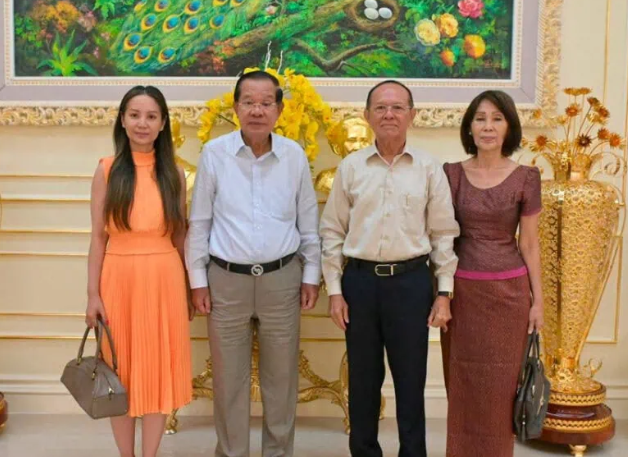
The evolving relationship between Cambodia's Senate president Hun Sen and former opposition leader Kem Sokha took another notable turn when the two men met at Hun Sen's residence on Sunday morning, with the ruling party chief subsequently describing the encounter as productive and extended. Hun Sen announced through social media that he had spent three hours in conversation with Sokha and his family during the visit, which ran from 9am until noon. The meetings represent a significant shift in the political dynamics between two figures who stood at opposite ends of Cambodia's political spectrum for years, before Sokha's legal troubles and subsequent partial rehabilitation.
Hun Sen gave few details about the substance of their discussion, declining to specify which topics dominated the three-hour exchange or whether political matters featured prominently in their conversation. However, what he chose to emphasise in his public statement proved revealing about the nature of the encounter and its potential implications. The Senate president singled out Kem Monovithya, Sokha's daughter, for particular praise, describing her as "an excellent human resource for the nation" and noting that he had devoted considerable time during the meeting to speaking with her. Such direct compliments directed at a member of the dissolved opposition party represent a departure from the confrontational political environment that characterised Hun Sen's interactions with the CNRP and its leadership.
The significance of Hun Sen's comments regarding Monovithya cannot be understated given her prominent association with the Cambodia National Rescue Party before its dissolution by the Supreme Court in 2017. Monovithya had maintained visibility within opposition circles even as her father faced legal restrictions and confinement. Hun Sen's characterisation of her as valuable national personnel, without elaborating on any prospective role or position, leaves open multiple interpretations about whether the remark signals potential future political or public responsibilities for her. Neither Hun Sen nor the Sokha family has indicated that the recent meetings relate to any formal political agreement, reconciliation framework, or plans to involve either figure in governance structures.
This latest encounter follows an earlier visit that Hun Sen referenced in his statement, when Sokha came to his home several weeks prior before undertaking a journey to meet Cambodian troops and civilians displaced by the ongoing Cambodia-Thailand border conflict. That previous meeting itself represented a notable development in the warming relationship between the two former antagonists. The pattern of increasing contact between Hun Sen and Sokha, combined with Sokha's gradual reintegration into public life following years of severe restrictions, reflects broader developments in Cambodia's political landscape that regional observers have been monitoring closely.
Sokha's journey toward rehabilitation has been measured and incremental, marked by a series of legal and administrative measures that progressively eased constraints imposed during years of prosecution and detention. In 2023, he received a 27-year prison sentence on treason charges alleging conspiracy with foreign powers, following his arrest in 2017 and his dissolution of the CNRP. The Phnom Penh Appeal Court upheld this conviction on April 30, 2026, while also imposing a five-year restriction on overseas travel. However, a royal pardon on May 25 terminated his remaining incarceration and house arrest, though restrictions preventing political activity persisted.
Further easing of constraints occurred when a royal decree issued on July 24 lifted the overseas travel ban that had been part of his court sentence. These successive reductions in restrictions created space for Sokha to resume limited public activity, provided he remained outside the formal political sphere. Days after the overseas travel restriction was removed, Sokha made a significant public appearance on July 28 when he travelled to Banteay Meanchey province in the northwest to visit communities affected by border hostilities. He carefully framed this visit as undertaken in a personal capacity rather than as a representative of any political party or state body, a distinction that allowed him to address humanitarian concerns while remaining within the boundaries of permissible activity.
The Cambodia-Thailand border region has been a persistent flashpoint in regional relations, with periodic armed clashes displacing civilians and creating humanitarian challenges that extend across provinces. Sokha's willingness to visit affected populations and reportedly raise their circumstances with international contacts demonstrates an attempt to remain engaged with national concerns despite formal political restrictions. This humanitarian dimension to his re-emergence provides a framework within which he can maintain public relevance without directly violating prohibitions on political activity.
The historical context underlying these recent developments extends back over a decade, during which the Cambodia National Rescue Party emerged as Cambodia's principal opposition force and mounted increasingly successful electoral challenges to the ruling Cambodian People's Party. In the 2013 national election and particularly the 2017 commune elections, the CNRP demonstrated substantial support that alarmed the established power structure. The dissolution of the party in November 2017, occurring merely two months after Sokha's arrest, dismantled the institutional framework that had given voice to opposition sentiments and effectively removed the primary challenger to single-party dominance.
For Southeast Asian observers and regional analysts, the apparent warming between Hun Sen and Sokha carries implications beyond personality or individual political fortunes. The trajectory of their relationship reflects broader questions about political inclusivity, reconciliation mechanisms, and the potential for opposition figures to eventually reintegrate into public discourse in Cambodia. The Sokha case demonstrates how political exile and legal incapacitation can eventually give way to selective rehabilitation, even absent formal acknowledgment of wrongdoing or explicit reconciliation processes.
The significance of Hun Sen's remarks about Monovithya warrants particular attention in this context. Her positioning as a potential resource for national development, while remaining outside formal political structures, could represent either genuine appreciation for her capabilities or a calculated signal that certain individuals from opposition backgrounds might eventually be incorporated into governance through non-partisan channels. Without explicit statements from either Hun Sen or the Sokha family, observers must parse meanings from carefully chosen language and the progression of publicly visible contacts.
Cambodia's political evolution toward greater openness—if that is indeed the direction—would carry implications for regional stability and international perceptions of democratic governance in Southeast Asia. The ASEAN region has watched Cambodia's political consolidation with varying degrees of concern, particularly regarding the fate of opposition figures and the scope for genuine political competition. Any movement toward broader political participation or reduced restrictions on former opposition leaders could reshape both domestic Cambodian politics and the country's standing within regional forums that emphasise democratic norms.
The unfolding relationship between Hun Sen and Sokha remains shrouded in ambiguity, with neither party articulating clear intentions or frameworks for future engagement. Whether the meetings represent preliminary steps toward formal political reconciliation, an attempt to co-opt opposition figures into government-aligned institutions, or simply the normalisation of relations between former adversaries remains unclear. What appears definitive is that the rigid political segregation that characterised Cambodia's politics during the CNRP's period of operation has become more fluid, creating space for interactions that would have been unthinkable during years of acute political division. How this evolving relationship develops will likely influence both Cambodia's internal politics and its presentation to the international community.

