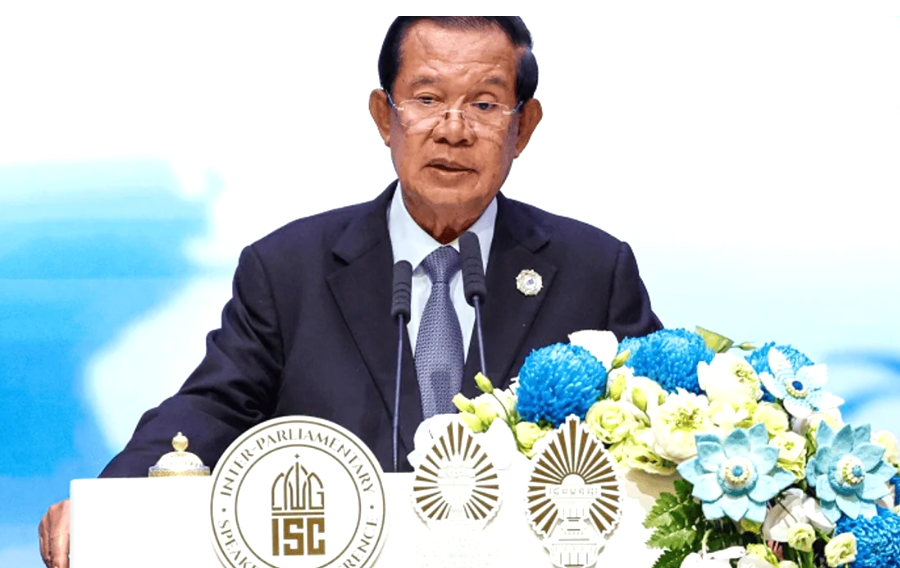
Cambodia's Senate president Hun Sen levelled a direct accusation against Thailand at a regional parliamentary gathering on Thursday, alleging that the neighbouring kingdom has weaponised the global concern over online scams as a thin pretext to illegally occupy portions of Cambodian territory. Speaking before delegates at the 2nd Inter-Parliamentary Speakers' Conference in Phnom Penh, Hun Sen positioned the Cambodia-Thailand border dispute as a stark example of how powerful nations circumvent international norms by dressing territorial aggression in the language of legitimate governance concerns.
The conference, which drew parliamentary leaders and delegations from Pakistan, Malaysia, Myanmar, Australia, Russia and numerous other nations, provided Hun Sen with a prominent platform to articulate Cambodia's grievances within a broader framework of contemporary geopolitical instability. His remarks illuminated a troubling pattern in 21st-century international relations: the exploitation of cross-border criminal issues—in this case, online scam operations—as justification for military action that fundamentally contradicts established principles of sovereignty and territorial integrity.
Hun Sen characterised the current border occupation as a violation of ceasefire agreements, suggesting that Thailand views such arrangements as merely symbolic commitments rather than binding obligations. The Senate president did not cite specific agreements by name, but his language pointedly questioned Thailand's commitment to even the most basic understandings between neighbouring states. This rhetorical move frames the dispute not as a technical disagreement over delineation, but as a deliberate repudiation of documented arrangements by a more militarily capable neighbour.
Beyond the immediate Cambodia-Thailand situation, Hun Sen embedded his critique within a comprehensive analysis of how modern conflict operates outside traditional battlefield parameters. He outlined several contemporary forms of international competition that exploit economic, technological and resource dimensions: trade wars utilising customs barriers and the selective withdrawal of preferential agreements; technology wars centred on semiconductor dominance and cybersecurity infrastructure; and resource protectionism targeting energy supplies and rare earth minerals. Each mechanism, he suggested, destabilises vulnerable nations by leveraging structural dependencies created through historical and contemporary power imbalances.
Particularly significant was Hun Sen's observation that powerful actors increasingly invoke expansive interpretations of self-defence doctrine to justify pre-emptive military strikes that contradict international law. This practice, he warned, has decimated the post-World War II vision of collective security through multilateral institutions. The consequence has been predictable: smaller and developing nations, recognising that treaty frameworks offer insufficient protection, face mounting pressure to acquire advanced military capabilities. This cascade of insecurity threatens the entire nuclear non-proliferation architecture painstakingly constructed over decades.
Hun Sen articulated a pointed critique of selective international enforcement mechanisms, particularly those wielded by wealthy nations against developing states. He highlighted how accusations regarding human rights violations, environmental standards, and cross-border criminal activity often obscure structural vulnerabilities inherent to less developed economies. Wealthy nations, he contended, apply stringent standards calibrated to their own institutional capacities when evaluating developing countries still rebuilding from historical conflicts. This asymmetry, he argued, transforms international governance tools into instruments of pressure rather than frameworks for genuine cooperation.
The Senate president's most sweeping indictment targeted the apparent erosion of predictability in international economic relations. He characterised contemporary global commerce as an arena where rules shift unpredictably, where previously granted advantages vanish without notice, and where nations cannot rely on established frameworks. This observation resonates particularly acutely across Southeast Asia, where smaller economies depend on stable trade relationships for sustained development. The implication is clear: those nations that authored the post-1945 international architecture have begun dismantling it whenever doing so serves immediate strategic or economic interests.
Hun Sen's call for restoration of the rules-based order, the UN Charter, and the ASEAN Charter carried particular weight given his audience and Cambodia's position within Southeast Asian diplomacy. These instruments, he suggested, remain the only viable foundations for restraining great power behaviour and protecting smaller nations from arbitrary action. Yet his diagnosis implied deep pessimism: if established powers can ignore the rules they created, what enforcement mechanism could possibly compel compliance?
For Malaysian and broader Southeast Asian observers, Hun Sen's argument carries uncomfortable implications. The region's prosperity depends substantially on a predictable international order guaranteeing freedom of navigation, stable trade rules, and respect for borders. If major powers increasingly interpret international law flexibly and weaponise ostensibly neutral issues like cross-border crime to achieve territorial or strategic objectives, the foundations supporting regional stability crumble. Cambodia's experience—whatever the specific territorial disputes with Thailand—illustrates how vulnerability to great power pressure extends beyond traditional security concerns into economic, legal and reputational dimensions.
The gathering of multiple parliamentary delegations at Hun Sen's forum underscored the transnational character of these governance challenges. Pakistan, Malaysia, Myanmar and other participants confront analogous pressures: selective application of international standards, great power intervention justified through various pretexts, and the weaponisation of trade and technology relationships. Hun Sen's speech, therefore, functioned partly as an appeal for solidarity among vulnerable nations facing similar pressures, even as it articulated Cambodia's specific territorial grievance.
Ultimately, Hun Sen's warnings reflected an underlying anxiety animating much of the developing world: that international institutions designed to constrain power have proven insufficient, that great powers increasingly treat these frameworks as obstacles to accommodate rather than constraints to respect, and that vulnerable nations must fundamentally reimagine their security strategies. Whether this diagnosis accurately captures contemporary dynamics or represents Cambodia's strategic perspective on its own predicament, it articulates concerns resonating across Southeast Asia as regional states navigate an increasingly unstable international environment.

