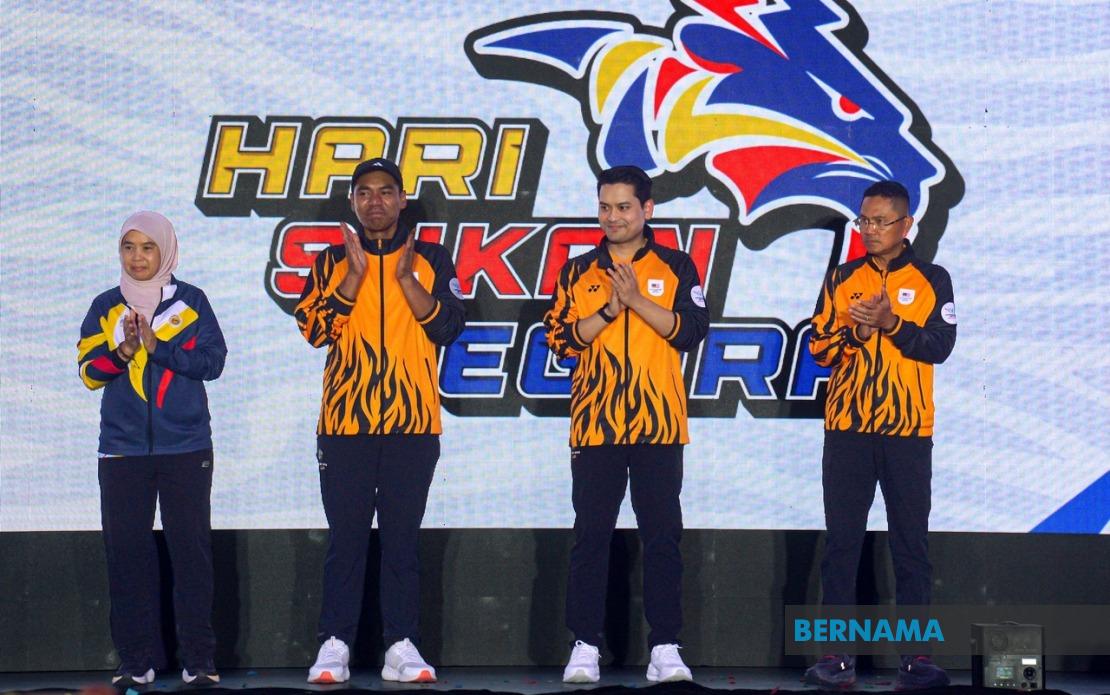
Malaysia's Ministry of Youth and Sports has unveiled an ambitious vision for the 2026 National Sports Day (HSN), setting its sights on mobilising more than 5.3 million Malaysians to participate in sports and recreational activities across district, state and national tiers. The three-day celebration, confirmed for October 9 to 11, represents a strategic pivot toward technology-enabled fitness promotion, with Youth and Sports Minister Dr Mohammed Taufiq Johari unveiling a fresh thematic direction centred on digital innovation and artificial intelligence. This departure from previous approaches signals the government's commitment to aligning traditional sports participation with contemporary technological advancement, recognising that modern Malaysians increasingly interact with fitness through digital channels.
The 2026 iteration introduces a redesigned logo and positions "Digital Technology and Artificial Intelligence" as its central organising principle. Rather than treating technology and physical activity as competing interests, the ministry's framework seeks to demonstrate how digital tools can serve as gateways to broader health participation. This represents a nuanced understanding of Malaysian society's evolving relationship with sport, particularly among younger demographics who may first engage through e-sports or virtual fitness platforms before transitioning to traditional athletic pursuits. The thematic choice reflects wider Southeast Asian trends in which governments and sports organisations acknowledge that digital engagement often precedes or complements physical participation.
A significant departure from standard pre-launch ceremonies, the HSN 2026 announcement itself incorporated extensive virtual reality technology demonstrations. This strategic choice—embedding digital tools directly into the launch experience—serves multiple purposes simultaneously. It communicates ministerial commitment to the announced theme with practical consistency, provides media and attendees with tangible understanding of the technological integration promised in subsequent activities, and generates distinctive visual content for news distribution and social media amplification. By deploying VR at the announcement stage rather than reserving it for downstream programmes, Dr Mohammed Taufiq signalled that digitalisation represents an operational philosophy rather than merely a thematic decoration.
The minister's emphasis on e-sports and gaming culture reveals a pragmatic acknowledgment of demographic reality. Video games and competitive gaming now constitute legitimate entry points for youth engagement, yet these activities are often viewed through a health-deficit lens. Rather than dismissing e-sports as incompatible with sports development objectives, the HSN 2026 framework proposes demonstrating how gaming culture can coexist with physical fitness advocacy. This framing suggests that the ministry recognises that young Malaysians who engage deeply with gaming need not be written off as sedentary populations; instead, they represent an audience that can be activated toward broader wellness participation through culturally appropriate messaging and integrated programming.
The national-level launch ceremony carries significant political weight, with Prime Minister Datuk Seri Anwar Ibrahim scheduled to officiate proceedings at the National Stadium in Bukit Jalil on October 10. This placement at the apex of the ceremony programme underscores the government's investment in sports participation as a policy priority, elevating what might otherwise be considered a routine sports ministry initiative to a platform-level event. The Prime Minister's involvement signals broader policy alignment around national wellness objectives and suggests that sports development constitutes part of the government's wider development narrative rather than occupying a compartmentalised portfolio.
HSN 2026 functions strategically as an anticipatory mechanism for the 2027 Southeast Asian Games, which Malaysia will host. By channelling public enthusiasm through HSN programming in 2026, the ministry advances the dual objective of immediate sports participation growth whilst simultaneously priming the population for the hosting experience that lies ahead. The Malaysia SEA Games Organising Committee (MASOC) will coordinate a dedicated SEA Games Roadshow aligned with HSN activities, creating a continuous activation cycle that sustains public momentum across the twelve-month gap between HSN and the Games themselves. For Malaysia, this represents an opportunity to demonstrate inclusive sports culture capacity to regional audiences while building domestic enthusiasm that benefits both participation metrics and eventual Games operations.
The specific programming components reflect a deliberate breadth of engagement modalities. The MADANI Fun Run and MADANI Fun Walk initiatives embed government branding directly into participatory activities, creating opportunities for vast populations to engage in branded fitness experiences. These events function as accessible entry points for demographics that might be intimidated by competitive sports contexts—families, elderly populations, and those new to structured exercise can participate meaningfully in mass walking and running events without performance pressure. The simultaneous integration of Rakan Muda (Young Friends) Lifestyle elements and broader Active Malaysia initiatives ensures that HSN 2026 caters across generational segments, from youth-focused programming to adult and senior participation frameworks.
The targeting of 5.3 million participants—representing approximately one-sixth of Malaysia's total population—reflects ambitious but strategically calibrated goal-setting. This figure exceeds previous HSN participation levels whilst remaining within the realm of achievable mobilisation given Malaysia's urbanisation patterns, sports facility distribution, and existing community sports infrastructure. The specification of participation across district, state and national tiers indicates that the ministry understands that genuine mass participation requires nested programming opportunities; national-level visibility and the Bukit Jalil launch create headline momentum, whilst distributed district and state activities provide the actual infrastructure through which most Malaysians will encounter and participate in HSN programming. This multi-tier approach reflects sophisticated understanding of how sports activation functions in decentralised contexts.
The integration of AI and digital technology into sports development messaging positions Malaysia within emerging global conversations around technology's role in wellness promotion. Nations across Southeast Asia increasingly explore how artificial intelligence applications—ranging from fitness tracking algorithms to AI-powered coaching systems—can democratise access to personalised health guidance. By anchoring HSN 2026's identity to these technological frontiers, Malaysia signals its positioning as a digitally-engaged nation capable of importing and adapting global wellness innovations whilst maintaining culturally contextualised participation frameworks. This approach contrasts with purely traditionalist sports promotion, acknowledging that future engagement depends upon convincing digitally-native populations that organised sports represent destinations worth their attention despite competing entertainment options.
The sports ministry's deliberate incorporation of diverse activity types—competitive sports, recreational walking, gaming-adjacent activities, family-oriented events—suggests recognition that monolithic approaches to participation fail. By creating multiple on-ramps through which different demographics, interest profiles and physical capacities can engage, HSN 2026 attempts to maximise the addressable population rather than optimising for specific athletic subgroups. This inclusive framing aligns with World Health Organisation guidance around population-level health behaviour change, which emphasises that sustainable wellness improvements require removing barriers to participation across demographic spectrums rather than concentrating resources on already-motivated athlete populations.
For Malaysian policymakers and regional sports observers, HSN 2026 represents a meaningful experiment in aligning legacy sports infrastructure with emerging digital realities. The three-day October celebration will demonstrate whether technology-integrated messaging and programming actually drive participation increases, or whether the appeal of digital elements remains largely novelty-focused. Results from HSN 2026 will likely inform subsequent regional sports promotion strategies across Southeast Asia, particularly as nations hosting major events like the 2027 SEA Games seek to build public investment and participation momentum. The outcomes will also illuminate whether Malaysian audiences respond to technology-forward sports framing or whether more traditional participation motivations continue to dominate engagement decisions.

