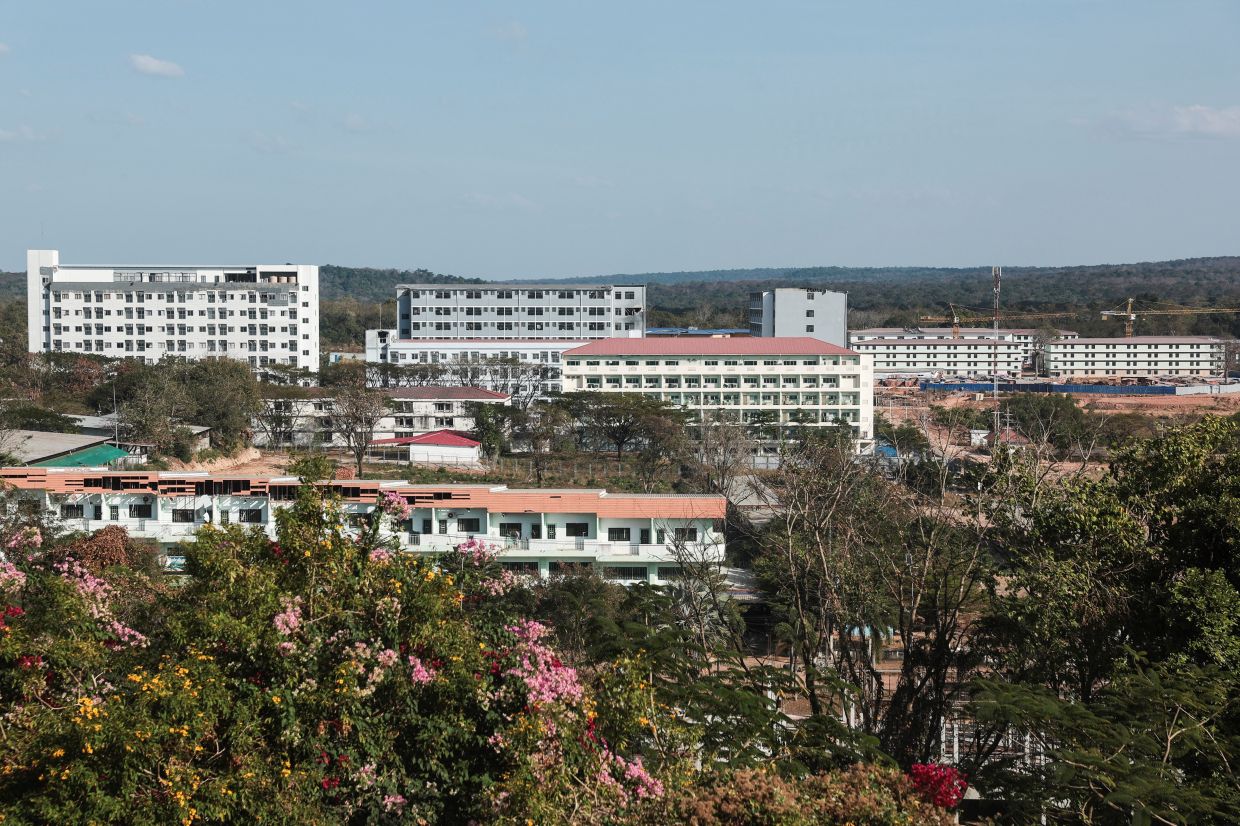
A sprawling gambling complex controlled by a well-connected Cambodian businessman has emerged as the alleged landlord to a sophisticated criminal operation that perpetrated mass fraud and human trafficking from the Thai-Cambodian border. The revelation exposes how Southeast Asia's most powerful figures can become entangled in the region's booming underworld of romance scams and police impersonation schemes, which have cost Americans alone an estimated US$10 billion in 2024. The case exemplifies the broader challenge facing governments attempting to crack down on organised crime networks that often maintain close ties to political and military elites.
Lim Heng Group, the gambling empire at the centre of the investigation, leased multiple structures within its Royal Hill casino compound at rates far exceeding market value according to a March 2024 rental agreement. The three buildings were contracted for US$200,000 monthly—a price that starkly exceeds comparable real estate in Phnom Penh, where similarly sized mixed-use buildings in premium locations commanded just US$25,000 per month. This extraordinary markup suggests that the landlord relationship went beyond ordinary commercial transaction and may have reflected either a premium for discretion or an arrangement designed to maximise profits from criminal enterprise.
Inside these leased structures, criminal operatives had meticulously constructed facades designed to deceive victims across the globe. Rooms were transformed to replicate police stations and banking facilities from multiple nations, creating convincing backdrops for video calls and online interactions with fraud targets. This level of preparation demonstrates industrial-scale sophistication: scammers would use these fake environments to convince victims they were communicating with legitimate authorities or financial institutions, extracting money through elaborate confidence schemes. Witnesses who worked within the compound, along with Thai military personnel who subsequently occupied the site, confirmed the existence and purpose of these fabricated spaces.
The involvement of Lim Heng Group in providing premises raises complex legal questions about landlord liability in Cambodia. According to independent human rights organisations and business law specialists based in Phnom Penh, property owners can face criminal charges if investigations establish they possessed knowledge of illegal activities on their premises and chose to permit them to continue. The distinction between negligence and complicity becomes crucial in such cases, yet gathering evidence of knowing cooperation presents significant investigative challenges. What is clear is that by September 2024, Lim Heng Group had been made aware of trafficking allegations when company representatives filed legal complaints against publishers reporting on foreign nationals allegedly confined within the Royal Hill compound.
Lim Heng himself occupies an elevated position within Cambodia's business and political hierarchy, a background that may complicate accountability mechanisms. He holds a royal title equivalent to a duke, has been documented socialising with senior military commanders, and contributed US$20,000 to Cambodia's military in the preceding year. This proximity to power structures raises broader questions about whether regulatory oversight can function independently when targets maintain such intimate connections to state institutions. Cambodian casinos are predominantly controlled by businesspeople with significant political relationships, according to analysts studying the kingdom's political economy, creating environments where ordinary commercial rules may not apply uniformly.
The Royal Hill situation reflects a Southeast Asian pattern in which casinos become entangled with transnational crime syndicates. Experts tracking organised crime note that Chinese-affiliated scam operations frequently establish bases adjacent to gambling establishments, which provide convenient mechanisms for converting illicit earnings into ostensibly legitimate funds through casino transactions. An investigation by Amnesty International identified at least a dozen scam centres operating directly under the control of casino proprietors in Cambodia, based on gambling regulator records and eyewitness accounts, though these figures remain unconfirmed by independent researchers.
Thai military forces stumbled upon the Royal Hill operation during their occupation of the compound following a December border skirmish with Cambodian troops. According to Bangkok's account, Cambodian forces had positioned the casino buildings for military purposes, including drone and sniper operations. When Thai personnel conducted their subsequent inspections and invited journalists to document findings, the fake police stations and banking facades became impossible to ignore—images of these elaborate deceptions circulated globally, embarrassing Cambodian authorities who had consistently characterised Royal Hill as merely a hotel establishment. The theatrical nature of the discovery—military forces unveiling criminal infrastructure to foreign media—suggests that political messaging may have influenced investigative priorities.
Cambodia's official response to the revelations has emphasised commitment while remaining equivocal on specifics. Senior minister Chhay Sinarith, tasked with combating online fraud, stated that his government remains committed to international cooperation and is investigating alleged fraud operations in the Royal Hill vicinity. However, his assertion that Thai security forces should relinquish seized locations to facilitate Cambodian investigations introduced a nationalist dimension that potentially complicated thorough accountability. The government has extradited one casino-owning alleged scamming kingpin to China and enacted legislation targeting fraudsters, steps that suggest genuine policy commitment yet do not necessarily address the systemic relationship between political power, business control, and criminal activity.
Royal Hill itself represents the physical embodiment of these contradictions. The compound features neoclassical architecture with gold-rimmed spires, its faded grandeur incongruous with its border town location. Behind its main casino structure stands a razor wire-topped perimeter fence enclosing additional buildings, at least four of which housed criminal operations according to Thai officials and testimony from trafficking victims. This enclosed compound design—simultaneously isolated from casual scrutiny yet accessible to those with appropriate connections—perfectly suits the operational requirements of transnational crime networks that require both security and controlled access.
The rental agreement document itself offers tantalising clues about operational structure. The lease was signed by an unidentified Chinese national whose role in the scamming operation could not be independently confirmed, along with Seng Chanthy, identified as a Royal Hill employee at the time. The refusal or inability to identify the primary tenant suggests either inadequate record-keeping at the property management level or deliberate obfuscation. Either explanation raises questions about due diligence standards in Cambodian commercial transactions, particularly those involving substantial monthly sums and international operators.
What emerges from the Royal Hill case is a troubling picture of Southeast Asian governance structures in which powerful businesspeople can simultaneously serve as pillars of the formal economy while facilitating transnational organised crime. Lim Heng's documented ties to military leadership, his royal title, and his business prominence did not prevent his property from becoming a scam factory; rather, these same connections may have provided the insulation necessary for such operations to flourish unmolested until external military intervention forced exposure. For Malaysia and other regional governments, the case underscores the risks posed by inadequate regulatory frameworks, insufficient inter-agency coordination, and the particular vulnerability of border regions where multiple jurisdictions compete for enforcement authority.
The broader implications extend to victim compensation and prosecution strategy. Scam victims across numerous countries suffered losses attributable to operations centred at Royal Hill, yet identifying responsible parties within Cambodia's corporate and political structures has proven far more difficult than identifying the individual scammers and traffickers. This asymmetry—whereby prosecutions typically target low-level operatives while facilitating structures escape legal consequence—perpetuates conditions conducive to future criminal enterprise. As Southeast Asian governments recalibrate their approaches to organised crime, the Lim Heng case demonstrates that thoroughgoing accountability requires willingness to scrutinise the activities of well-connected business figures rather than restricting investigation to peripheral participants.

