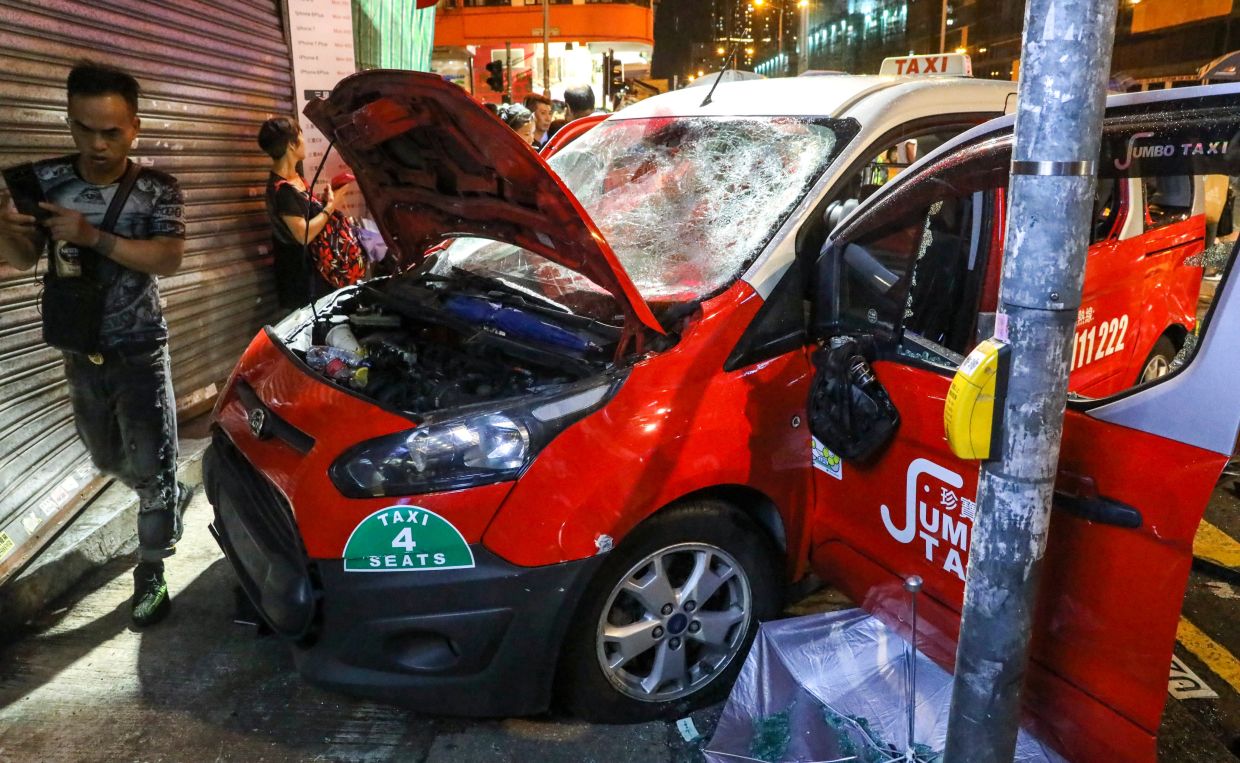
A Hong Kong woman who sustained severe injuries when a taxi mounted a pavement and collided with her during a demonstration in Sham Shui Po on October 6, 2019, is pursuing a claim for HK$8.4 million (US$1.07 million) in damages. Park Hoi-lam, now working as a kindergarten clerk in Tuen Mun, contends that the taxi driver Henry Cheng Kwok-chuen failed to exercise reasonable care and bears responsibility for the incident that fundamentally altered the trajectory of her life.
The legal proceedings, which commenced in 2022, have brought into sharp focus the lingering human toll of the 2019 protest period in Hong Kong. Park's case represents one of many civil claims arising from incidents that occurred during demonstrations across the territory. The trial before Mr Justice Simon Leung Chun-man is scheduled to last six days and will examine competing narratives about accountability and culpability in a politically sensitive context.
According to Park's account, she had initially been travelling by bus towards Tsim Sha Tsui that afternoon when road closures necessitated she and her companions disembark in Sham Shui Po. Upon discovering that railway services had also been disrupted, the group opted to walk towards Mong Kok. However, Park became separated from her friends after walking ahead more quickly than intended. She recalled the immediate surroundings as composed and orderly prior to the incident, characterising the gathering of people as peaceful.
The collision occurred with what Park described as considerable velocity. She testified that when she heard commotion near Cheng's vehicle and attempted to escape the area, the taxi struck her before she could take more than a few steps. The impact was severe enough to require seven surgical operations over the subsequent three months, with her hospitalisation extending until January 18, 2020. The nature and extent of her injuries—concentrated in her lower limbs—have created enduring physical limitations that constrain her capacity to function in her current employment and personal life.
More than four years after the incident, Park continues to experience debilitating knee pain and cannot maintain walking for longer than approximately one hour without requiring rest. Her medical prognosis offers little optimism regarding further natural improvement, despite undergoing two additional procedures since her initial discharge. Physicians have indicated that she may eventually require knee replacement surgery as her condition potentially deteriorates. While a cosmetic surgeon has recommended reconstructive procedures to address scarring on her legs, financial constraints have prevented her from pursuing such treatment.
The limitations imposed by her injuries have rendered numerous aspects of her professional duties problematic. In her position at a kindergarten, Park finds herself unable to lift objects of significant weight or provide physical comfort to distressed children through holding them—fundamental responsibilities in early childhood education settings. She articulated a distinction between merely executing basic activities such as shopping or dining, which surveillance footage revealed she could perform, and genuinely engaging in a meaningful existence characterised by uncompromised physical autonomy.
Plaintiff's counsel Susanna Leong has argued that the negligence inherent in the collision itself is self-evident. The absence of any warning signal—no horn sounded, no apparent braking—prior to the vehicle mounting the pavement and striking Park and another woman on Yen Chow Street demonstrates, according to Leong, a fundamental failure to maintain reasonable standards of vehicular operation and pedestrian awareness. She has emphasised that the subsequent violence directed against Cheng by elements within the crowd represents a separate issue entirely and cannot contextualise or justify the circumstances that produced the initial collision.
The defence has adopted a markedly different framing of events, positioning Cheng himself as a victim of the circumstances rather than their perpetrator. Defence counsel have stressed that the taxi driver endured a vicious assault involving metal implements and hard objects in the course of his ordinary employment. The defence argument suggests that holding another victim of the violence financially accountable for injuries sustained during a chaotic period does not constitute a just resolution, regardless of the severity of Park's condition.
Defence counsel Ashok Sakhrani attempted to undermine Park's credibility and the extent of her disability by questioning why she had engaged legal representation when providing a police statement in March 2020, implying her concerns extended beyond personal injury protection. Park responded that such precautions reflected a reasonable exercise of self-interest rather than anxiety about legal consequences stemming from protest participation. The defence also presented covert surveillance video obtained by a private investigator, arguing that the footage demonstrated Park's capacity to navigate daily activities without significant difficulty.
Park's response to this evidence proved particularly revealing about the distinction between functional capacity and genuine wellbeing. She noted that casual shopping excursions and restaurant visits—the substance of the surveillance footage—constitute the ordinary activities that any person might undertake, yet their performance does not necessarily indicate a restoration to meaningful life. Her comment underscored how invisible disabilities and chronic pain conditions often fail to register in visual documentation, even when they profoundly constrain an individual's quality of existence and professional effectiveness.
The case resonates beyond the immediate parties involved, reflecting broader questions about accountability and justice that have preoccupied Hong Kong society since 2019. As legal proceedings continue to resolve incidents from that turbulent period, courts must navigate complex evidentiary and liability questions while acknowledging the genuine suffering experienced by multiple parties caught in circumstances beyond their direct control. Park's litigation represents an attempt to establish personal responsibility within a context where causation and blame remain contested and emotionally charged.
The trial's outcome will carry significance not merely for Park's financial circumstances but for how Hong Kong's legal system addresses injury claims arising from the 2019 demonstrations. Whether courts will hold individuals accountable for traffic-related injuries occurring during protest periods, or whether they will apply different standards when violence complicates the causal narrative, remains to be determined. For Park, now nearly five years removed from the moment that fundamentally redirected her life, the courts offer the primary mechanism through which she can seek acknowledgment of loss and material compensation for her altered circumstances.

