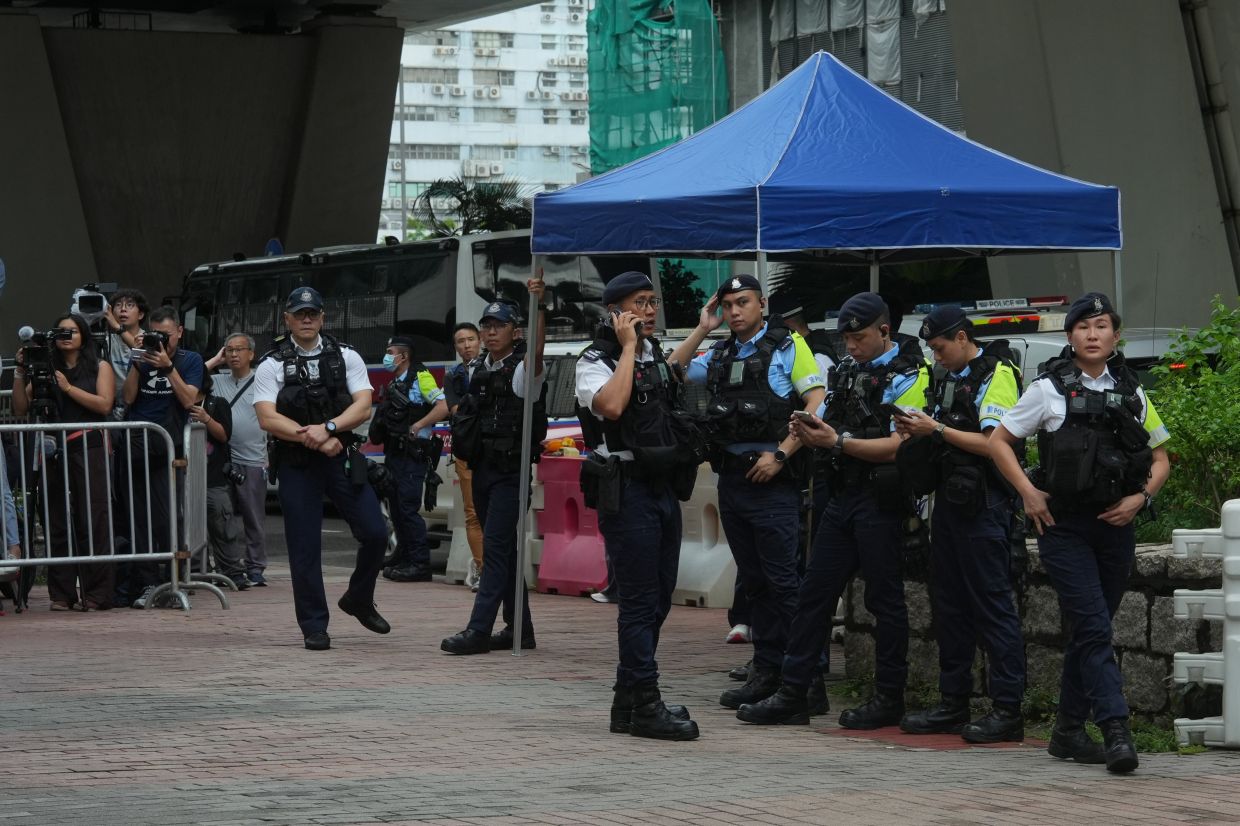
A woman was arrested by Hong Kong police last week for allegedly wearing a T-shirt with a seditious message outside West Kowloon Court, authorities said on Monday night. The detention occurred on suspicion of disorder in a public place, obstructing police, and acting with seditious intent, demonstrating the territory's increasingly stringent approach to public expression and assembly.
Police provided limited details about the operation, with a spokesman stating that its purpose was to maintain public safety and order, though specifics could not be disclosed. The vagueness surrounding the arrest reflects the opacity that has characterised security operations in Hong Kong since the implementation of the national security law, leaving questions about the precise grounds for detention and the threshold for what constitutes seditious expression in public spaces.
The timing of the arrest proved significant, occurring hours before judges delivered a guilty verdict against Lee Cheuk-yan and Chow Hang-tung, the former chairman and vice-chairwoman respectively of the now-disbanded Hong Kong Alliance in Support of Patriotic Democratic Movements of China. Both defendants had faced accusations of inciting subversion under the national security law for their calls to end "one-party dictatorship" in mainland China, a charge that highlights how the law casts a wide net over political speech and advocacy.
Before dawn on the day of the verdict, more than 50 people had gathered outside the courthouse, some hoping to observe or report on the judgment. According to eyewitness accounts, a plain-clothes officer singled out a woman wearing a black T-shirt with Japanese characters printed on it, deeming it suspect for seditious content, and led her away to a police vehicle. The incident was recorded by media personnel present at the scene, though officers reportedly instructed journalists to leave the area during the woman's detention.
The arrest underscores the climate of heightened sensitivity surrounding any form of political expression near courts and government buildings in Hong Kong. The deployment of plain-clothes officers and the swift removal of an individual based on clothing suggests a proactive stance by authorities in policing not just actions but symbols and messages, raising concerns about the boundaries of permitted expression in public spaces across the territory.
Later that morning, the three High Court judges issued their guilty verdict in a comprehensive 216-page ruling. The judgment established a significant legal precedent by determining that any attempt to overthrow or undermine the leadership of the Communist Party of China could constitute subversion. The judges further held that China's constitution does not accommodate Western-style democracy, effectively narrowing the scope of acceptable political discourse in Hong Kong.
Lee Cheuk-yan, a former lawmaker, and Chow Hang-tung, a practising barrister, have remained in custody for nearly five years during their trial, facing the prospect of substantial sentences now that their guilt has been established. The lengthy incarceration preceding conviction has drawn criticism from international human rights organisations, who view it as contrary to principles of due process and fair trial standards.
A fourth defendant, Albert Ho Chun-yan, who served as vice-chairman of the alliance, has been detained for more than four years. Ho pleaded guilty in January and remains in custody awaiting sentencing, having chosen not to contest the charges against him. His acceptance of guilt, despite the alliance's original position, suggests the weight of evidence and legal interpretation weighed heavily on the defence.
The Hong Kong Alliance itself has been disbanded, effectively ending the organisation's decades-long tradition of holding the annual Tiananmen Square vigil each June, a commemorative event that drew thousands of Hong Kong residents seeking to remember the 1989 crackdown. The dissolution of the alliance and the conviction of its leaders mark a watershed moment in Hong Kong's political landscape, signifying the end of an era when such public commemorations and civic organisations could operate relatively openly.
For Malaysian and broader Southeast Asian observers, these developments carry significant implications. They demonstrate how national security legislation, introduced ostensibly to combat terrorism and foreign interference, can be deployed to suppress lawful political expression and peaceful advocacy. The case raises questions for regional democracies about balancing security concerns with fundamental freedoms, particularly as similar security measures proliferate across Asia.
The vagueness of what constitutes "seditious intent" in practice—whether through clothing, speech, or association—creates a chilling effect on public discourse. Citizens may self-censor to avoid ambiguous legal violations, and organisations may dissolve rather than risk criminal prosecution of their members. This has broader implications for civil society activism and political participation across Hong Kong and potentially influences how other governments in the region approach regulation of public expression.
The international attention drawn by this case, combined with the high-profile nature of the defendants involved, ensures that Hong Kong's judicial and security responses will continue to shape perceptions of the territory's autonomy and the scope of freedoms guaranteed under the Basic Law. For businesses, civil society groups, and individuals across Southeast Asia maintaining operations or connections to Hong Kong, these legal developments underscore the shifting regulatory environment and the need for heightened awareness of local security laws.
The arrest of a woman for her T-shirt, while perhaps appearing minor in isolation, exemplifies a broader pattern of enforcement that has fundamentally altered Hong Kong's public sphere. Combined with the conviction of respected figures like Lee and Chow, it signals that the security framework now extends into everyday conduct and expression, reshaping what political participation and civic engagement mean in the territory.

