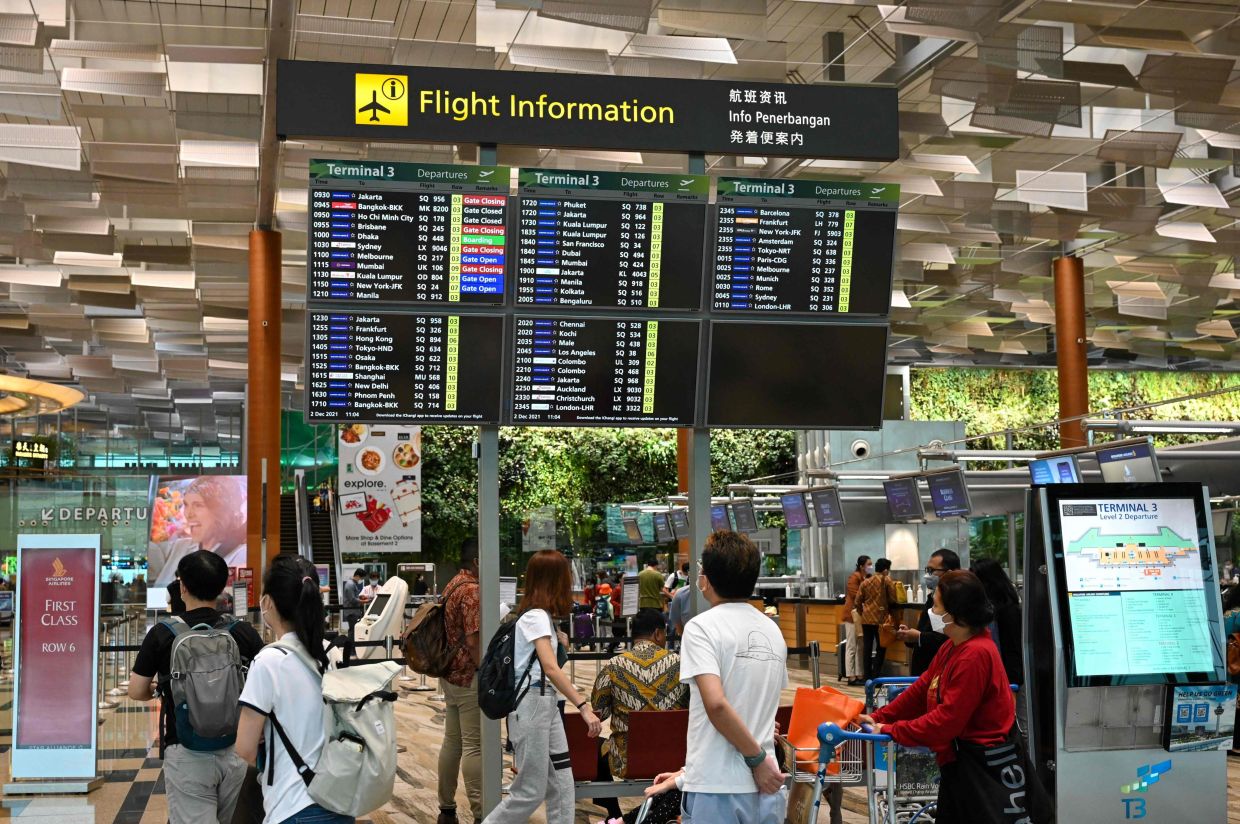
A Singapore court has handed down custodial sentences to a Hong Kong mother and her adult son following a violent confrontation at Changi Airport's Terminal 3 that escalated from a family dispute into assaults on both a member of the public and a police officer. Chan Sui-kwan, aged 65, received a six-month prison term for deliberately causing injury to a public servant in a manner intended to obstruct him from carrying out his lawful duties, while her son Chan Wing-kwan, 42, was sentenced to ten days' imprisonment for the separate charge of causing hurt. The sentencing, handed down this week, concluded judicial proceedings that had stretched across more than a year following the initial June 30, 2024 incident.
The circumstances surrounding the airport clash reveal a sequence of events triggered by a misunderstanding that rapidly deteriorated into physical violence. Court records indicate that Chan Wing-kwan became visibly upset after misinterpreting remarks from nearby travellers, apparently believing they were directing ridicule towards him. Rather than seeking clarification or moving away from the source of his frustration, he responded by kicking his own mother, a response that raised immediate concerns among those witnessing the scene. When a 69-year-old bystander, motivated by concern for the woman's wellbeing, approached to check on her condition and offer assistance, he was rebuffed harshly by the mother, who instructed him to leave the area. Her son's reaction was markedly more aggressive, as he openly confronted the man and issued a challenging invitation to physical combat, signalling an escalating willingness to engage in violence.
The situation deteriorated further when the incident transferred to a different level of the terminal building. Chan Wing-kwan initiated another assault against his mother by kicking her again, demonstrating a pattern of violence rather than an isolated outburst of anger. When the same bystander attempted to contact airport security and police in response to the escalating disturbance, the son moved menacingly towards him with evident intent to prevent the call. What followed was a physical altercation during which Chan Wing-kwan repeatedly struck the older man with his fists, inflicting injuries that included a significant haematoma on the head—a pooling of blood beneath the skin that can be medically serious—along with abrasions to the knee area and bruising across his fingers.
Initial police response at the scene took a measured approach. Officers who attended the disturbance gathered identifying information by recording passport details from both the mother and son before returning their travel documents, seemingly treating the matter as one requiring documentation rather than immediate detention. However, this decision would prove consequential, as the pair did not depart the airport as might have been expected. Later that same afternoon, police once again located Chan Sui-kwan and Chan Wing-kwan in the departure hall area of Terminal 3, suggesting they had either attempted to remain in the airport or returned to it. During this second encounter, the mother displayed overt resistance to lawful authority by declining to surrender her passport when requested to do so and creating a public disturbance that necessitated her formal arrest.
The arrest itself proved contentious when the mother mounted active physical resistance against police officers moving to detain her. During the struggle that ensued, she bit a police officer on his right forearm, managing to penetrate his clothing and leave a one-centimetre wound mark accompanied by bruising. This bite constituted a separate assault on a public servant, which formed the basis of her more serious charge relating to causing hurt with intent to deter a public servant from performing his duties.
The timeline of the case's progression through Singapore's court system reflects the procedural complexities that often accompany criminal proceedings involving foreign nationals. Chan Wing-kwan was formally charged on April 24 of the previous year, well before his mother's court appearance. By contrast, Chan Sui-kwan was not brought before the courts until November 18, 2024, a substantial delay that may reflect investigative processes or legal processes specific to her particular charges. Both defendants failed to appear for a scheduled court date set for July 22 this year, prompting the issuance of arrest warrants and likely their re-apprehension. They were subsequently convicted on July 29 before receiving their sentences this week.
For Malaysian and Southeast Asian observers, this case underscores the serious consequences that can follow from brief lapses in judgment and emotional self-control in public spaces. Singapore's courts have demonstrated consistent application of penalties for assaults involving police officers, with the distinction in sentencing lengths reflecting the hierarchy of seriousness the judiciary assigns to attacks on public servants versus private citizens. The significantly heavier sentence imposed on the mother compared to her son—six months versus ten days—reflects the legal system's particular emphasis on protecting police officers and deterring violence against those enforcing the law. The bite incident, while perhaps seeming minor in isolation, appears to have substantially influenced the sentencing outcome.
The incident also highlights practical realities faced by international airports across the region, where high volumes of tired, stressed, and emotionally volatile passengers create environments where minor conflicts can unexpectedly escalate into serious criminal matters. Changi Airport, one of Asia's most heavily trafficked aviation hubs, handled the incident through standard procedures, but the outcome demonstrates that airport security and police responses will not hesitate to escalate interventions when violence emerges or safety is jeopardised. For travellers transiting through major airports in Singapore and across Southeast Asia, the case serves as a cautionary reminder that airports are under strict legal jurisdiction and that violent conduct, regardless of provocation or emotional distress, carries real criminal liability.
The sentencing also reflects Singapore's robust approach to maintaining public order and safety in critical infrastructure facilities. Airports constitute spaces where authorities maintain heightened vigilance and enforcement capacity, and incidents of violence are pursued with appropriate severity through the court system. The case demonstrates that Hong Kong nationals, like all foreign visitors, are not exempt from Singaporean law and can expect consistent prosecution for criminal conduct. For those travelling internationally through the region, understanding that emotional self-control and peaceful conflict resolution are not merely virtuous qualities but legal requirements serves as an important practical lesson with potentially serious consequences.

