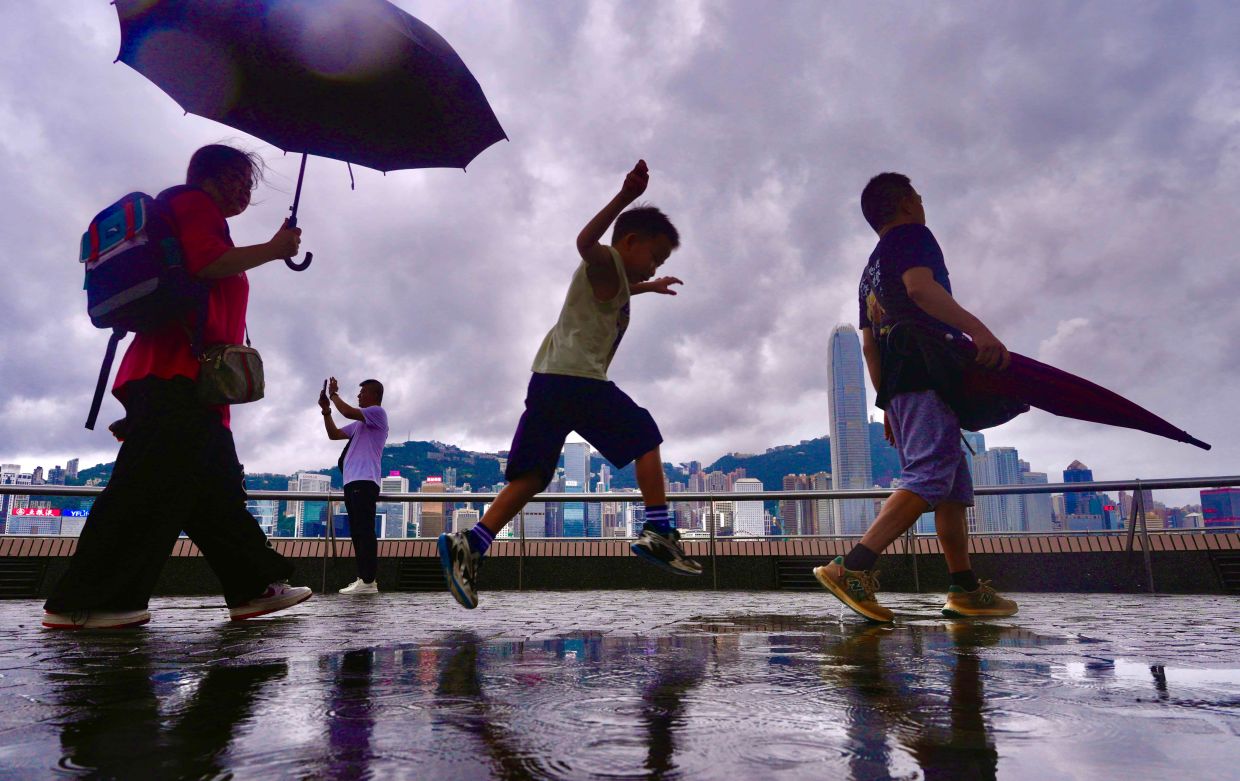
Hong Kong residents finally caught a break from an oppressive heatwave on Friday morning as widespread rainfall swept across the territory, temporarily halting what had become the city's most relentless summer heat event in over a century. The Hong Kong Observatory issued its lowest-tier amber rainstorm warning at 8:40 am as the system moved through, offering much-needed respite to a population that had endured consecutive days of sweltering conditions. The alert was lifted three hours later, though meteorologists cautioned that showers and squally thunderstorms would persist throughout the day as the system continued its passage across the region.
The arrival of the rainfall system represented a turning point after an extraordinarily punishing seven-day stretch that left residents struggling through temperatures consistently well above the 34-degree Celsius threshold across multiple districts. The meteorological event that triggered Friday's downpour stemmed from upper-air disturbances combining with a southwesterly airstream—atmospheric conditions that are characteristic of tropical monsoon systems affecting Southeast Asia during summer months. This meteorological setup disrupted the high-pressure system that had been anchoring oppressively hot and stable conditions over Hong Kong and surrounding areas.
The previous week's heat intensity proved historic by any measure. Hong Kong Observatory data showed that the maximum temperature recorded at its main station remained at or above 33 degrees Celsius for nine consecutive days—an unprecedented streak for the month of August that shattered the previous duration record for sustained summer heat. This consecutive-day benchmark underscores how unusual and persistent the system had become, moving beyond typical summer variations into genuinely exceptional territory that stretches the infrastructure and social systems built to manage the climate.
The absolute peak came on the preceding Sunday when the observatory's thermometer climbed to 36.9 degrees Celsius—the highest temperature ever recorded in Hong Kong since systematic weather observations began in 1884, a span of 140 years. This singular data point encapsulates the severity of what residents experienced, surpassing all previous summer temperature records and raising questions about how climate patterns may be shifting in the region. The reading stands as a stark benchmark against which future extreme heat events will be measured and carries implications for urban planning, public health systems, and energy infrastructure across the city.
For Malaysian and Southeast Asian observers, Hong Kong's heatwave offers instructive lessons about regional climate vulnerability. As a densely urbanized environment surrounded by Victoria Harbour with limited vegetation coverage, Hong Kong's heat island effect is pronounced, meaning the already extreme temperatures felt by residents were often worse than readings in surrounding areas. Cities across Southeast Asia—including Kuala Lumpur, Bangkok, and Singapore—share similar characteristics of high urban density, extensive development, and tropical locations that can amplify natural heat events into dangerous public health emergencies. The experience demonstrates that even wealthy, well-equipped urban centres face genuine challenges when extreme weather pushes beyond historical norms.
The meteorological outlook following Friday's rainfall offered limited comfort to those hoping for sustained cool conditions. Weather forecasters predicted that Saturday would bring morning thunderstorms to scattered locations with intermittent sunny periods during daylight hours—essentially returning to typical August conditions of heat punctuated by afternoon convective systems. More significantly, meteorologists warned that very hot weather would resume in the early part of the following week, alongside isolated shower activity that would likely prove insufficient to prevent temperatures from climbing back into dangerous territory.
The cyclical nature of this forecast—temporary relief followed by a return to heat—illustrates the challenge facing public health authorities and urban planners during intensifying summer seasons. Unlike gradual temperature shifts that allow populations and infrastructure to gradually adapt, these cycles of extreme heat followed by brief respites create sustained stress on cooling systems, water supplies, and emergency services without providing meaningful opportunity for recovery. The pattern reflected in Hong Kong's forecast mirrors climate change predictions for Southeast Asia, where meteorologists expect increasing frequency of extreme temperature events interspersed with brief periods of more moderate conditions.
For the broader region, Hong Kong's experience serves as an early warning system of sorts. The city's position at the southern edge of China and northern boundary of Southeast Asia means it often experiences weather patterns before they reach Malaysia, Thailand, and other neighbouring territories. When Hong Kong experiences a record-breaking heatwave, it frequently presages similar conditions spreading southward within days or weeks. This temporal displacement provides valuable lead time for neighbouring countries to prepare public health responses, issue advisory guidance, and ensure vulnerable populations understand how to manage exposure to extreme heat.
The institutional response to Hong Kong's crisis—relatively rapid issuing of weather warnings and public communication about the situation—highlights the importance of robust meteorological services across Southeast Asia. The Hong Kong Observatory's capacity to track upper-air disturbances and forecast the arrival of rain-bearing systems depended on sophisticated monitoring equipment, satellite data integration, and skilled interpretation of complex atmospheric dynamics. Many developing nations in Southeast Asia still operate with more limited meteorological infrastructure, which underscores why regional cooperation in weather monitoring and early warning systems remains crucial for public safety across the zone.

