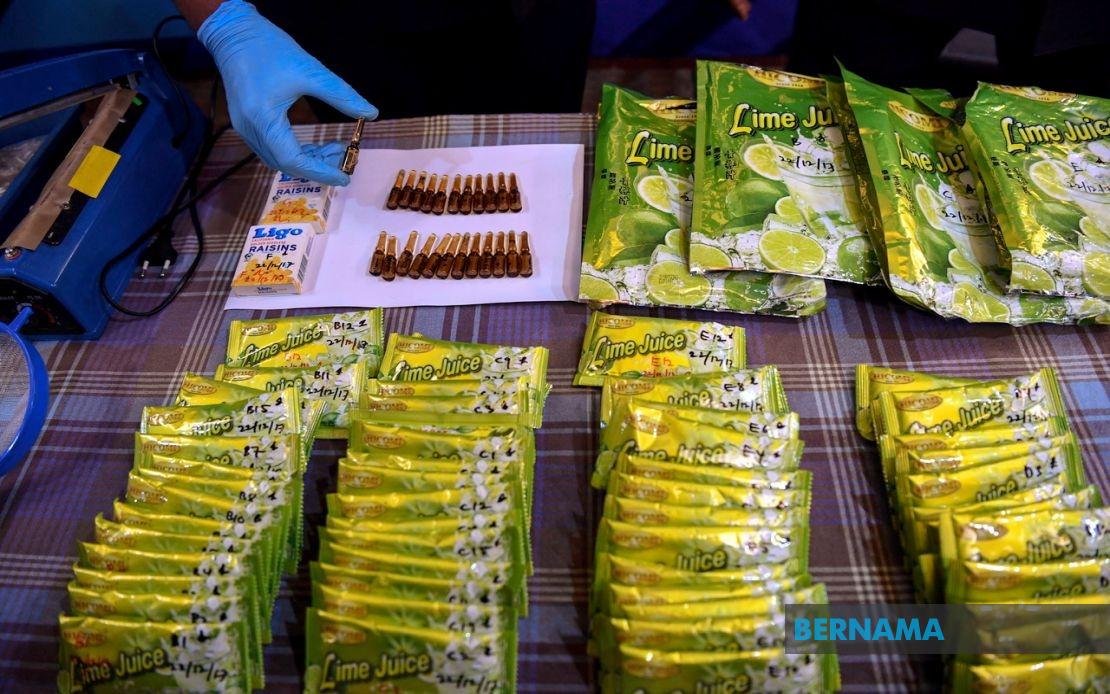
Malaysia's Home Ministry has declared synthetic drugs a critical security threat, prompting a nationwide enforcement surge targeting methamphetamine, fentanyl, and psychoactive tablets colloquially known as "piu-piu." Home Minister Datuk Seri Saifuddin Nasution Ismail revealed the escalating challenge in a parliamentary reply this week, highlighting the particularly insidious dangers posed by these substances—their potency for addiction, lethal overdose potential, and documented links to organised crime and social deterioration across communities.
The scale of the problem has become undeniable. Between 2023 and June 2026, the Royal Malaysia Police (PDRM) documented 238,704 arrests nationwide stemming from various synthetic drug offences. This figure underscores the relentless prevalence of illicit drug activity despite years of enforcement. The specific focus on synthetic compounds rather than traditional narcotics reflects a critical shift in Malaysia's drug landscape, where chemically engineered substances present novel enforcement challenges and public health risks that conventional anti-drug strategies were not originally designed to address.
To combat this tide, law enforcement agencies have intensified coordinated operations nationwide. Operation Tapis and Operation Tapis Khas represent the police's flagship initiatives, deployed across urbanised centres, provincial towns, and isolated regions alike. These operations function through systematic collaboration between the PDRM, the National Anti-Drugs Agency (AADK), and the Royal Malaysian Customs Department (JKDM), creating a multi-agency enforcement framework that acknowledges the complexity of modern drug trafficking networks, which often transcend jurisdictional and geographical boundaries. The involvement of customs authorities particularly addresses the transnational dimension of synthetic drug smuggling, where precursor chemicals and finished products move across borders through ports and checkpoints.
Technology has become indispensable to these enforcement efforts. Drones and surveillance cameras now form part of the operational toolkit, enabling authorities to monitor suspected trafficking hotspots with greater precision than ground-based patrols alone permit. These technological enhancements signal recognition that traditional policing methods require augmentation in an era where drug networks employ sophisticated distribution logistics and exploit gaps in conventional monitoring. The surveillance infrastructure represents investment in intelligence-gathering capabilities that can anticipate supply chain movements rather than merely reacting to street-level arrests.
Legal frameworks are also undergoing modernisation. The government is actively considering amendments to the Dangerous Drugs Act 1952 to explicitly schedule newly emerging synthetic drugs and New Psychoactive Substances (NPS). This legislative evolution addresses a fundamental challenge: the speed at which clandestine chemists synthesise novel compounds outpaces traditional regulatory responses, creating temporary windows where new substances remain technically legal despite their obvious dangers. Amendments would close such gaps, allowing faster regulatory action against emerging threats without requiring lengthy parliamentary processes each time a new analogue appears.
Beyond enforcement, preventive education forms the complementary pillar of Malaysia's strategy. Between 2023 and June 2026, authorities conducted 1,144 drug prevention programmes nationwide, targeting public awareness and community education. This community policing approach acknowledges that supply-side enforcement alone cannot succeed without reducing demand. Schools, universities, workplaces, and community centres have become venues for these initiatives, attempting to inoculate younger demographics against synthetic drug experimentation before addiction takes hold.
Sarawak exemplifies both the severity of the synthetic drug problem and the concentrated enforcement response. Between January 1 and June 7 this year, the state recorded 7,097 arrests encompassing different offence categories: 342 traffickers, 1,314 individuals caught in possession, and 5,441 drug users. This disaggregation reveals the breadth of drug-related activity from wholesale distribution to street-level consumption. Authorities simultaneously seized 418.01 kilogrammes of drugs valued at RM53.73 million—a substantial quantity reflecting either significant trafficking volume or concentrated seizure operations targeting major supply routes.
Enforcement actions extended beyond immediate arrests. Authorities detained 13 individuals under the Dangerous Drugs (Special Preventive Measures) Act 1985, a provision allowing indefinite detention of habitual offenders deemed societal threats. Additionally, action under Section 39C of the Dangerous Drugs Act 1952 targeted 131 hardcore addicts, presumably applying treatment and rehabilitation requirements. Simultaneously, authorities confiscated syndicate assets valued at RM1.95 million, attacking the financial infrastructure supporting trafficking networks and degrading their operational capacity.
Frontier capabilities in forensic analysis complement enforcement and prevention efforts. Enhanced forensic laboratory capacity now enables profiling of emerging synthetic compounds, including fentanyl analogues and synthetic opioids, facilitating rapid identification and supporting prosecution. This scientific infrastructure allows Malaysian authorities to characterise new substances swiftly, informing both enforcement priorities and regulatory decisions about scheduling. The ability to detect and profile novel compounds represents critical advantage in the perpetual cat-and-mouse contest between regulators and clandestine chemists.
The synthetic drug challenge extends beyond Malaysia's borders, reflecting regional trafficking realities. Sarawak's particular vulnerability stems partly from its long, porous international boundaries and geographic remoteness from federal enforcement centres. Rural and remote areas present enforcement difficulties where limited police presence and rugged terrain enable trafficking activity with reduced interdiction risk. The emphasis on Sarawak in parliamentary questioning underscores Sabah and Sarawak's recognised vulnerability to narcotics trafficking, requiring tailored enforcement strategies accommodating geographical realities.
Moving forward, Malaysia's synthetic drug strategy demonstrates evolution beyond simplistic drug wars toward integrated approaches combining enforcement, legal modernisation, community prevention, and scientific capability. However, the persistence of nearly 240,000 arrests over three years suggests that supply remains abundant and demand resilient. Whether enforcement intensity, legislative amendments, and prevention programmes achieve meaningful impact on synthetic drug prevalence remains to be demonstrated through declining addiction rates and reduced trafficking volume—metrics ultimately more meaningful than arrest figures alone.

