Home Minister Datuk Seri Saifuddin Nasution Ismail has outlined an ambitious programme to upgrade security infrastructure and public service capabilities across Johor, positioning the southern state as a critical operational hub for the nation's internal security apparatus and border administration. The announcement, made in Johor Bahru on July 10, signals the government's intention to channel significant resources into facilities managed by multiple Home Ministry agencies operating throughout the state, from the northern districts to the maritime zones along the Straits of Johor and the South China Sea.
Johor occupies a uniquely strategic position within Malaysia's security and administrative framework. As the country's primary gateway to Singapore via the Johor–Singapore Causeway and a major entry point for regional traffic, the state requires robust institutional capacity across multiple domains. The Home Ministry's decision to concentrate development efforts here reflects an acknowledgment that ageing facilities and operational constraints in border management, law enforcement, and detention services could undermine both national security objectives and the quality of service delivery that Malaysian and international travellers expect when crossing into or through the state.
The Royal Malaysia Police component of the initiative encompasses several projects that address long-standing infrastructure gaps. The construction of a new district police headquarters for Segamat represents investment in policing capacity for one of the state's major population centres in the north. Simultaneously, the ministry has allocated resources for land acquisition in Pengerang, a coastal district that has witnessed significant industrial and port development in recent years, suggesting that police operational presence needs to expand in tandem with demographic and economic changes. Beyond major installations, the programme includes routine but essential work on police quarters and lift repairs at existing premises—maintenance that, while less glamorous than new construction, prevents degradation of working conditions for personnel stationed throughout the state.
Immigration and border management features prominently in the initiative, reflecting the heightened importance placed on managing cross-border flows of people and goods. Upgrades to immigration facilities at the Sultan Iskandar Building and the Sultan Abu Bakar Complex address capacity constraints at two of Johor's principal border processing centres. These improvements aim to streamline administrative procedures, reduce congestion during peak travel periods, and enhance the professional environment in which immigration officers operate. The ministry framed these upgrades explicitly as measures to ensure border services function with greater efficiency while upholding institutional integrity—language that acknowledges both operational pressures and public concerns about corruption or inconsistent application of entry and exit regulations.
The National Registration Department's expansion into Batu Pahat through a new district office represents another dimension of the programme. As Malaysia's vehicle for identity documentation and civil registration, JPN's presence directly affects the citizen experience of basic state functions. Establishing dedicated facilities in district capitals ensures that identity card renewals, birth registrations, and related services are accessible without requiring residents to travel to larger urban centres, a consideration especially important in more remote or sparsely populated areas of Johor.
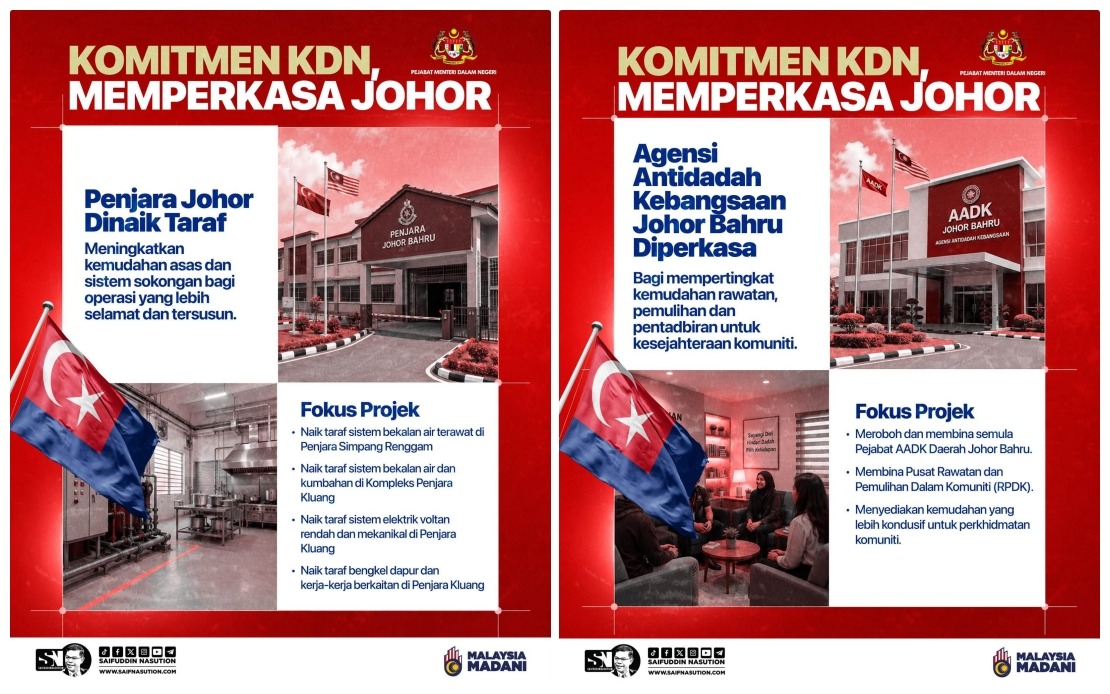
Prison infrastructure improvements address detention conditions at two facilities: Kluang Prison and Simpang Renggam Prison. The decision to upgrade basic systems at these institutions reflects recognition that the Prisons Department, which operates under Home Ministry oversight, requires adequate facilities to maintain security, hygiene, and humane conditions of custody. For Johor, which serves as a transit point for drug trafficking and other transnational criminal activities flowing through Southeast Asia, maintaining functional and secure correctional facilities carries significance beyond the state itself.
The National Anti-Drugs Agency's redevelopment of offices and treatment centres across Johor underscores the ministry's emphasis on combating narcotics trafficking and addiction. As Johor represents a critical node in regional drug supply chains moving from source countries toward Malaysian markets and beyond, AADK's operational capacity directly impacts both public health outcomes and law enforcement effectiveness. Upgrading treatment facilities particularly suggests a policy orientation toward rehabilitation alongside enforcement—an approach gaining traction across the region as countries grapple with drug epidemics.
Maritime security features through planned upgrades to the jetty and buildings at Abu Bakar Maritime Base, reflecting the Malaysian Maritime Enforcement Agency's expanded responsibilities in policing Johor's coastal waters and territorial seas. As shipping lanes off Johor carry enormous volumes of regional trade, and as maritime piracy and smuggling remain persistent concerns in Southeast Asian waters, investing in MMEA infrastructure demonstrates the ministry's commitment to naval and coastal security operations.
The programme's breadth across six distinct agencies illustrates the integrated approach required for comprehensive security governance in a complex, multi-faceted region like Johor. Rather than concentrating resources in any single domain, the Home Ministry has distributed investments across policing, border management, civil administration, corrections, drug control, and maritime enforcement—a holistic strategy that acknowledges how security threats and administrative challenges interconnect across these functional areas.
For Malaysian readers and regional observers, the timing and framing of these announcements merit consideration. The programme was announced on July 10, immediately preceding polling for the 16th Johor state election scheduled for July 12, with approximately 2.7 million registered voters choosing 56 state assemblymen. While the infrastructure projects themselves represent legitimate government priorities independent of electoral cycles, the public announcement at this particular juncture reflects standard political practice whereby incumbents highlight development commitments and future investment plans during election periods to demonstrate governance effectiveness and forward planning to voters.
The broader implications for Johor's development trajectory involve questions about maintenance, operational funding, and political continuity. Infrastructure improvements require not only construction capital but also sustained operating budgets and technical expertise to function effectively. Whether the Home Ministry maintains financial commitment to these facilities after the electoral spotlight dims will determine whether announced projects translate into genuine capability enhancements or become incomplete or underutilized installations. For Southeast Asian security cooperation, a well-equipped and professionally staffed security apparatus in Johor facilitates smoother cross-border coordination with neighbouring authorities and strengthens Malaysia's capacity to address transnational challenges including trafficking, terrorism financing, and maritime security threats.

