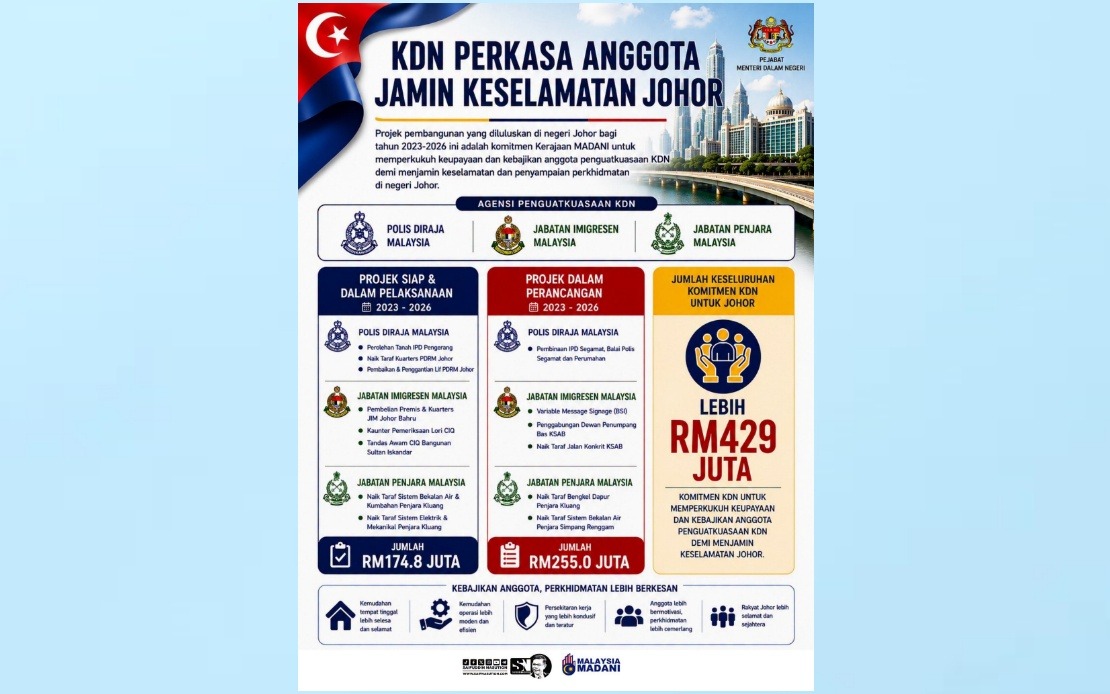
The Ministry of Home Affairs has channelled over RM429 million into Johor's security infrastructure and personnel support systems since 2023, reflecting a strategic pivot towards strengthening the foundation of public safety institutions. Home Minister Datuk Seri Saifuddin Nasution Ismail outlined the comprehensive investment framework, which targets three critical agencies: the Royal Malaysia Police, the Malaysian Immigration Department, and the Malaysian Prisons Department. This substantial commitment underscores the government's recognition that durable security ecosystems depend fundamentally on the professional development and material well-being of the personnel tasked with enforcement responsibilities.
The ministry's approach treats personnel welfare as an operational imperative rather than a peripheral concern. By ensuring that enforcement officers work in safe, well-equipped environments with adequate accommodation and modern tools, the government contends that public security improves measurably. The logic is straightforward: officers operating from inadequate facilities or under poor conditions struggle to deliver consistent, high-quality service. Conversely, those deployed within properly resourced stations and barracks can focus on their core mandate without the friction caused by deteriorating infrastructure or personal hardship.
The RM429 million allocation is split into two phases. Projects amounting to RM174.8 million are either completed or currently advancing through implementation stages, while a further RM255 million funds initiatives still in the planning pipeline. This structure allows the ministry to maintain momentum on urgent priorities while methodically developing longer-term improvements. The bifurcation reflects prudent fiscal management and the practical reality that large-scale institutional development unfolds across multiple budget cycles.
Current implementation efforts reveal the government's immediate priorities in Johor. Land acquisition for the Pengerang District Police Headquarters represents a foundational step in expanding the police presence within that region. Simultaneously, the ministry is acquiring office premises and residential quarters for the Johor Bahru Immigration Department, addressing a longstanding capacity constraint in the state's frontline immigration operations. The upgrading of basic facilities at Kluang Prison demonstrates attention to custodial conditions, an area historically vulnerable to neglect and public controversy across Southeast Asia.
Projects in advanced planning stages signal the government's medium-term vision for enforcement infrastructure. The construction of Segamat District Police Headquarters, envisioned to include both a police station and residential quarters, will expand the police operational footprint into areas currently underserved. The consolidation of bus passenger terminals at the Sultan Abu Bakar Complex represents a different angle—improving the physical environment where law enforcement intersects with public transit, thereby creating safer, more orderly travel hubs. Complementary facility upgrades, including kitchen workshops and water supply systems at prisons, address quality-of-life factors that directly influence staff retention and morale.
For Malaysian readers, particularly those in Johor, the investment carries tangible implications. Enhanced police headquarters and immigration facilities translate into faster processing of applications, more responsive policing, and better management of border and internal security functions. Prison improvements matter beyond the correctional system itself; they signal state commitment to humane custodial standards and professional prison management, reducing the likelihood of escapes or internal disorder that periodically dominate regional headlines.
The broader policy context frames this allocation as part of the MADANI Government's commitment to equitable development across states. Home Minister Saifuddin Nasution connected the enforcement spending to Prime Minister Datuk Seri Anwar Ibrahim's recent parliamentary statement on Johor's expanded development budget, which has risen to approximately RM14.6 billion from the previous RM10.2 billion. This link emphasizes that enforcement capacity is treated as integral to state development rather than a separate security concern. A state capable of attracting investment and sustaining economic activity requires functioning police, immigration, and correctional services.
Regionally, Malaysia's sustained investment in enforcement infrastructure stands out. Many Southeast Asian nations struggle with underfunded security agencies, leading to corruption, inefficiency, and public mistrust. The deliberate channelling of capital into personnel welfare and modern facilities positions Malaysia as comparatively well-resourced, though regional security experts note that equipment and buildings alone do not guarantee effectiveness without complementary investments in training, oversight, and institutional culture.
For prospective investors and multinational corporations considering Johor as a regional hub—particularly given the state's proximity to Singapore and role in the Iskandar Malaysia development corridor—the government's enforcement spending offers reassurance. A state with well-equipped police forces, efficient immigration systems, and properly managed prisons projects stability and competence. These conditions matter considerably for companies evaluating operational risk and employee safety.
The personnel welfare angle deserves emphasis, as it addresses a structural challenge throughout the region. Enforcement agencies across Southeast Asia frequently suffer high turnover, burnout, and low morale due to poor working conditions and inadequate compensation. By deliberately linking facilities, accommodation, and modern tools to personnel retention and performance, the Home Ministry acknowledges that human capital is as critical as hardware. Officers who sleep in deteriorating barracks or work with obsolete equipment tend to underperform and consider career alternatives, whereas those operating from professional standards generally exhibit stronger commitment and competence.
Implementing such an ambitious programme presents obvious challenges. Construction delays, cost overruns, and logistical complications routinely affect government projects across Malaysia and the region. The two-phase structure—with RM174.8 million committed and RM255 million still in planning—suggests the ministry is acutely aware of execution risk. Success will depend on transparent project management, timely resource disbursement, and sustained political support beyond the current administration.
Moving forward, the Home Ministry faces the question of whether this RM429 million injection will be sustained or represent a one-time expansion. Enforcement agencies require continuous capital investment to maintain ageing infrastructure and adapt to emerging security threats, from cybercrime to transnational human trafficking. Johor's geographic position as a transit state amplifies these demands, making ongoing funding essential rather than optional.
The allocation ultimately reflects a maturing understanding within Malaysian governance that security and development are mutually reinforcing. A state cannot attract talent, investment, and economic activity without functional enforcement institutions. Conversely, officers working within professional, well-maintained systems deliver better outcomes for public safety and investor confidence. For Johor specifically, this RM429 million represents a significant commitment to closing infrastructure gaps and signalling that enforcement personnel and state security receive genuine prioritization, not rhetorical support.

