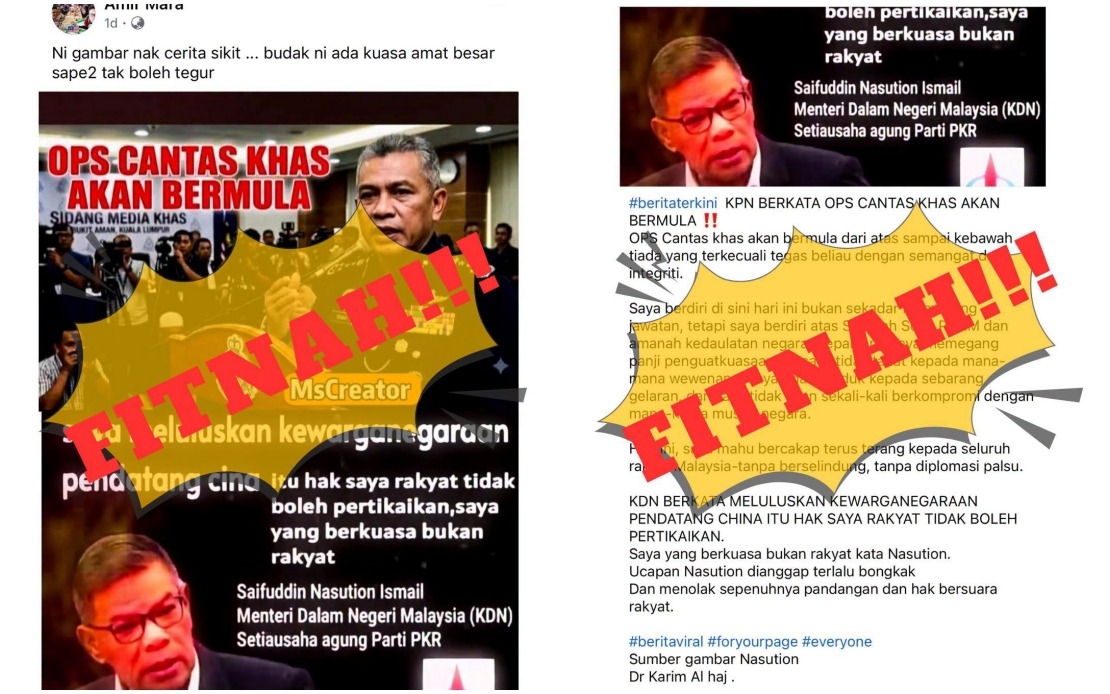
Home Minister Datuk Seri Saifuddin Nasution Ismail has categorically denied allegations that the Ministry of Home Affairs (KDN) conducted mass citizenship grants to foreign nationals, and refuted claims that 1.2 million Chinese nationals remain unlawfully settled in Malaysia. Speaking from Putrajaya on August 19, Saifuddin stressed that he has repeatedly addressed these allegations with evidence and official documentation, yet certain parties continue to resurrect discredited narratives through social media channels.
The minister's statement comes as various posters alleging improper citizenship grants have proliferated across digital platforms, fuelling public concern and speculation about the integrity of Malaysia's immigration and naturalisation procedures. Saifuddin pointed out that despite his previous clarifications supported by factual records and government data, bad-faith actors have persisted in circulating videos, graphics and claims that have already been thoroughly debunked and corrected through official channels.
In his social media post, Saifuddin emphasised that the deliberate dissemination of false and defamatory claims extends beyond merely damaging institutional or personal reputation. He articulated a broader concern about the systemic risks posed by such misinformation, warning that unsubstantiated allegations can erode public trust in state institutions, incite communal tensions, disrupt public order and ultimately compromise national security. This framing reflects growing awareness among Malaysian policymakers that weaponised misinformation on citizenship and demographic composition carries heightened sensitivity in a multi-ethnic society.
The circulation of these claims represents part of a broader pattern of immigration-related conspiracy theories that have gained traction in Southeast Asia in recent years. Malaysia, with its history of mass immigration waves and periodic regularisation programmes, has been particularly susceptible to such narratives. The allegations specifically target KDN's administrative processes, suggesting either widespread corruption or deliberate policy implementation contrary to law—claims that Saifuddin has systematically rejected by referencing verified official records.
Saifuddin's response underscores the challenge faced by government institutions in combating coordinated misinformation campaigns, particularly when such campaigns exploit legitimate public concerns about immigration, demographic change and national identity. The fact that he felt compelled to issue multiple public denials suggests that the narrative has gained sufficient traction to warrant sustained official counter-messaging. This dynamic reflects the broader challenge of fact-checking in the digital age, where false claims often circulate faster and more widely than official corrections.
The minister called on all citizens to exercise responsibility when engaging with social media content, urging the public to verify information through official government sources before accepting or disseminating claims. This appeal reflects an implicit acknowledgment that combating misinformation requires public participation and media literacy, not merely government statements. Saifuddin's emphasis on distinguishing between facts and false claims speaks to a fundamental challenge in contemporary Malaysian public discourse: the difficulty of establishing shared agreement on basic factual foundations.
The timing of Saifuddin's statement is significant in the context of Malaysia's ongoing immigration debates and periodic public anxieties about citizenship protocols. These concerns periodically resurface during election cycles or when immigration-related policy discussions intensify, often fanned by political actors seeking to mobilise specific constituencies. The minister's warning against exploiting sensitive issues for political or social media advantage appears directed at both politicians and social media influencers who may benefit from amplifying such narratives.
The distinction between legitimate public scrutiny of immigration and naturalisation procedures and malicious misinformation campaigns remains a contentious issue in Malaysian civic discourse. While government transparency regarding citizenship grant statistics would theoretically help counter false narratives, Saifuddin's approach relies primarily on denials and appeals to official credibility. Whether this strategy adequately addresses underlying public concerns or merely dismisses them remains debatable among observers of Malaysian governance.
For regional readers, the Malaysian experience with citizenship misinformation carries broader relevance across Southeast Asia, where similar narratives have emerged in Thailand, Indonesia and other nations. The vulnerability of rapidly digitising societies to coordinated false claims about migration and demographic composition represents a transnational challenge requiring coordinated responses and enhanced public media literacy. Saifuddin's intervention thus touches on issues that extend well beyond Malaysia's borders, reflecting patterns of disinformation that have become characteristic of regional political discourse.

