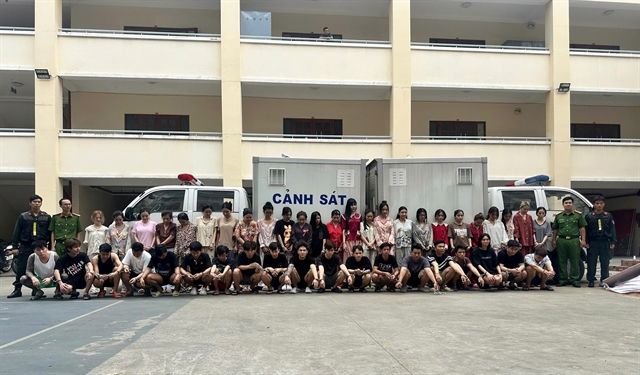
Ho Chi Minh City's narcotics police have dismantled a sophisticated illegal vaping operation, with authorities announcing the arrest of 49 suspects—including four foreign nationals—who allegedly distributed anaesthetic drugs through electronic cigarettes. The crackdown, detailed by the city's drug-related crime investigation division, uncovered a network that had successfully concealed a Schedule I controlled substance within seemingly innocuous consumer products marketed with enticing branding. Police recovered 1,670 contaminated vape pods during the operation, alongside substantial seizures of ketamine and methamphetamine, indicating the operation's scale and multi-drug involvement.
The primary substance identified in the seized vapes is etomidate, a powerful short-acting sedative typically administered only in surgical settings under direct medical supervision. Vietnam's government added etomidate to its controlled substances list in January, transforming its possession and distribution into serious criminal offences. The substance represents a significant departure from traditional street drugs, partly because its chemical structure allows it to evade standard rapid testing kits available to consumers and venue operators, creating a dangerous blind spot in public health monitoring.
Distribution networks proved remarkably strategic in their approach to market penetration. Rather than employing crude marketing, the operation repackaged etomidate-laced sweeteners into e-cigarette pods bearing carefully selected names calculated to appeal to youth culture—"chill pod," "relaxation pod," "sleep-well pod," and "fly pod" among them. These branded products commanded premium prices, enhancing their appeal as status symbols while masking their dangerous composition. The supply chains deliberately targeted venues where young people congregate: nightlife establishments, karaoke lounges, private rental accommodation, and similar socialising spaces.
The investigation commenced after police received intelligence regarding a street vendor operating under the alias Ba Giá on An Duong Vuong Street in An Lac Ward. This individual was subsequently identified as Nguyen Huu Huan, 28, from Dong Thap province in the south. On June 25, Huan and his wife, Ngo Thi Kim Chi, 30, faced arrest following their sale of etomidate vapes to Tran Phuc, 31, a Ho Chi Minh City resident. The couple's apprehension became the operational pivot point, allowing investigators to trace backward through the supply chain and identify upstream suppliers.
Detailed investigation revealed multiple interconnected supply networks operating with specialised functions. The first ring, allegedly headed by Huynh Ngoc Thuy Nhu, 26, with assistance from Hua Tuong Vy, 20—both Ho Chi Minh City-based—focused on procurement and initial distribution. A second network operated by Le Quoc Duy, 40, from An Giang province, managed the critical international smuggling component, moving contraband across the Vietnam-Cambodia border through minor crossing points before consolidating shipments in Ho Chi Minh City. Police recovered 37 vape pods plus 200 grammes each of ketamine and methamphetamine from Duy's holdings. A third group, led by Han Kiat, a Cambodian national, and three other foreign associates, specialised in catering specifically to expatriate communities within the city.
The pharmacological danger posed by etomidate consumption through inhalation demands careful public understanding. Unlike nicotine, which requires metabolic processing, etomidate crosses the pulmonary barrier directly and enters the bloodstream within seconds, reaching the brain with alarming speed. Initial effects—light-headedness and mild hallucinations—may appear manageable to inexperienced users, potentially encouraging repeated consumption. However, acute exposure produces severe neurotoxic consequences: pronounced drowsiness, involuntary muscle spasms, and complete loss of consciousness. Critically, combining etomidate with alcohol or other central nervous system depressants creates significant risk of sudden respiratory failure and death, particularly among adolescents whose physiological responses remain unpredictable.
The marketing sophistication employed by traffickers deliberately exploited vulnerabilities in both public awareness and detection capabilities. Vendors prominently advertised their products as "undetectable" or guaranteed "100 per cent negative" on standard field tests, a claim technically accurate but deeply deceptive. Commercial rapid-detection kits available in markets across Southeast Asia target conventional drugs such as heroin, cannabis, and methamphetamine—substances with well-established chemical signatures. Etomidate's distinct molecular structure lies completely outside these detection parameters. Only specialised forensic analysis systems operated by state laboratories can identify etomidate with certainty, meaning venue operators, parents, and young people themselves possessed virtually no practical means of distinguishing contaminated products from legitimate merchandise.
The foreign dimension of the operation reflects broader regional drug trafficking patterns. The arrest of two South Korean nationals alongside Chinese and Cambodian suspects indicates international drug markets increasingly utilise Southeast Asian transit routes and consumer populations. Cambodia's porous borders and limited enforcement resources have made the nation a convenient transshipment point for narcotics moving between production areas and consumption centres. Vietnam's growing prosperity and young urban population create attractive target demographics for criminal enterprises willing to innovate with novel substances and distribution methods.
For Southeast Asian policymakers and enforcement agencies, this bust underscores the evolving challenge posed by designer drugs and emerging consumption technologies. Traditional drug education campaigns emphasising heroin or methamphetamine fail to address synthetic anaesthetics or the manipulation of vaping devices. The deliberate targeting of young people through trendy marketing and socialising venues requires preventive strategies extending beyond enforcement—including credible education about novel substances, cooperation with venue operators, and genuine dialogue with youth about peer pressure and risk. Vietnam's January addition of etomidate to controlled lists represents appropriate regulatory response, yet the Ho Chi Minh City operation demonstrates that legal designation alone proves insufficient without sustained investigative resources and public awareness.
Authorities have advised citizens, particularly young people, to exercise extreme caution regarding e-cigarettes from unfamiliar sources and to reject any product claiming to be "drug test-proof." Such claims themselves constitute reliable warning signals of contamination. The operation's dismantling removes a significant threat to Ho Chi Minh City's youth, but similar networks likely operate throughout Southeast Asia's urbanised regions. Regional cooperation frameworks addressing synthetic drug production, border security, and intelligence-sharing will prove essential as criminal organisations continue innovating beyond conventional drug forms and into territory where public health systems, law enforcement, and community awareness all lag dangerously behind.

