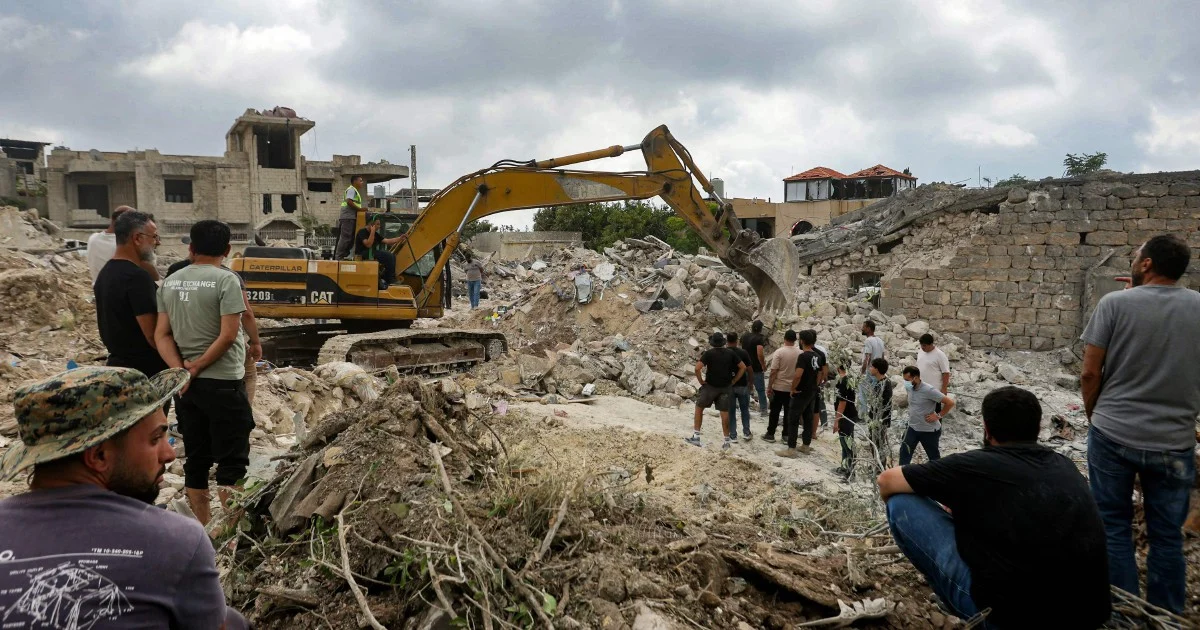
The standoff between Israel and Hizbollah over occupation of southern Lebanese territory has deepened, with the militant group's chief Naim Qassem flatly rejecting any arrangement that would establish an Israeli-controlled buffer zone within Lebanese borders. His statement came in direct response to remarks from Israeli Prime Minister Benjamin Netanyahu, who declared that Israeli military forces would maintain their presence in the region for an extended period to safeguard Israeli communities along the border.
Qassem's rejection signals the complex negotiations surrounding a ceasefire that has left Israeli troops positioned within Lebanese territory despite assurances from international mediators that a withdrawal timeline could be negotiated. The Lebanese government, already fragile and constrained by Hizbollah's considerable influence over state institutions, finds itself caught between preserving a ceasefire that has halted cross-border hostilities and defending national sovereignty against what many Lebanese view as indefinite foreign occupation.
The dispute centres on whether Israel can maintain a unilateral security arrangement without Lebanese consent. Netanyahu's statements suggest Israel views the southern zone as essential for preventing Hizbollah from rearming or repositioning its military assets near the border, a stance driven by security concerns rooted in decades of cross-border attacks. Hizbollah, conversely, frames any Israeli presence as a violation of Lebanese sovereignty and an impediment to its own operational capacity, making the group's acceptance of permanent Israeli forces politically untenable within its constituency and among broader anti-Israeli factions across Lebanon and the region.
From Malaysia's perspective and that of other Southeast Asian nations, the Lebanon crisis underscores how regional military standoffs can entrench occupation without formal treaty arrangements. The ambiguous status of the security zone—neither fully recognized internationally nor rejected by all parties—parallels various territorial disputes in Asia, where de facto control often precedes formal settlement. The precedent of extended military deployment without explicit time limits challenges international norms that Malaysia and its ASEAN partners rely upon to manage their own border security and maritime disputes.
The humanitarian dimension also affects regional perceptions. Residents of southern Lebanon have endured cycles of conflict interspersed with military occupation for decades. International observers worry that an indefinite Israeli presence could prevent reconstruction and development in the region, creating a prolonged refugee and humanitarian crisis. Such scenarios resonate across Southeast Asia, where conflicts in Myanmar, southern Thailand, and elsewhere have generated displaced populations and humanitarian challenges that neighbouring countries must absorb.
Mediation efforts, led primarily by the United States and involving France and Saudi Arabia, have struggled to bridge the gap between Israeli security demands and Lebanese insistence on territorial integrity. Lebanon's weak central government lacks the capacity to enforce a border demarcation that Hizbollah might challenge, making external guarantees theoretically necessary but practically difficult to secure. This vulnerability mirrors security challenges faced by smaller Southeast Asian states that depend on external powers to guarantee compliance with border agreements.
Netanyahu's refusal to commit to a specific timeline for withdrawal reflects Israel's assessment that rushed withdrawal could allow Hizbollah to quickly reconstitute military positions that Israeli operations have degraded. This calculation assumes that only sustained Israeli military presence can prevent such reconstitution, a premise that ignores the possibility of international monitoring arrangements or Lebanese military deployment in the zone. The lack of concrete alternatives has strengthened hardliners on both sides who view compromise as impossible.
Qassem's categorical rejection also reveals divisions within Lebanon itself. The Lebanese state, already struggling with economic collapse and institutional breakdown, cannot credibly guarantee security cooperation with Israel even if its government wanted to negotiate. Hizbollah's refusal to accept Israeli security arrangements therefore indirectly blocks any Lebanese government initiative to resolve the standoff through diplomatic channels, effectively giving the militant group veto power over national policy on this crucial matter.
For regional observers, the Lebanon situation illustrates how unresolved military confrontations in the Middle East continue to shape international relations and complicate efforts to establish predictable security frameworks. Malaysia and other ASEAN members have consistently advocated for dialogue, respect for sovereignty, and international law as mechanisms to resolve disputes. The Israel-Hizbollah disagreement demonstrates how deeply entrenched antagonism, combined with strategic incentives for one party to maintain military presence, can render such principles difficult to implement in practice.
The prospect of indefinite Israeli occupation of Lebanese territory without formal agreement establishes a troubling precedent for how military power can override diplomatic resolution. If Israel succeeds in maintaining the security zone despite Lebanese and international objections, it would signal that sufficiently strong military capabilities can impose territorial arrangements regardless of the affected state's preferences—a principle that threatens weaker nations throughout Asia and the broader developing world.
As negotiations continue, neither side appears willing to compromise on fundamental positions. Hizbollah sees any Israeli presence as unacceptable, while Israel views the presence as necessary. This deadlock suggests that the current ceasefire, however welcome after months of escalation, may represent only a temporary pause rather than a durable settlement. For Malaysia and Southeast Asian countries dependent on international frameworks to protect their interests, the outcome will offer insights into whether military occupation can eventually be normalized or whether sustained international pressure might eventually force withdrawal negotiations.

%22%2F%3E%3C%2Fpattern%3E%3C%2Fdefs%3E%3Crect%20width%3D%22100%25%22%20height%3D%22100%25%22%20fill%3D%22url(%23ph378eqg)%22%2F%3E%3Crect%20width%3D%22100%25%22%20height%3D%22100%25%22%20fill%3D%22url(%23ph378eqp)%22%2F%3E%3Ctext%20x%3D%2250%25%22%20y%3D%2250%25%22%20text-anchor%3D%22middle%22%20dominant-baseline%3D%22central%22%20fill%3D%22rgba(255%2C255%2C255%2C0.95)%22%20font-family%3D%22Georgia%2C%20'Times%20New%20Roman'%2C%20serif%22%20font-weight%3D%22700%22%20font-size%3D%22320%22%20letter-spacing%3D%22-0.02em%22%3EMuda%3C%2Ftext%3E%3C%2Fsvg%3E)
%22%2F%3E%3C%2Fpattern%3E%3C%2Fdefs%3E%3Crect%20width%3D%22100%25%22%20height%3D%22100%25%22%20fill%3D%22url(%23ph3ukt1g)%22%2F%3E%3Crect%20width%3D%22100%25%22%20height%3D%22100%25%22%20fill%3D%22url(%23ph3ukt1p)%22%2F%3E%3Ctext%20x%3D%2250%25%22%20y%3D%2250%25%22%20text-anchor%3D%22middle%22%20dominant-baseline%3D%22central%22%20fill%3D%22rgba(255%2C255%2C255%2C0.95)%22%20font-family%3D%22Georgia%2C%20'Times%20New%20Roman'%2C%20serif%22%20font-weight%3D%22700%22%20font-size%3D%22320%22%20letter-spacing%3D%22-0.02em%22%3EIran%3C%2Ftext%3E%3C%2Fsvg%3E)